Beginning in 1925, Minnesota farmer John Christensen spent more than a decade transforming a cellar project into a 14,000-square-foot rock garden of castles, bridges and ponds
Discover the fascinating story of John Christensen, a Minnesota farmer who transformed glacial rocks into a stunning 14,000-square-foot rock garden featuring castles, ponds, and bridges, now beautifully restored and available for public viewing.
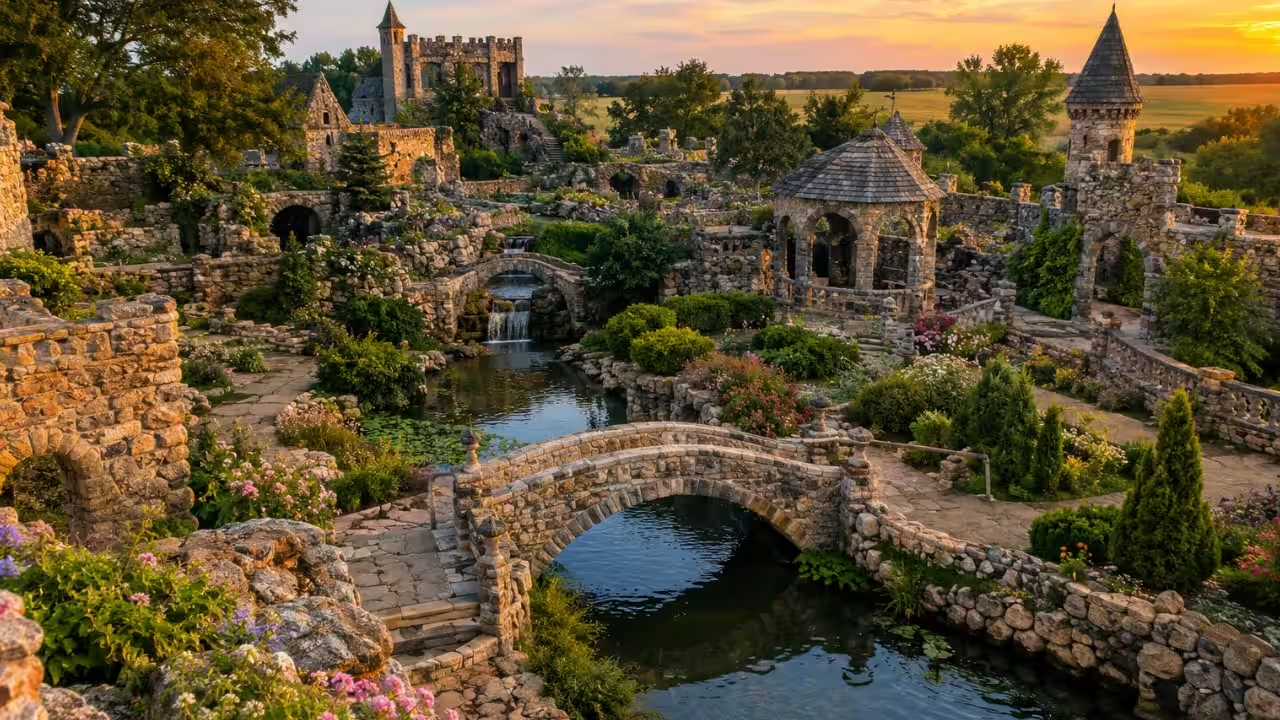
Albert Lea is a city in Freeborn County in southern Minnesota, an area of farmland where glaciers left behind stones of many sizes and colors. This meant clearing away all the rocks on the farms yearly, which was an undertaking for the farmers. In one case in the Albert Lea community, a farmer found a different use for all these rocks. John Christensen lived outside town with his wife, Sophie. After he stopped farming, he began digging at his home and the site grew into a landscape of castles, ponds and bridges.A retired farmer and a 1925 excavation near Albert LeaChristensen had been farming in Minnesota for 40 years when he cleared many glacial boulders from his land, Raw Vision states and only after retirement did he realize their beauty and usefulness. In 1925, the magazine adds, he began excavating a basement for a vegetable cellar beneath their house. The SPACES Archives entry Itasca Rock Garden (Christensen Rock Garden) tells it differently. Christensen first set out to build the largest structure on the property, a rock and concrete castle big enough for several standing adults, to serve as a root and vegetable cellar.A castle, ponds and bridges across 14,000 square feetThe Kohler Foundation page on John Christensen’s Itasca Rock Garden states that Christensen built a 14,000-square-foot rock garden of castles, ponds, bridges and grottos over a decade or so beginning in 1925. According to Raw Vision, the huge castle had turrets on top of it and 1925 written on its stone structure. Walkways with steps and archways ran around the ponds, while waterfalls, benches and a small castle birdhouse rounded off the project.Roadside America points out that the ponds once held fish and working fountains and Raw Vision adds that lily pads floated in them. The SPACES website describes the same landscape, with rock walls, miniatures, a circular seating area and a second, smaller castle.Rocks and geodes gathered on tripsThe Minnesota Museum of the Mississippi’s Itasca Rock Garden entry states that John Christensen and his wife often collected rocks while traveling, bringing home geodes and unusual specimens to incorporate into the garden and a second page from the same museum, titled Christiansen’s Rock Garden after an alternate spelling of the surname, repeats that detail. Sophie planted the flowerbeds and terraces, Raw Vision adds and her plantings added to the garden’s lush, storybook character.The last work in 1938 The Minnesota Museum of the Mississippi dates the most recent construction in the garden to 1938 and Christensen died in 1939. The SPACES article lists his name and the year 1939 among the garden’s decorations, a date later than the last recorded construction and the article does not say who added it. The museum goes on to state that his widow and later owners continued to maintain the garden and kept it open to the public and a postcard from 1952 shows it in use as a tourist site.Johnson family care from 1954 to 1985Kohler Foundation says that the land was owned by the Johnson family from 1954 to 1985. After the Johnson family’s ownership ended in 1985, the site declined and was eventually foreclosed. Kohler discovered the garden in fall 2019 through descendants of the Johnson family. At the time, the foundation said that the garden was overgrown but the structure could still be seen and that the house was structurally sound.A Kohler restoration was completed in 2022Kohler’s project was finished by 2022. Further gardening followed, including some planting in 2023 and guided tours resumed in 2024. As noted on the Roadside America website, the foundation donated the site to the Freeborn County Historical Society. An appointment is necessary for visiting; the admission fee is quoted at $5 for adults, though one should call to make sure. A Raw Vision article written in summer 2024 describes the restored garden as enchanting its keepers and visitors again almost a century after the first stone was laid, which fits the 99 years between 1925 and 2024.You use AI every day. Now get your AI Quotient. Take the AIQ test.
Topics in this story
Gathered from external sources. Rights to this text belong to whoever originally published it.