Kenya planted Grevillea trees among maize to make farms more productive; long-term research found their roots competed for the same soil water
Rest of World News: Farmers across Kenya have long planted Grevillea trees alongside maize, hoping the tall, fast-growing species would add timber, shade and income witho.
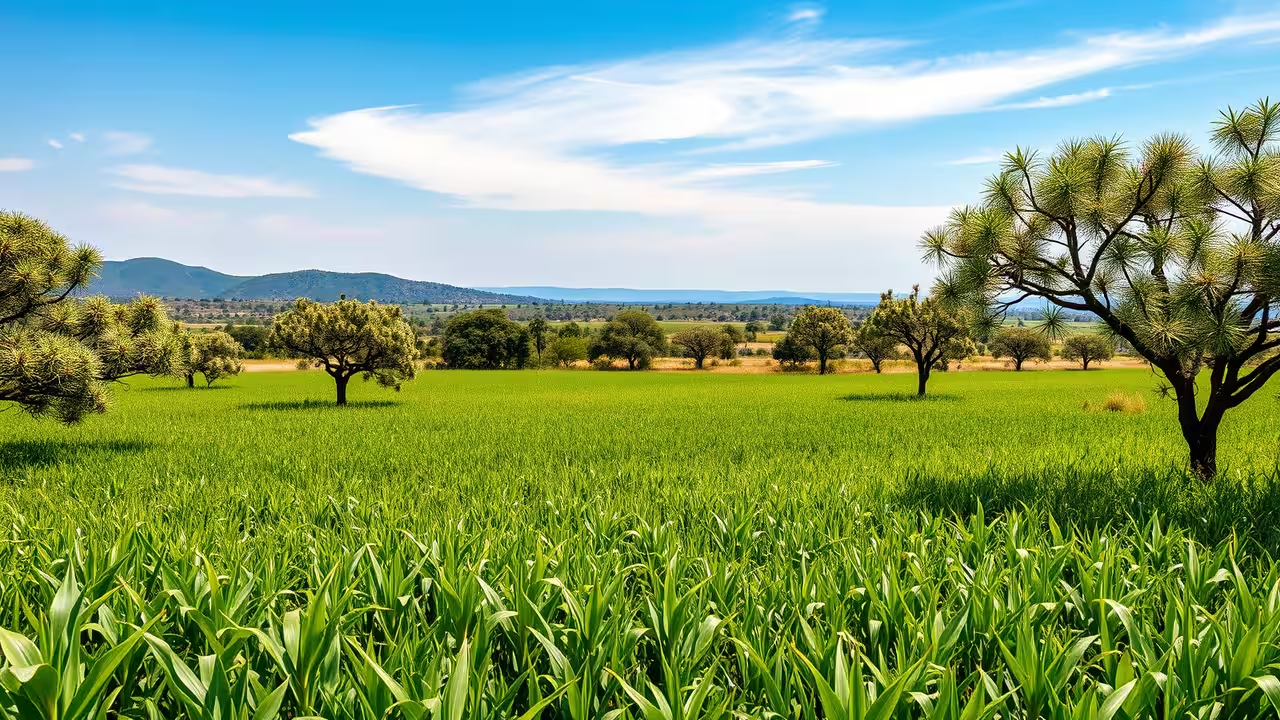
Farmers across Kenya have long planted Grevillea trees alongside maize, hoping the tall, fast-growing species would add timber, shade and income without hurting the crop underneath. A long-term field trial in semi-arid Kenya put that idea to the test over 4.5 years and nine growing seasons, tracking maize and cowpea grown either alone or alongside grevillea trees. The findings come from a study called Long-term productivity of a Grevillea robusta-based overstorey agroforestry system in semi-arid Kenya: II. Crop growth and system performance, published in the journal Forest Ecology and Management, based on a trial at Machakos in eastern Kenya. For the first four seasons, crop yields in the tree and maize plots matched those grown without trees. But as the grevillea matured, yields collapsed in most later seasons, falling close to zero in three of the final four, and reaching as much as half the tree-free yield only in the one season when rainfall was unusually high, pointing to a problem hiding underground rather than up in the canopy.How researchers separated the effects of shade from competition for waterThe experiment, known as the CIRUS trial, was established at the ICRAF Machakos Research Station in Kenya. Grevillea trees were planted in a dispersed arrangement either as sole stands or alongside crops. Cowpea and maize were rotated during the first five seasons after the trees were planted, while maize was grown continuously during the final four seasons. One growing season was lost when the rains failed. To determine how much of the crop decline could be explained simply by reduced sunlight, the researchers also grew sole maize beneath shade netting that reduced incoming radiation by 25%, 50% or 75%. The comparison produced an important result. Maize growing alongside the trees performed worse than maize grown under the artificial shade treatments. If reduced sunlight had been the main reason for the yield losses, heavily shaded maize should have performed similarly to the maize growing beneath grevillea. Instead, the shade-net crops generally produced more biomass and grain. The researchers therefore concluded that shading alone could not explain the decline and that below-ground competition for resources, particularly water, was becoming increasingly important as the trees matured.Why grevillea roots ended up competing with maize below groundA companion study at the same Machakos site examined the roots of grevillea and maize directly. Root samples showed that the two species were not neatly separated into different soil layers. The maximum root length densities of both species occurred in the upper soil layer, while grevillea dominated the root population at different depths. When maize was grown with the trees, its root growth into deeper soil was also suppressed. The researchers concluded that severe competition for water should be expected unless the trees had access to a separate source of water unavailable to the crop. That finding challenged the assumption that grevillea would avoid competing heavily with maize simply because trees can make use of deeper soil water. The tree-growth study from the same experiment found that grevillea continued growing through the dry season, sometimes at rates comparable to or greater than those recorded during cropping seasons, suggesting that the trees could make use of residual soil moisture or deeper reserves. As the trees became the dominant component of the system, the balance between the tree and crop shifted increasingly in their favour.What happened to maize yields as the grevillea trees maturedThe change was gradual rather than immediate. During the first four seasons, maize and cowpea grown with grevillea were not significantly different from the corresponding sole crops. But the performance of the understorey crops declined sharply during later seasons as the trees became more dominant. The study reports that performance ratios for the crops, which compare their output with sole-crop stands, approached zero during three of the final four seasons. By contrast, the trees' performance relative to sole grevillea stands increased as they established. Rainfall could still change the severity of the competition. Maize reached half the yield of the corresponding sole crop only once during the final four seasons, when rainfall was unusually high. In another study of crop performance at the site, maize biomass approached half that of sole maize after above-average rainfall, while grain yield was still only 36% of the sole-crop value. This shows why the effect was particularly important in a semi-arid environment: when water was plentiful, the crop could partly recover, but when water was limited, competition with established trees became much harder to overcome.What the Kenya experiment means for tree-and-crop agroforestryThe experiment does not show that grevillea and maize can never be grown together. Instead, it shows that the balance between the two can change dramatically as the trees mature. During the early years, the crops and trees could coexist without a significant reduction in maize or cowpea yield. Later, the growing grevillea canopy and, more importantly, its extensive root system increased competition for resources. The researchers concluded that the viability of the system depended on understanding these changing interactions rather than assuming that the benefits of agroforestry would remain constant as the trees grew. For semi-arid farming systems, the finding is particularly relevant because water availability can determine whether competition remains manageable or becomes severe. The Machakos experiment shows that a tree that appears compatible with a crop during its first few years may become a much stronger competitor as its root system and biomass develop. In this case, the problem was not simply that grevillea blocked sunlight from reaching maize. Much of the competition was happening underground, where the roots of both species were drawing on overlapping parts of the soil profile.Catch the latest World News and Live updates. Download the TOI app.
Topics in this story
Gathered from external sources. Rights to this text belong to whoever originally published it.