King Charles inherited a royal connection to London Zoo dating back nearly 200 years; as a baby, he was taken there to see a polar bear
London Zoo has been part of the royal story for almost as long as it has existed.
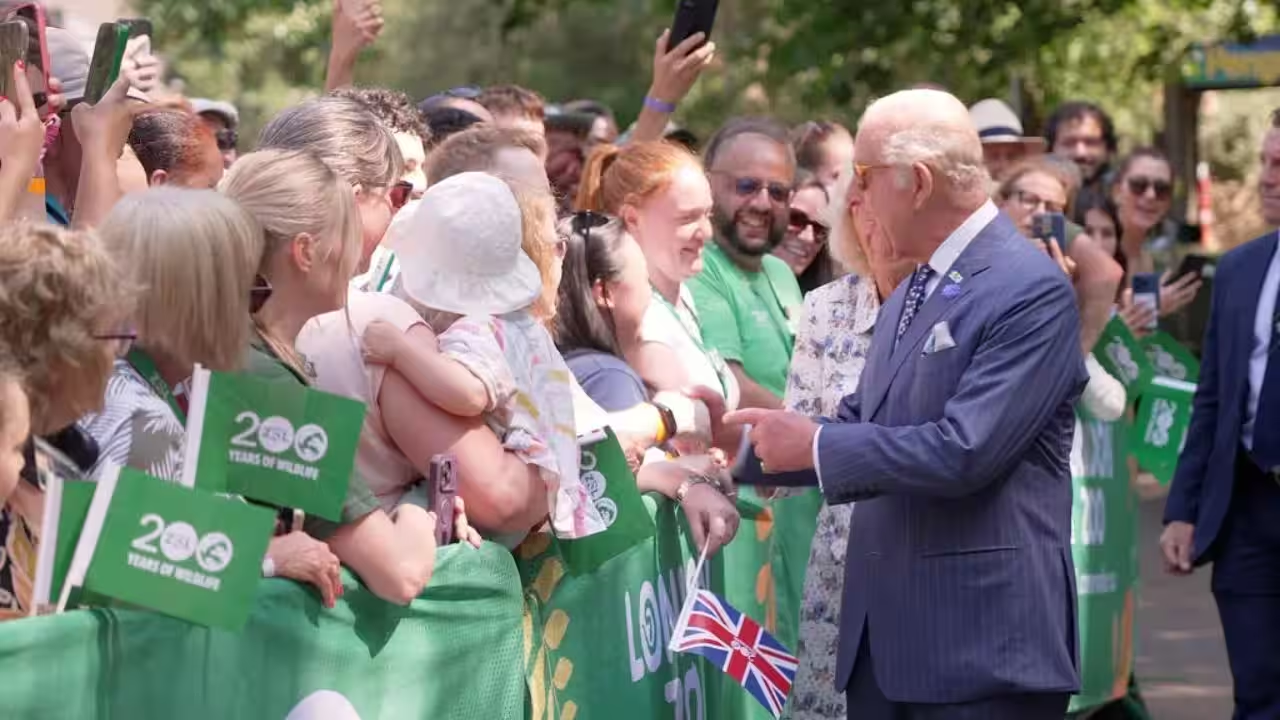
London Zoo has been part of the royal story for almost as long as it has existed. When King Charles III visited the zoo with Queen Camilla in July 2026, he was not simply marking the 200th anniversary of the Zoological Society of London (ZSL). He was continuing a connection between the Crown and the institution that stretches back to the early 19th century. Since 1830, the reigning monarch has served as ZSL’s patron, meaning the role passed to Charles after the death of Queen Elizabeth II. The relationship began generations earlier, when royal interest in the zoo was already being recorded. Charles is therefore the latest monarch in a line that has remained linked to the London institution for nearly two centuries.Charles III marks a new chapter in London Zoo’s royal historyZSL was founded in 1826, with London Zoo opening its doors a few years later. The organisation’s relationship with the monarchy followed soon afterwards. Charles inherited that role from his mother, Queen Elizabeth II. His July visit was his first official appearance at London Zoo as ZSL’s patron. For Queen Camilla, meanwhile, it was her first official visit to the zoo.The connection is older than either of their public roles. Royal visits to the zoo have been recorded across generations, including a particularly unusual early encounter involving a young member of the royal family and a polar bear.Charles’s London Zoo connection stretches from infancy to kingshipKing Charles was born in 1948, but the royal association with London Zoo reaches back much further than his own lifetime. His great-great-grandmother, Queen Victoria, was on the throne when the zoo became established as a prominent London attraction.The royal visits also acquired a distinctly personal character over the years. According to ZSL, one of the more memorable episodes came when Charles was taken to London Zoo as a baby to see a polar bear. The visit linked the young prince with an institution that had already become part of London's public life and had been attracting royal attention for generations.That early appearance now sits at the beginning of a much longer relationship. Decades later, Charles returned to the same zoo not as a child being shown its animals, but as the monarch and patron of the organisation responsible for its wider scientific and conservation work.The 200th anniversary brought the relationship into focusCharles and Camilla visited London Zoo on 9 July 2026. Their tour took in several parts of the zoo, with the programme moving between animals, veterinary work, conservation projects and the organisation's historical collections.At the Giants of the Galápagos habitat, the couple met keepers Dan Kane and Unnar Aevarsson and helped mark the anniversary with Molly, one of the zoo's Galápagos tortoises. Her unusual birthday-style treat was a carved watermelon filled with flowers and plants.The tortoises also offered a connection to the history of evolutionary science. The Galápagos Islands played an important role in Charles Darwin's work, while Darwin himself was a Fellow of ZSL. The society's library now holds a first edition of On the Origin of Species.The tortoises at London Zoo are still relatively young by the standards of their species. They are in their early thirties, while Galápagos tortoises can live for well over 100 years.Penguins provided a hands-on part of the visitThe penguin encounter did not stop with the veterinary examination. Charles and Camilla also joined a training session involving Humboldt penguins.Using a laser pointer, they encouraged the birds to move through the water. The exercise is designed to resemble the glint of fish scales and encourages swimming, diving and changes of direction.It is also part of the practical approach keepers use to make veterinary procedures easier. Animals can be trained to cooperate voluntarily with certain checks, reducing the need for more intrusive handling. At London Zoo, similar techniques can allow keepers to examine mouths or ask larger animals to present parts of their bodies for treatment.For a royal visit marking two centuries of ZSL, it was a fairly simple demonstration, but it showed how animal care has changed since the institution's earliest days.The zoo's history goes beyond royal visitsThe anniversary programme also brought attention to the cultural side of London Zoo. Queen Camilla visited the statue of Lieutenant Harry Colebourn and Winnie, the bear whose story later became connected with Winnie-the-Pooh.Winnie came into the zoo's care during the First World War and subsequently became part of the inspiration behind A.A. Milne's famous character. During the visit, students from ZSL's Education Access Scheme presented Camilla with an early copy of Winnie-the-Pooh: A Little Boy and His Bear, written by Jane Riordan as part of the centenary celebrations for Winnie-the-Pooh.You use AI every day. Now get your AI Quotient. Take the AIQ test.
Topics in this story
Gathered from external sources. Rights to this text belong to whoever originally published it.