In 2015, conservationists cleared invasive rats from Vahanga Island; 5 years later, its critically endangered ground-dove population had doubled
Discover how Vahanga Island's successful rat removal led to a doubling of its critically endangered ground-dove population, showcasing a beacon of hope for conservation efforts worldwide.
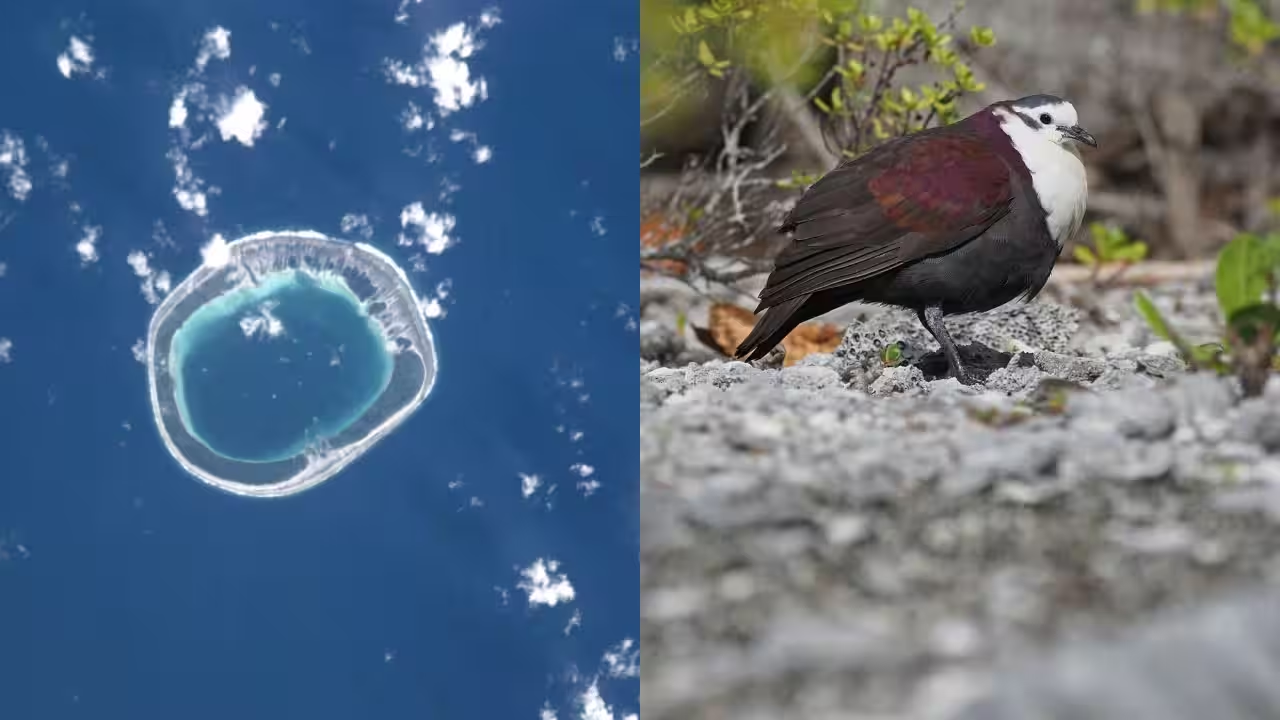
In the vast stretch of ocean between Tahiti and South America lie a handful of coral atolls so remote that most people will never hear of them, let alone visit. For generations, Vahanga, which belongs to the Acteon and Gambier island groups in French Polynesia, has borne a silent burden unrelated to its own indigenous wildlife. Rats brought in by passing ships long ago gradually wiped out the ground-nesting birds that had developed on the atoll without ever having to defend themselves against a land predator.One of these was the Polynesian ground dove, a little, beautifully patterned species so uncommon that when environmentalists got involved, there were thought to be fewer than two hundred individuals left anywhere on earth. A coalition of BirdLife International, Société d'Ornithologie de Polynésie and Island Conservation launched what remains one of the most ambitious island restoration projects ever attempted in the Pacific in 2015, eradicating invasive rats, rabbits and feral cats from six islands across the archipelago, including Vahanga. Five years later, the number of ground doves on Vahanga had doubled, a result that astounded even the experts who had worked for years to achieve it.Why one island was so importantIt helps to realise how narrow this bird’s margin for survival has become, to see why Vahanga’s comeback is vital. Prior to the operation, the whole world population of Polynesian ground doves existed as one population on one predator-free island, Tenararo. Every other atoll where the species had flourished had long since been overrun by rats which prey on eggs, chicks and even adult birds too small to defend a nest. The six-island operation seemed less like an improvement effort and more like an emergency intervention, as a single storm, disease outbreak or inadvertent reintroduction of predators on that one island could have wiped out the species altogether.That hurry bled into what the removal work actually entailed. Teams travelled over 1500 kilometres from Tahiti to reach these atolls, conducting the eradication on each island in a matter of days once they arrived, racing against tight weather windows and the logistical nightmare of resupplying a crew working in one of the most isolated parts of the ocean. The team didn’t simply depart once the rats were gone and hope for the best. Regular monitoring trips checked whether ground doves and other native species were starting to recover naturally, because removing a predator only helps if the prey species can find its way back to regain former territory.What the doubling in population turned out to beThat was the monitoring that finally yielded the numbers conservationists had been hoping for. Ground doves, which had barely clung on around Vahanga before the operation, had doubled in number within five years, according to Island Conservation. On the neighbouring atoll of Tenarunga the species re-established a secure presence for what researchers believe is the first time in hundreds of years. This was important beyond the basic figures, since it confirmed something conservationists had long hoped but could not guarantee: that a species reduced to a single fragile population could nevertheless recolonise its previous range once the fundamental threat was removed, without the need to be physically re-located by hand.The ground dove was not the only species to benefit. The Tuamotu sandpiper, another highly vulnerable bird found exclusively in this section of the Pacific, also began to show signs of slow but steady recovery across the restored islands, albeit the sandpiper's growth was slower than the more spectacular advances seen in the dove population. The researchers on the project have noted that introduced predators are linked to most of the bird extinctions documented since the 1500s. Vahanga’s tale is one small but important counterpoint to a story that has otherwise played out badly for island birds across the globe.A model other conservation projects have since followedWhat makes Vahanga worth revisiting years later isn’t simply the doubling of one bird species but the precedent it left behind for other imperilled islands. The Acteon and Gambier Islands success has shown BirdLife International that the most logistically complex restoration projects, involving multiple remote islands in a single expedition, can deliver measurable outcomes in a relatively short timeframe, provided predator removal is followed by patient, sustained monitoring.Conservation groups that have undertaken similar operations elsewhere in the Pacific, including recent eradication efforts on islands in Tonga and Palau, have pointed to the Acteon and Gambier operation as evidence that the strategy can be reproduced at scale. For a bird that came within a hair of losing its solitary home a decade ago, Vahanga's slow but steady return offers something conservationists rarely get to celebrate outright: a genuine, measurable second chance for a species that had almost run out of places left to hide.You use AI every day. Now get your AI Quotient. Take the AIQ test.
Topics in this story
Gathered from external sources. Rights to this text belong to whoever originally published it.