A California man spent nearly 30 years hand-building Salvation Mountain from adobe, straw and thousands of gallons of paint; Leonard Knight’s landmark rises near Niland
US News: Discover the inspiring story of Leonard Knight and his iconic Salvation Mountain, a vibrant testament to faith and art built over 30 years in the California desert. Learn about its rich history, artistic evolution, and preservation efforts.
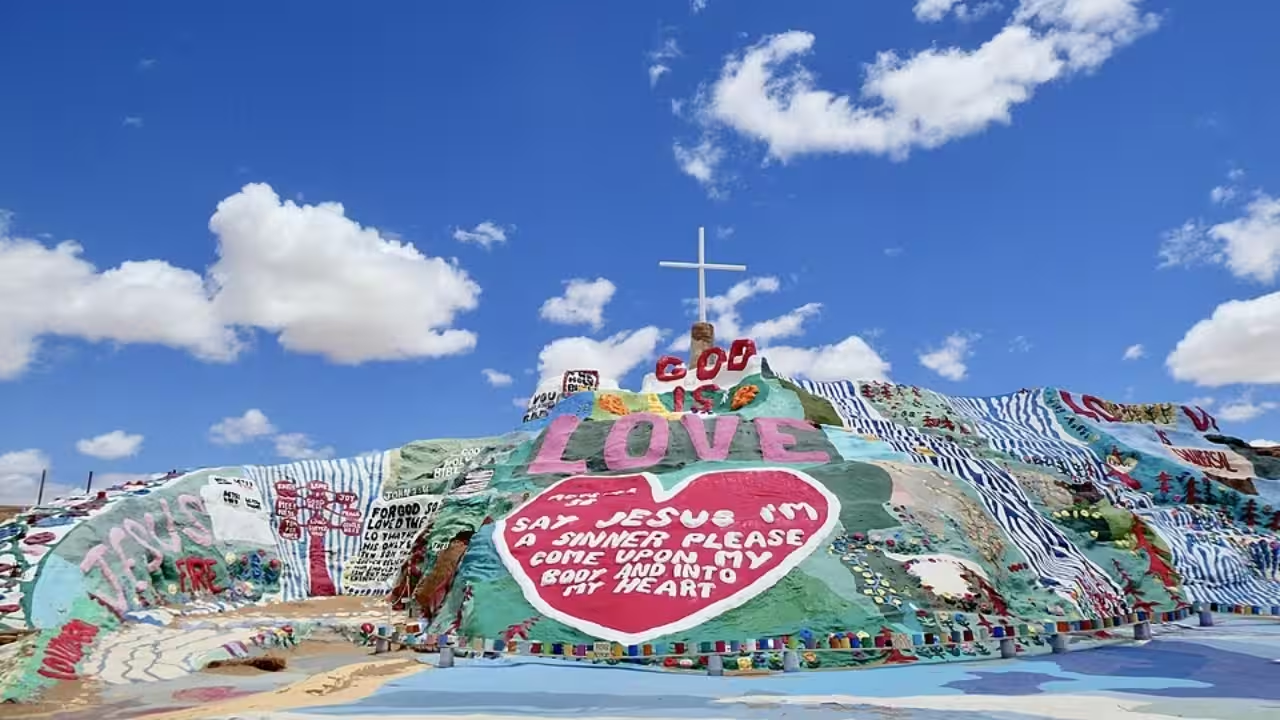
In California’s Imperial Valley, near the community of Niland, a painted mountain rises from the desert with a message at its centre saying, “God Is Love.” Popularly known as Salvation Mountain, the sprawling folk-art environment was created by Leonard Knight, who spent nearly 30 years building, painting, and repeatedly repairing it. In 2014, National Geographic described the structure as a man-made mountain that took 28 years to make, while other contemporary accounts described Knight’s work as a nearly three-decade endeavour.Knight had previously spent years trying to build an enormous hot-air balloon bearing his religious message, but the balloon repeatedly failed to become a workable project. Following his arrival in Southern California in the mid-1980s, Knight eventually brought the idea to the desert near Slab City, and there he started turning the message he had originally hoped to convey through the sky into a monument on the ground. The organisation dedicated to preserving his work dates 1986 as Salvation Mountain’s beginning.Transformation from a small monument to a colourful mountain Leonard Knight did not begin with the giant structure that is visible today. Following the failure of his balloon project, he erected a small monument on a desert ledge using a bucket, a shovel and cement. Knight gradually added cement, sand and discarded materials, thus decorating and expanding the structure with painted designs and his religious message. However, the first version eventually collapsed into a pile of sand, prompting Knight to reevaluate how the mountain should be constructed.According to Salvation Mountain Inc., the organisation dedicated to preserving the mountain, Knight began constructing his second mountain in late 1989, after experimenting with native adobe clay. This time around, he used adobe clay and straw as the principal building materials, producing a sturdier and more solid structure. The resulting mountain ultimately became the basis of the landmark that stands near Niland today.While talking to the publication, National Geographic photographer Aaron Huey recalled meeting Knight when the artist could still carry a 40-pound bucket of adobe up a 30-foot ladder. Knight continued to work slowly and methodically over the years, often continuing repairs as weather damaged sections of the structure. Although his methods were unconventional, they were persistent.Adobe and straw formed the structural basis of the mountain; paint played a huge part in both its appearance and protection. The preservation organisation notes that Knight applied more than ten coats of paint in places, with the layers acting as an additional hardening surface that helped protect the material from cracking. Notably, visitors and supporters donated paint, thus allowing the creator to keep expanding the colourful surface.The current preservation organisation estimates that the site contains more than 100,000 gallons of donated paint, while The Los Angeles Times reported in 2014 that Knight himself generously estimated that he had used more than 500,000 gallons of paint. Although the exact quantity of paint reported over the years varies, it is clear that the mountain was built and maintained with thousands of gallons of donated paint.A sprawling folk-art environmentEventually, the Salvation Mountain became much more than a single painted mound, as the complex now includes the main mountain along with additional structures and artwork. National Geographic described peripheral elements made from telephone poles, tyres, and car windows, along with art cars and sculptures, all decorated with the bright patterns and colourful characteristics of Knight’s work.The mountain’s core message still remains unmistakable, while flowers, waterfalls, birds, hearts, biblical quotations and other spiritual imagery cover the surrounding surfaces. Additionally, the mountain incorporates Knight’s version of the Sinner’s Prayer. It is worth noting that Knight also built structures around the mountain using the same improvised approach he came up with during his second attempt. In 1998, he began constructing a domed Hogan from straw bales and adobe, intending to create a cooler shelter from the desert heat; however, he never moved into the shelter, opting to sleep in his truck. Furthermore, the complex includes a structure called the Museum, which is conceptually based on his earlier hot-air-balloon idea and built with domed areas supported by structures made from tyres, wood and adobe.In 2000, the Fold Art Society of America recorded the Salvation Mountain as a “folk art site worthy of protection,” according to contemporary reports. The Los Angeles Times also reported that Senator Barbara Boxer had later referred to the mountain in the Congressional Record as a national treasure, highlighting the cultural appreciation and recognition for Knight’s work.Leonard Knight’s final yearsContemporary reports described Knight living in the back of a broken-down fire truck without conventional household comforts and spending his days building the mountain, eating, giving tours and talking with visitors. He reportedly regarded the site as a way to communicate his beliefs instead of merely viewing it as a part of an art project.However, as Knight aged, the physical demands became harder to sustain, and by 2011, declining health had forced him into long-term care. Los Angeles Times reported that the creator of Salvation Mountain spent more than two years in a nursing home’s care facility before his death in February 2014 at the age of 82. By then, the structure he had started in the 1980s had become an internationally recognised example of self-taught art, with followers already attempting to preserve his work. After Knight’s death, efforts to preserve the landmark continued, eventually becoming the responsibility of organisations and volunteers dedicated to maintaining his work.Catch the latest World News and Live updates. Download the TOI app.
Topics in this story
Gathered from external sources. Rights to this text belong to whoever originally published it.