In 1917, the Crane family bought the first piece of Choate Island; decades later, the island entered the Crane Wildlife Refuge under the Trustees in 1974
US News: Explore the fascinating transformation of Choate Island from a thriving agricultural landscape to a protected wildlife refuge. Discover its historical significance, diverse ecosystems, and the legacy of the Crane family.
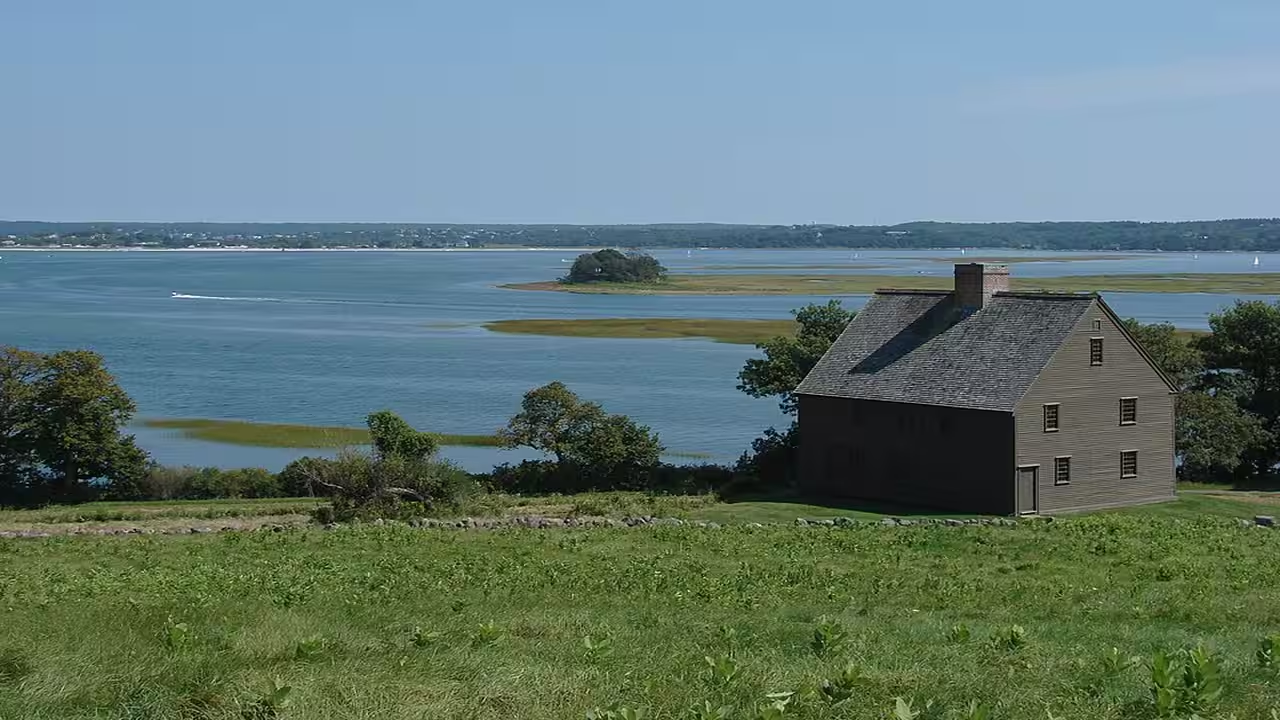
For centuries, the island supported Indigenous communities, farms, livestock and family homes before becoming a wildlife refuge on the Massachusetts coast. Choate Island, once known as Hog Island, is now the largest island in the Crane Wildlife Refuge, where salt marsh, grassland and forest frame historic buildings that date back more than two centuries. Its transformation was gradual, beginning with the Crane family's early-20th-century land purchases and ending with Miné Crane's 1974 gift to The Trustees of Reservations.According to The Trustees of Reservations, Choate Island is the largest island in the Crane Wildlife Refuge, covering 135 acres within the refuge’s 697-acre network of coastal islands and marshes in the Essex River Estuary. More than 200 bird species have been recorded across the refuge, while Choate Island provides habitat for mammals including deer, fisher, coyotes and otters. Its spruce forest supports birds such as golden-crowned kinglets and sharp-shinned hawks, while its grasslands provide important habitat for bobolinks and Savannah sparrows.From Indigenous land to a farming islandAccording to Babson Historical Society, Indigenous communities in the region had established agricultural settlements and maintained a mixed subsistence economy based on farming, fishing, hunting and shellfish gathering. The Agawam and other Indigenous communities used the coastal landscape and surrounding estuaries long before the Crane family arrived, while the islands later became part of a farming landscape that remained important through the 18th and 19th centuries.European settlers later called Choate Island “Hog Island”, reflecting its role in the region’s colonial farming system. The Choate family became closely associated with the island after Thomas Choate acquired land there in the late 17th century, with subsequent generations developing and maintaining farms for generations. The Choate House, built in the early to mid-18th century, became the centre of the family’s long presence. Choate Island and neighbouring Long Island were connected by a causeway, allowing people, livestock and agricultural goods to move between them, while fields, grazing areas, stone walls and farm buildings developed alongside salt marshes and tidal waters. The island was officially renamed Choate Island in 1887.The Cranes arriveThe Trustees of Reservations also note that the next major change came in the early 20th century, when Richard T. Crane Jr., the Chicago industrialist who was developing the Crane Estate around Castle Hill, acquired the first portion of Choate Island in 1917. The Crane family expanded its holdings in 1927, bringing more of the island into the estate. Rather than removing every trace of its agricultural past, the Cranes retained historic structures, including the Choate House and the nearby Proctor Barn on Long Island, while reshaping parts of the landscape for their own use.One of the most visible changes was tree planting, with Cornelius Crane establishing about 95 acres of spruce and pine forest on Choate Island in the 1930s. Norway spruce became one of the dominant species, creating a prominent new feature in the island’s landscape. Over the decades, however, severe storms damaged large sections of the ageing plantation, prompting The Trustees to remove about 30 acres of trees and restore the area as shrubland and young forest habitat. Crane and his wife, Miné, also developed a strong personal connection with the island, using the White Cottage, designed by architect Royal Barry Wills, as a private retreat overlooking Ipswich Bay and the surrounding marshes. The couple were later buried near the island’s summit, where their graves overlook the landscape that had become an important part of their lives.From private estate to wildlife refugeAccording to Historic Massachusetts, Miné Crane donated about 700 acres of land, including Choate Island and surrounding islands and salt marshes, to The Trustees of Reservations in 1974 in memory of her husband, Cornelius Crane. The gift formed the foundation of the Crane Wildlife Refuge, which was later expanded through additional acquisitions and donations. The transition from private estate to protected refuge did not mean freezing the landscape in its historic state. Instead, conservation work has continued to respond to changing ecological conditions. In 2017, for example, The Trustees and conservation partners cleared about 30 acres of ageing Norway spruce plantation after severe storms had damaged large sections of the forest. The project created space for shrubland and young forest habitat, supporting species including American black ducks, American woodcocks, eastern towhees and native pollinators. This approach reflects a broader conservation goal: maintaining a functioning coastal ecosystem rather than preserving every element of the landscape exactly as the Cranes left it. Today, visitors can follow gravel roads and mown trails past the historic Choate House towards the Crane burial site near the island’s highest point. The route passes through a changing landscape of grassland, woodland, shoreline and salt marsh, showing how natural habitats and historic features coexist on the island.Catch the latest World News and Live updates. Download the TOI app.
Topics in this story
Gathered from external sources. Rights to this text belong to whoever originally published it.