Taylor Swift doesn’t hold a pen the way most people do: What this tiny detail about the pop star reveals about handwriting, comfort and the myth of a ‘perfect’ grip
Imagine sitting beside someone who reaches for a pen and holds it in a way you have never seen before.
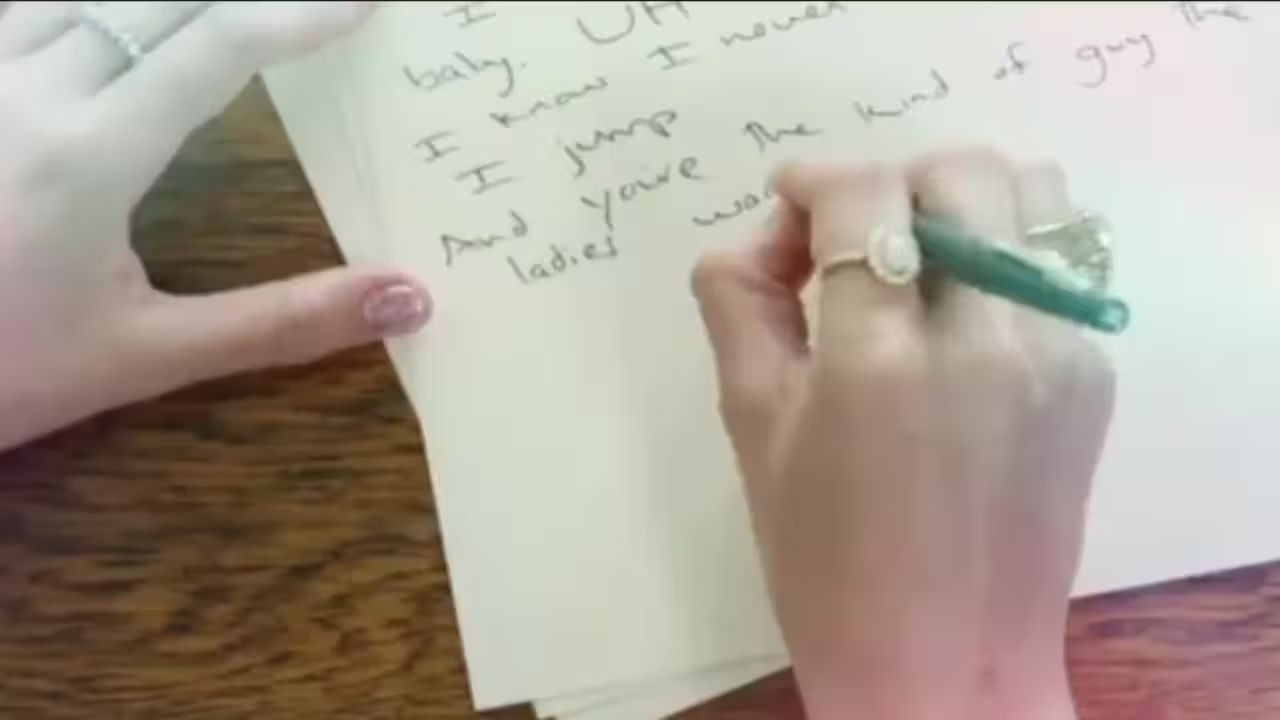
Imagine sitting beside someone who reaches for a pen and holds it in a way you have never seen before. Their fingers are positioned differently from yours, their thumb rests at an unexpected angle.That is the curiosity surrounding images of Taylor Swift writing. The singer is known for her handwritten lyrics and personal notes, and the way a person holds a pen can attract almost as much attention as what they write.There is no single grip that works for everyoneIn school, many children are taught to hold a pencil or pen using a three-finger grip, with the thumb and index finger controlling the writing instrument while the middle finger supports it. Occupational therapists often call the commonly taught version a dynamic tripod grip.It is familiar, but it is not the only way to write effectively.A review published in the Australian Occupational Therapy Journal examined factors affecting adult handwriting performance and found that grips other than the traditional dynamic tripod could still produce legible writing within an acceptable time. In other words, an alternative grip is not automatically a sign of poor handwriting or a motor problem.A 1990 study published in the American Journal of Occupational Therapy also documented atypical pencil grips among adults who were able to write normally. Its findings suggested that some alternative grips, particularly the lateral tripod grip, can be functional rather than problematic.Why does a pen grip become a habit in the first place?Writing looks effortless once a person has practised it for years. Yet handwriting requires the coordination of small muscles in the fingers and hand, visual guidance, controlled movement and repeated adjustments to pressure.Children experiment with how they hold writing instruments while learning. Over time, a particular grip becomes familiar, and the movements needed to form letters become increasingly automatic. People may also adjust their grip depending on the pen, the size of the letters they write, the angle of the paper or the task they are performing.Can the way Taylor Swift holds a pen reveal her personality?This is where the story becomes particularly interesting.Handwriting analysis, commonly known as graphology, has long been associated with claims that the shape, slant, spacing and pressure of someone's writing can reveal personality traits.It is an appealing idea, particularly when the handwriting belongs to a celebrity whose personality fans are already curious about. But the scientific evidence does not support treating an unusual pen grip as a reliable personality test.A 2009 study by psychologists Carla Dazzi and Luigi Pedrabissi, published in Psychological Reports, tested whether graphologists could accurately assess personality traits from handwriting samples. Across two studies, the researchers found no convincing evidence that graphological assessments could measure the personality dimensions they examined. Agreement between the graphologists was also low.That does not mean handwriting has no useful information to offer. Handwriting can be examined in clinical settings, and changes in writing ability or movement may sometimes be relevant to health assessments. But that is different from claiming that a person who holds a pen unusually must be more creative, stubborn or emotionally expressive.In Swift's case, an image of her holding a pen cannot establish why she uses that grip, whether she learnt it as a child or whether it has any special significance to her.The real lesson behind the penTaylor Swift's pen grip makes for an intriguing visual detail because it invites us to look closely at an everyday action we rarely question. Most people learn to write once, settle into a familiar habit and never think much about the mechanics again.But handwriting is not a rigid template. It is a learned motor skill shaped by practice, movement and individual variation.The science does not offer a secret code for decoding Swift's personality from the way she holds a pen. It offers something more useful: a reminder that there is often more than one way to perform an ordinary task well.So, the next time someone's fingers sit differently around a pen, look at the result before judging the grip. If the writing is comfortable, controlled and legible, the apparent oddity may simply be a personal habit that works.Get the latest movie news, reviews, and celebrity updates. Download the TOI App.
Topics in this story
Gathered from external sources. Rights to this text belong to whoever originally published it.