Suspect arrested after Limoges town hall set alight during disorder - French media
The spire of the clock tower at Limoges city hall dramatically collapsed as it was engulfed in flames on Saturday.
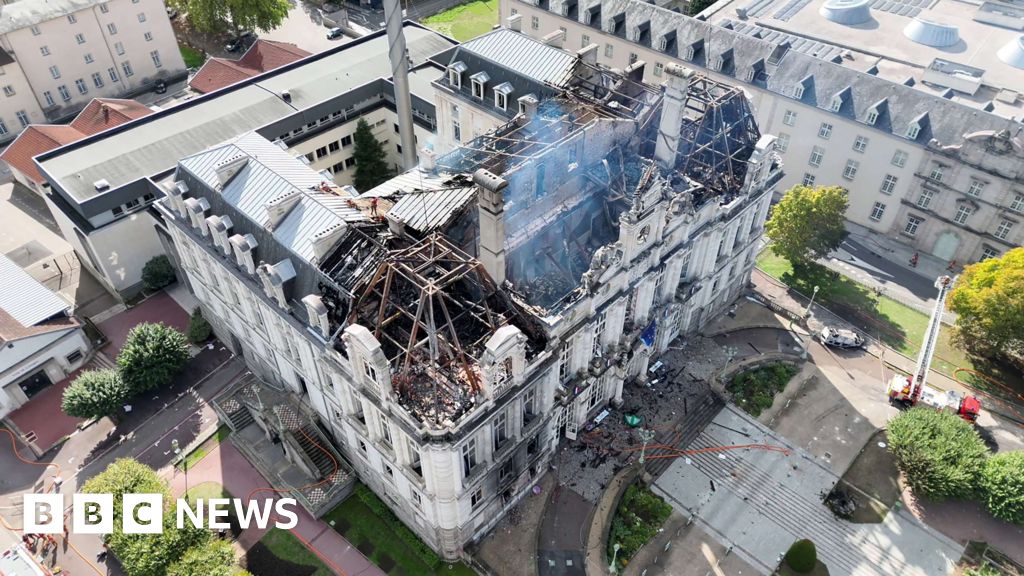
A suspect linked to a far-left movement has been arrested in France after a 19th Century city hall was gutted by a fire over the weekend that broke out during mass disorder, French media report.
The clock tower and parts of the roof of the ornate city hall in the central city of Limoges were engulfed in flames before collapsing on Saturday.
The 40-year-old suspect is known for acts of violence against public officials and has been classified as an "S" subject, meaning he is a potential threat to national security, FranceInfo reported.
More than 120 people have already been imprisoned following widespread demonstrations across France, French Justice Minister Gérald Darmanin told CNews-Europe.
Hundreds of thousands of demonstrators took to the streets to protest against rising fuel prices, the cost of living and deteriorating public services, including schools.
Darmanin said he asked prosecutors to be "extremely firm" and "ruthless towards those who attacked police officers, gendarmes and firefighters, who looted shops and who attacked public buildings".
The justice minister insisted France did not need to be put into a state of emergency which would "deprive all French people of their individual freedoms".
But French Prime Minister Sébastien Lecornu earlier said he had not ruled out imposing a state of emergency.
Targeted curfews introduced across France on Monday contributed to a quiet night following the disorder, Lecornu said.
Curfews were introduced across parts of central Paris, including Place de la République, where protesters had gathered over the weekend, and the Les Halles shopping area.
Other measures restricting the movement of young people and gatherings were introduced in cities such as Marseille, Bordeaux, Nice and Lyon in the south, as well as Lille and other towns in the north.
Lecornu thanked police officers and gendarmes for enforcing the measures, adding that further curfews on Tuesday night would be decided depending on where they were necessary.
Writing in a post on X, he said decisions would be made "on the ground" by French regions and local mayors.
Earlier Interior Minister Laurent Nuñez admitted police had "lost control" in some cities.
He was strongly criticised by opposition politicians over authorities' preparedness for the disorder, leading him to offer his resignation on Monday, which was rejected by President Emmanuel Macron.
More than 2,500 people have been arrested since the disorder broke out, officials said on Monday. One demonstrator's hand was blown off by a police crowd-control grenade, according to the AFP news agency. About 1,000 police officers were injured.
Protests first began last month with students demanding better school conditions but they have escalated to take in a broader range of concerns with numbers at demonstrations bolstered by trade unions and various protest groups.
More than 2,000 shops and other businesses have been directly impacted by the weekend's violence, the head of France's Chambers of Commerce and Industry (CCI) said.
Rioters, some dressed in black and wearing masks and balaclavas, were seen setting fire to cars and buildings and looting businesses in Paris, Marseille and other cities and smaller towns.
Protest organisers have declared that a second round of protests will take place on Saturday across France.
The so-called yellow vests (gilets jaunes), who were responsible for France's longest-ever modern protests in 2018, has said "Act II" will take place this weekend.
Curfew imposed in parts of central Paris and other cities after rioting across France
In pictures: French landmarks damaged and destroyed by violent protesters
Are student protests being manipulated ahead of France's presidential election?
Topics in this story
Gathered from external sources. Rights to this text belong to whoever originally published it.