In 2024, a New Jersey dissertation reported on asphalt that heats itself; conductive road strips maintained a snow-free surface at about 6 watts per square foot
New Jersey researchers develop self-heating asphalt that maintains snow-free roads using low energy consumption. Conductive road strips tested at Rowan University showcase significant potential for winter maintenance and safety. Discover innovative solutions in asphalt technology for cold weather conditions.
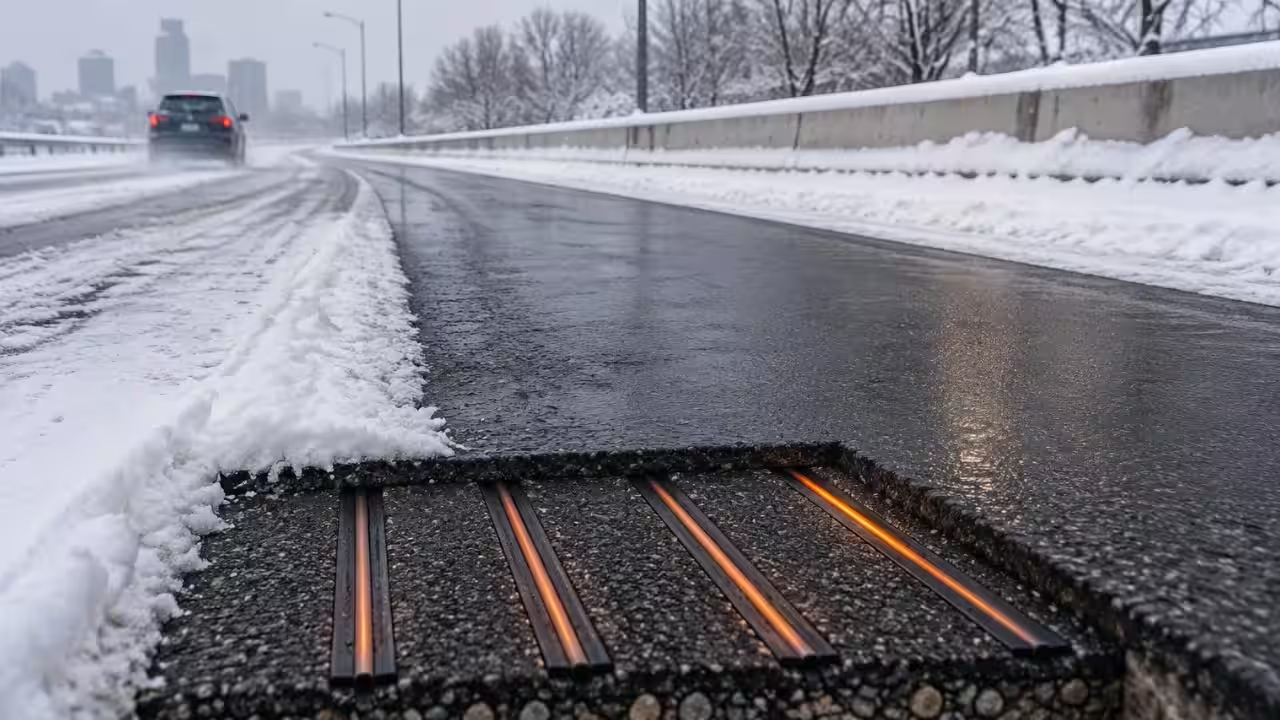
Clearing snow from pavement usually means either removing it by force or dissolving it with chemicals. Plows scrape the road surface, while salt changes how water freezes and then drains into soil and water systems. Both methods require labor, equipment and repeated passes through a storm. A third method uses the road itself as the heating element. Because asphalt is not a good conductor of electricity, engineers must add conductive materials and electrodes to the asphalt layers to heat it with current. The current warms the asphalt enough to melt snow, and the technology has been tested at Rowan University’s accelerated pavement testing facility in southern New Jersey.The CREATES test strips in GlassboroThe research comes from the Center for Research and Education in Advanced Transportation Engineering Systems (CREATES), part of Rowan University’s Henry M. Rowan College of Engineering. The center is housed at the South Jersey Technology Park on Rowan University’s West Campus in New Jersey. The team worked with the U.S. Army Engineer Research and Development Center’s Cold Regions Research and Engineering Laboratory. ASME reports that the conductive mixture contains 30% graphite and 1% carbon fiber by volume of asphalt binder. In a study published in Transportation Research Record, researchers from Rowan University reported that their laboratory-prepared conductive asphalt mixtures achieved an electrical resistivity of 1 to 2 ohm-meters (Ω·m), averaging 1.21 Ω·m.The first one was the control strip without any electrodes. The second design used a 0.4-inch conductive layer with steel electrodes spaced 6 and 12 inches apart. The third used a 1-inch conductive layer with electrodes spaced 12 inches apart in one section and 6 inches apart in the other. The New Jersey field tests were conducted during the winters of 2021 and 2022, according to Rowan University’s announcement.What the Transportation Research Record paper found about powerRowan announced the full-scale results in November 2023, after the paper appeared in Transportation Research Record that year. The paper, Full-Scale Evaluation of Electrically Conductive Asphalt Pavements for Deicing Applications, covered the winters of 2021 and 2022. Rowan University announced the full-scale test results on November 29, 2023. The research paper appeared in Transportation Research Record, volume 2679, issue 1, in January 2025. The paper says the team built three 30-by-15-foot full-scale strips at Rowan University’s Accelerated Pavement Testing Facility: one control lane and two electrically conductive sections.Strip II used an asphalt binder with conductive fibers, while strip III used a modified high-performance thin overlay with graphite and carbon fibers; strip III also let the researchers compare 12-inch and 6-inch electrode spacing under the same 24V AC setup. ASME reported that strip two consumed about three times more power than strip three, but the paper’s abstract gives 19.75 watts per square foot for strip two against 4.92 for strip three, which is nearly four times as much.The 6 watts per square foot figure in Marath’s 2024 dissertationThe lowest-power result appears in a doctoral dissertation by Ashith Marath, Development of Electrically Conductive Asphalt Pavements for Deicing Applications in Cold Regions, approved at Rowan on September 26, 2024. The abstract of the dissertation says the conductive asphalt test strips could maintain a snow-free pavement surface with a thermal power output as low as 6 watts per square foot (65 watts per square meter) under winter conditions in New Jersey. The abstract of Marath’s laboratory study says mixtures with 30% graphite had electrical resistivity similar to those with 15% graphite and 2% carbon fiber. Accelerated truck loading using a Heavy Vehicle Simulator found that the heated strips worked about as well as regular asphalt.Operating costs of $2,280 per hour and the airfield use casePower demand determines the running cost, so the low-power finding matters here. ASME’s estimate of $2,280 an hour for a million square feet at $0.19 per kilowatt-hour works out to about 12 watts per square foot, which is double the dissertation’s 6 watts and well above the 4.92 watts per square foot reported for the third strip, so the figures are not directly comparable. Heating cannot fully offset the cost of manual snow and ice removal, which is why Yusuf Mehta, the center’s director, said the system is designed mainly for short stretches such as airports and bridges, where safety and uninterrupted operation justify the expense. The system was also being tested in Alaska during fall 2023 and winter 2024. Life expectancy becomes another reason to use heated pavements. Plows set at the wrong height can damage the asphalt and peel off the sealant, while deicing salts accelerate freeze-thaw damage and shorten the pavement’s life.You use AI every day. Now get your AI Quotient. Take the AIQ test.
Topics in this story
- self-heating asphalt
- conductive road technology
- snow-free roads
- Rowan University asphalt research
- electric asphalt heating
- self-heating asphalt technology
- conductive asphalt for snow removal
- Rowan University deicing research
- electrically conductive asphalt
- asphalt snow-free roads
- CREATES Center New Jersey
- winter road safety technology
Gathered from external sources. Rights to this text belong to whoever originally published it.