In 2026, 20 scientists, artists and writers received $800,000 each through the MacArthur 'genius' grants; here is what their work aims to change
The MacArthur Foundation has named 20 fellows whose work spans climate science, history, philosophy, chemistry, poetry, dance and jazz.
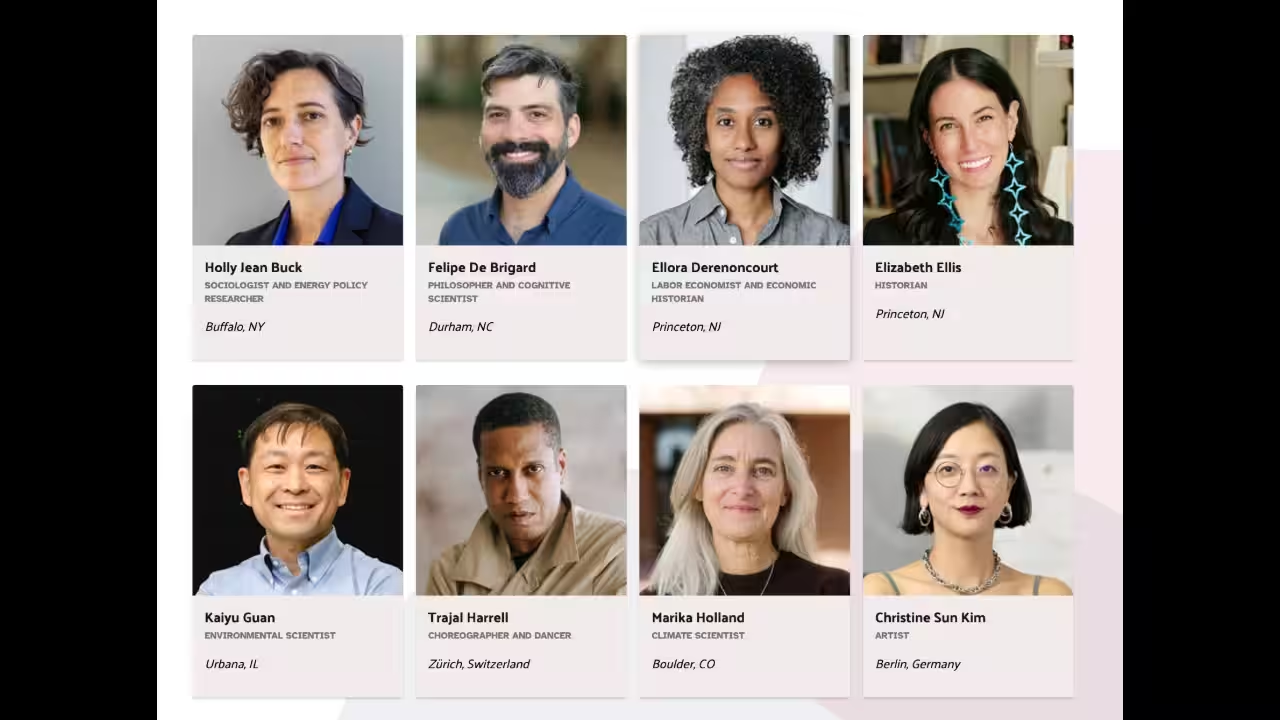
The MacArthur Foundation has named 20 fellows whose work spans climate science, history, philosophy, chemistry, poetry, dance and jazz. The prize rewards people rather than projects, and nobody can apply for it. Nominations feed a selection process lasting years, and many recipients say they were stunned by the news. The recognition often opens further doors. Reading the full class together shows recurring concerns: damage to the climate and the environment, the memory of violence and injustice, hidden or erased communities, and technology that could make medicine, farming and materials safer and more efficient.Researchers aim to bring communities into clean energy, forecast polar ice and predict harvestsAccording to The Associated Press, Holly Jean Buck, a sociologist at the University at Buffalo, studies the part local communities play in limiting climate change and moving towards clean energy. Marika Holland, a climate scientist based in Boulder, Colorado, helps predict changes in ice cover and works out how polar climate change affects marine ecosystems.Kaiyu Guan, an environmental scientist at the University of Illinois Urbana-Champaign, uses data and machine learning to help farmers predict and optimise their crop yields.Scholars revisit history to explain racial wealth gaps, Indigenous nationhood and federal powerEllora Derenoncourt, a labour economist at Princeton University, investigates where racial wealth disparities in the United States came from and which policies could narrow the gap. Her Princeton colleague Elizabeth Ellis, a historian, is correcting the colonial record to highlight the different ideas of nationhood held by Indigenous tribes and the strategies Native Americans used to resist European settlement.Ariel Ron, a historian at Southern Methodist University in Dallas, examines how agriculture in the northern states influenced economic growth and the expansion of federal power in nineteenth-century America.Memory, forgiveness and loss: A philosopher, a forensic anthropologist, a novelist and a poetFelipe De Brigard, a philosopher at Duke University, applies cognitive science to the link between memory and forgiveness, including among victims of political violence in his home country of Colombia. Kate Spradley, a forensic anthropologist at Texas State University, works to identify migrants who died along the Texas-Mexico border and to repatriate their remains. Her Operation Identification initiative also tackles the complications that make this work so difficult.Maaza Mengiste, a fiction writer at Wesleyan University, uses historically informed novels to show the human cost of political conflict. Layli Long Soldier, a poet in Santa Fe, reworks historical texts to underline the erasure of Native Americans and pairs her writing with visual art.Dance, sound, murals and jazz, artists reimagine whose stories are told and how they are heardTrajal Harrell, a choreographer and dancer based in Zurich, merges dance traditions into an imagined archive that dissolves the barriers between styles. Christine Sun Kim, an artist in Berlin, conveys the experiences of deaf people and finds new ways to understand sound through drawings, large-scale murals, video and interactive works.Rodney McMillian, an artist at the University of California, Los Angeles, moves between sculpture, painting, video and performance to explore how history and socioeconomic conditions shape belonging in the American South. Chip Thomas, a public artist in Flagstaff, Arizona, turns neglected spaces, mostly in the Navajo Nation, into public works rooted in community history.Vincent Valdez, who divides his time between Houston and San Antonio, paints historical and contemporary scenes that reflect Latino experiences in the United States. Immanuel Wilkins, a New York alto saxophonist and composer, writes music that often reflects historical narratives of injustice. Bryan Washington, a fiction writer in Tokyo, captures modern relationships in novels including “Memorial” and “Palaver”.Chemistry, physics and nanotechnology: Safer reactions, new materials and better disease treatmentsSong Lin, an organic chemist at Stanford University, develops methods that open routes to safer and more sustainable synthetic organic reactions. Vincenzo Vitelli, a physicist at the University of Chicago, builds theoretical frameworks to describe how matter and materials with unusual properties will behave.Liangfang Zhang, a chemical engineer and bioengineer at the University of California, San Diego, is creating new nanotechnologies to treat and prevent infectious diseases, cancers and immunological disorders.You use AI every day. Now get your AI Quotient. Take the AIQ test.
Topics in this story
Gathered from external sources. Rights to this text belong to whoever originally published it.