Hundreds from Russian-occupied Oleshky land in Belarus en route to Ukraine
Four planes transporting evacuees from the war-ravaged city have arrived in Belarus’s Gomel.
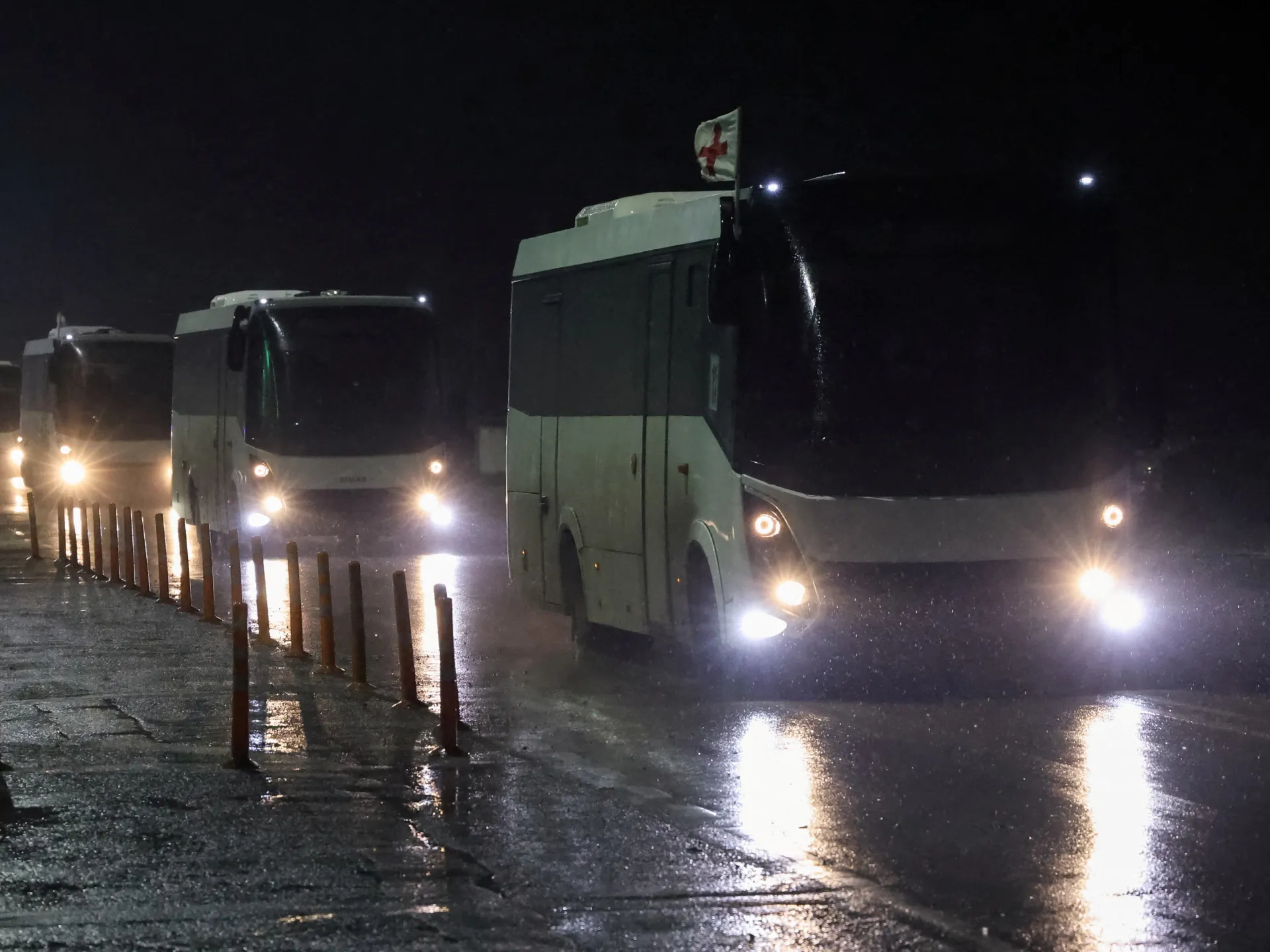
Hundreds of residents from the Russian-occupied Ukrainian town of Oleshky have been transported to Belarus, as part of a major evacuation mission under a truce that the White House says United States First Lady Melania Trump helped broker.
Four planes carrying the Oleshky evacuees arrived in the southeastern Belarusian town of Gomel on Saturday, said Ukrainian parliament member David Arakhamia.
The group was met in Gomel by rescue workers, medical teams and Red Cross volunteers, Belarusian state media reported.
From there, they were due to be transported to Ukrainian territory “within hours”, said Arakhamia.
The civilians from Oleshky, which has suffered from major food and medicine shortages after years of fighting, began the journey out of their region in bus convoys on Friday, under a rare regional truce that is expected to continue through Sunday.
The estimated 2,000 residents were offered the choice of travelling to Ukrainian- or Russian-held territory, or remaining in the city with replenished food and medical supplies.
Russia and Ukraine have not specified how many people chose to leave the city, but Melania Trump posted on Friday that the humanitarian convoy could safely evacuate more than 750 people.
Those travelling to Ukraine were first bused to the Russian city of Anapa, before being flown to Belarus.
“It was a very long journey for them,” Al Jazeera’s Yulia Shapovalova said, reporting from Moscow.
“First more than a dozen buses took them to Anapa on the Black Sea… and then they spent several hours get to Gomel by plane”.
Shapovalova said the evacuees, including many children and elderly people, were waiting to head to the Novaya Guta checkpoint at the Ukraine-Belarus border.
Al Jazeera’s Audrey MacAlpine, reporting from the Ukrainian side of the border where evacuees were expected to cross, said “a lot of preparation” was underway ahead of their arrival, with a large media presence and humanitarian aid workers on site.
“There’s food, there’s medical care, and, as we understand, this preparation has been going on for almost a week,” said MacAlpine.
Leonid Melinikov, a member of the Ukrainian Red Cross present at the border site, told Al Jazeera that aid workers were expecting around 500 arrivals.
Russia’s ombudswoman and lead representative on the evacuation mission, Yana Lantratova, said buses also transported Oleshky residents who wanted to live in Russia.
Those residents were first taken to a temporary accommodation centre in Simferopol in the Crimea region, said Shapovalova.
“We’re waiting for information on where and when they’re going to be taken next,” she said.
Aside from the first lady’s apparent role in the truce and evacuation mission, Pope Leo XIV – the first American pontiff – also pressed Russian and Ukrainian leaders to allow aid deliveries and civilian evacuations.
“The Russian military provided safe passage and safe corridors for the evacuees and were demining the roads near Oleshky,” said Shapovalova.
Moscow and Kyiv continued to trade attacks elsewhere even as the Oleshky truce continued.
The governor of Russia’s Bryansk region said a Ukrainian drone killed two people and injured five in the settlement of Klimovo on Saturday.
Meanwhile, Ukraine’s President Volodymyr Zelenskyy said overnight Russian attacks hit Ukrainian power plants, railway infrastructure and a gas distribution facility.
The strikes left more than 200,000 households without power in the Dnipro region, and 80,000 more without power in the Kyiv region, he said.
Zelenskyy, who has long pressed partners to supply Ukraine with more interceptors, renewed that call earlier on Saturday, saying: “Russians are attacking our energy infrastructure every single day”.
While Zelenskyy welcomed the US approval of Kyiv’s purchase of 500 PAC-3 Patriot interceptors, he warned that equipment could take years to deliver and that Ukraine’s military needs the supplies more urgently.
“The United States, our European partners, and other partners around the world have sufficient stocks of PAC-3 interceptors in their warehouses,” said Zelenskyy in a post on X.
He urged allies to supply those existing interceptors immediately to cover Ukraine during the winter of 2026–2027, adding that partners could replenish their own stockpiles in subsequent years through the production already contracted and paid for.
Topics in this story
Gathered from external sources. Rights to this text belong to whoever originally published it.