More than 100 detained in France as thousands protest in Paris
European countries have been bracing for discontent this weekend, with thousands of people taking to the streets. Follow for the latest updates.
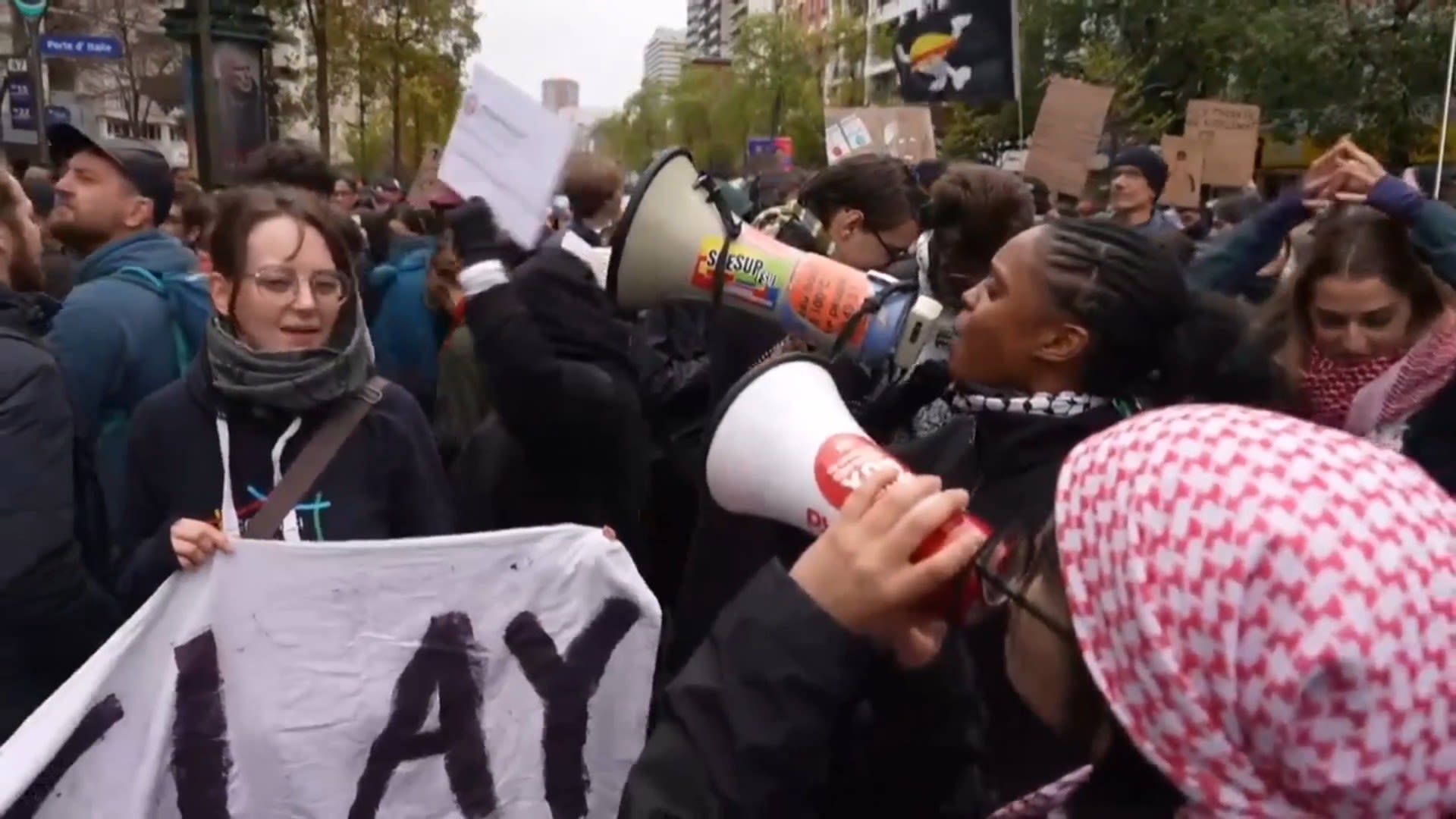
• Fresh protests: France’s Interior Ministry says at least 135 people have been detained in connection with today’s protests now sweeping the country. A march attended by thousands in Paris has so far passed by largely peacefully , but tear gas has been deployed in three cities .
• Security operation: Some 70,000 officers have been positioned across the country this weekend as part of a huge security operation . The city of Nice has deployed the largest number of police officers in its history to attend today’s demonstrations.
• Discontent in the continent: Anti-government demonstrations are also taking place in a number of other European countries. Police in Albania have been pictured deploying water cannon during clashes with protesters, while stores have been boarded up in Italy ahead of an expected march.
After a peaceful march through Paris, a crowd of several thousand protestors confronted police, who used tear gas and a water cannon to block them, according to a CNN team at the scene.
The clashes broke out at the Porte de Vincennes, the end-point of the march, which drew an estimated 110,000 people.
The protesters, mostly young and dressed in black congregated in front of police lines leading to Place de la Nation, where the organizers had originally intended to end the march.
With a police helicopter hovering overhead, police started using tear gas and a water cannon in an effort to move the protesters back. There was a defiant mood in the crowd, with a handful of protesters targeting the police with lasers. Groups of young people were seen dancing with music pounding through the crowd as meters away tear gas billowed into the air.
Images from Bordeaux on France’s Atlantic coast show tear gas being used against protesters in the famous Place de la Bourse in the city’s historic center.
Videos show some masked protesters hurling objects at police as the tear gas drifts across the square.
Regional authorities said in a post on X that “hostile groups are attacking law enforcement, throwing projectiles, and setting up barricades at Place de la Bourse.” The post warns the public to avoid the area.
Live coverage by CNN affiliate BFMTV showed a tense stand-off between riot police and several hundred protesters on the bank of the River Gironde.
Today’s protests in the French capital of Paris have largely been peaceful so far, in contrast to those seen last Saturday, a senior police officer told CNN affiliate BFMTV.
“For the moment, the situation is pretty much under control, apart from some attempts to block the peripherique, which we stopped,” said Olivier Bourde, the Paris police force’s deputy director for public order, as he stood with his colleagues dressed in riot gear.
Hundreds of protesters have been shouting “ACAB,” a commonly used acronym for an anti-police slogan, a CNN producer in Paris heard.
Bourde couldn’t yet estimate when the protest would be over.
“Last week, we finished at 2 a.m. Now, it will depend on the if the protesters disperse normally, like a normal protest, or if we have breakaway groups,” he said.
CNN’s Joseph Ataman contributed reporting.
The leader of the far-left party France Insoumise has described the march through Paris as a “total victory for the social movement.”
Jean-Luc Mélenchon, who took part in the march, said on X : “The march gathered at the newly authorized location and is now moving forward peacefully, stretching over more than four kilometers.”
Live video showed many thousands walking through the streets, despite a last-minute order by authorities changing the route of the march.
“The attempts by the Prefect of Police and (Prime Minister Sebastien) Lecornu to incite disorder have failed completely,” Mélenchon said.
“It is time for the authorities to yield; otherwise, the only option left to them will soon be the exit door,” he added. praising the discipline of the marchers.
Melenchon has championed the demands of high school students and earlier Saturday warned President Emmanuel Macron that it was time for him to give in to their demands for more investment in France’s schools.
“After that, all he’ll have left is the exit door,” he said.
As scores of protesters take to the streets in cities across France today, anti-government demonstrations are also taking place in a number of other European countries.
Protesters in Tirana, Albania , set fire to dumpsters and threw stones and tear gas canisters, according to photographs taken by Reuters.
Chair cushions which had been symbolically offered to protesters as an invitation for a dialogue were also set alight in front of a government building, according to the outlet.
One man was photographed lying on the ground in front of a police vehicle, while other protesters waved Albanian flags outside of the country’s Ministry of Education.
Police deployed water cannons to spray demonstrators near the ministry building, photos showed.
In Brussels, Belgium , student held up placards and barricaded streets. Police deployed a water cannon, according to public broadcaster VRT.
A police officer was photographed by Reuters spraying a substance at demonstrators. VRT reported that the police had deployed both pepper spray and tear gas.
In the Italian cities of Naples, Rome and Milan, stores boarded up their windows ahead of planned protests.
A CNN reporter on the ground in Rome said that a march began peacefully around 3 p.m. local time (9 a.m. ET). Many protesters waved Italian flags as they walked.
Police have used tear gas in the northern city of Lille in a confrontation with hundreds of protesters.
Videos showed police charging dozens of protesters, many of whom were wearing face masks. The demonstrators fell back and then regrouped.
Within the last few minutes, clashes began in the southern port city of Marseille, according to live coverage on CNN affiliate BFMTV. Riot police used tear gas there too.
Tensions were also running high in the southeastern city of Nice on the Mediterranean coast, where police tried to disperse demonstrators in the center of the city, using loudspeakers to order people to evacuate the area.
Tear gas was also deployed for more than an hour earlier in Lyon in central France, as scattered groups moved from street to street.
The regional authorities said that “several groups of individuals with hostile intentions were preparing to commit acts of violence and vandalism by masking and hooding themselves.”
“After warnings and demands for dispersal, with no reaction from the demonstrators, law enforcement used tear gas measures,” the Prefect of the Auvergne-Rhône-Alpes region said on X.
“Internal security forces were targeted by numerous projectile throws, including iron pellets. These individuals began erecting barricades,” it added.
Nationwide industrial action will take place in France on November 5 if French President Emmanuel Macron does not respond to the demands of protesters, the leader of far-left party La France Insoumise has warned.
“A general strike, called by the CGT, looms over the government for the 5th of November,” Jean-Luc Mélenchon told CNN’s French affiliate BFMTV from the frontline of today’s demonstration in Paris, adding: “The masses will be set in motion.”
Mélenchon said Macron risks the industrial action that he said would create “far more hazardous conditions” for the president unless he “gives in now.”
Some context: Some protesters have been calling for greater investment in the country’s education system, more opportunities for its youth workforce and solutions to its surging living costs.
Mélenchon’s La France Insoumise party has backed the student movement which has been a part of the protests sweeping France.
With protests underway in several cities across France, there have been clashes between police and protestors in the city of Lyon.
Live coverage from CNN affiliate BFMTV showed police using tear gas in central Lyon in an effort to disperse protestors wearing masks, some of whom picked up tear gas grenades and threw them back at police lines.
The clashes occurred around the Place Jean Macé, near Lyon university.
Elsewhere in the city, there was a stand-off between riot police and hundreds of demonstrators, according to live pictures.
“Some individuals, wearing hoods and masks, attempted to enter the restricted zone,” and “formal warnings were issued,” a source from the prefecture told BFMTV.
These individuals have since “split into two groups” and are currently being tracked by law enforcement, the source said. Police are intervening “whenever there is an attempt to set up barricades or when projectiles are thrown.”
Several peaceful protests are underway across France, with TV footage showing thousands of demonstrators marching in the cities of Marseille, Lyon and Lille.
Elsewhere, protests are also underway in Paris and took place in Orléans.
At least 135 people have been detained so far across France in connection with today’s protests, the country’s Interior Minister Laurent Nuñez has said.
Speaking to CNN affiliate BFMTV, Nuñez said the detentions had all taken place before 1 p.m. local time (7 a.m. ET).
Nuñez also discussed the authorities’ decision to change planned protest routes in Paris and Orléans today, saying the changes were decided upon last night for good reason.
A protest march is now underway in Paris , with 70,000 police officers expected to be deployed across the country this weekend.
Specialist SWAT units, helicopters, armored vehicles, police dogs and water cannons are at the ready to be deployed as part of the operation, after more than half a million took to the streets last Saturday.
Police in Paris have already conducted hundreds of control checks in the Île-de-France region, seizing items including a knife, an angle grinder and protective gear such as face masks and diving goggles in the run up to the demonstrations.
Yesterday evening, the Paris police banned the original protest route for today, which would have taken the protest from the Place de la Bastille to Place de la Nation. Unions appealed this decision in court, but the appeal was rejected.
A police spokesperson told CNN affiliate BFMTV the changes to the route were made in response to “evolving threats,” and influenced by what French President Emmanuel Macron described as a “ terrorist” attack in a Paris suburb yesterday in which one person was shot dead.
Separately, thousands of protesters have gathered in the French city of Orléans today to protest against the far-right National Rally party , which is holding its congress there this weekend.
CNN’s Joseph Ataman, Ivana Kottasová, Elina Baudier Kim, Charlotte Reck, Issy Ronald and Pierre Bairin contributed to this reporting.
The French city of Nice has deployed the largest number of police officers in its history to attend today’s demonstrations, the city mayor told CNN’s French affiliate BFMTV earlier.
“We have mobilized close to 310 municipal police officers, which is unprecedented in the history of the municipal police of Nice,” Éric Ciotti said earlier.
In total, there will be more than 700 security personnel on the streets of the waterfront city throughout the day, Ciotti said, tasked with protecting citizens and businesses.
While France is no stranger to mass protests and strikes, the latest wave of demonstrations is different, Michael Froman, the president of the Council on Foreign Relations, said.
Writing for US-based think tank’s website , Froman said the protests stem from a “fundamental collapse of the French social contract.”
Froman added the protests are also noteworthy because they are taking place as the political far right is rising in popularity in France.
“Those parties, heading into France’s April 2027 election (not to mention Germany’s rolling election schedule), will seek to capitalize on the resentment that the violence of these protests has fostered and, if successful, to implement their anti-immigrant policy agenda,” he wrote.
An NFL game between the Pittsburgh Steelers and New Orleans Saints is set to take place at the Stade de France just outside of the capital tomorrow, but the Ligue 1 top of the table clash between Paris Saint-Germain and Lyon has been postponed.
The US Embassy in France issued a security alert on Thursday, warning American citizens in town for the game to “avoid demonstrations and areas of unrest.”
“Americans in Paris for the NFL game on Sunday, October 25 should also exercise caution and be aware of their surroundings,” the embassy said, warning that “recent demonstrations were violent and involved heavy property destruction, uncontrolled looting, and attacks on police.”
While the match is still scheduled to go ahead, a Steelers fan event in Paris was canceled by the NFL.
And PSG’s match against Lyon, originally scheduled for 8:45 p.m. local time on Sunday, has been postponed until Monday evening due to the expected protests in Paris. Several other soccer fixtures have been postponed too, including Toulouse FC’s match against ESTAC Troyes, and Montpellier Hérault SC’s Ligue 2 clash against Red Star FC.
Around 550,000 people attended the massive demonstrations across France that took place last Saturday, according to the country’s Interior Minister Laurent Nuñez, marking one of the largest days of protest in France in recent years.
Hundreds were arrested, as violence broke out at several protests across the country. Catch up on what took place:
Before the demonstrations even began, fires were burning in the cities of Paris and Marseille. Police fired tear gas towards crowds in Paris and Lyon , charging into protest areas multiple times.
Though the protests were acknowledged by authorities as largely peaceful , in Lyon, a tourist office was set on fire , while demonstrators also broke into city halls in Marseille and Lille, according to CNN affiliate BFMTV.
As demonstrators in Paris reached the final destination of their march, large groups of young people were seen looting and starting fires where the protest began.
A protester in the city of Saint-Étienne, about 40 miles southwest of Lyon, lost his hand during a march there, a police source told CNN affiliate BFMTV. There were no further details of how the incident occurred.
French President Emmanuel Macron condemned the violence , saying that those who attacked government buildings and businesses would be “prosecuted and punished.” There is “no room for violence in our Republic,” he said in a social media post .
CNN’s August Phillips, Joseph Ataman, Elina Baudier Kim and Charlotte Reck contributed to this reporting.
The kids are not alright. Across Europe, young people are protesting issues ranging from a lack of funding for education to the cost of housing, posing massive challenges to governments already under pressure and providing a visible sign of the intergenerational frustration felt by Gen Z.
The precise configuration of these grievances vary from country to country. Despite their different catalysts, however, all these movements have acted as a sort of black hole, drawing in any discontent before exploding in a catch-all outburst of frustration for a generation of young people who fear they won’t have the same opportunities as their parents.
They have, in part, inspired each other, too. Protesters in Italy and Greece have referenced their French counterparts in their slogans. Housing protests in Spain spilled over into Portugal. And student unions across Europe are sharing advice and their experiences with one another, Alice de Brito, vice president of France’s main student union, UNEF, told CNN.
For Julius Fintelmann, the co-founder and editor-in-chief of the European Correspondent daily newsletter, the protests “reflect a kind of frustration, the feeling that Europe’s politics is failing to deliver for the next generation.”
As well as education and housing, he points to an increasingly uncertain job market, where artificial intelligence disproportionately affects entry-level jobs, and the climate crisis as laying the groundwork for this explosion of Gen Z anger.
A few minutes past 2 p.m. local time and the main protest march has begun on the edge of Paris. The gathering here was marked by confusion and anger after the police banned the previously agreed protest route yesterday, booting the march to the city’s border, far away from its commercial and political centres.
The authorities were surely hoping to keep the protest out of sight and out of trouble today but the anger among people in France, especially young people, hasn’t been dimmed by the violence around last week’s protest.
There were no sign of tensions that marked the beginning of last week’s march, as students today called for the government to take seriously their demands for greater funding in education.
Peaceful protest marches are underway elsewhere in France, especially in the city of Orléans where the far right is holding a party congress this weekend.
Thousands of protesters have gathered in the French city of Orléans today to protest against the far-right National Rally party, which is holding its congress there this weekend.
About 11,000 people had joined the demonstration by midday, local authorities estimated, according to CNN affiliate BFMTV. Some marched holding cardboard signs, with slogans like “Racism is a crime” and “When protesting is no longer a right it is duty,” according to Reuters.
“We are here because for us the National Rally will never be a party like the others,” Sophie Binet, general secretary of France’s main union CGT, said at the protest. “It is a racist, antisemitic, and sexist party.”
Amid the scores of protesters expected to take to the streets across France today are the gilets jaunes , or Yellow Vests, part of a grassroots citizens’ movement that began almost a decade ago.
The movement dates back to 2018, when more than 250,000 people protested a rise in fuel tax announced by the government, which it said was to fight against climate change.
The protests – named after the yellow high-visibility jackets French motorists must carry in their vehicles – morphed into broader demonstrations against French President Emmanuel Macron and his government in the weeks following November 2018.
They often turned violent, with at least 10 people dying in connection with the protests in their first six weeks.
The French government made many concessions in the first weeks of the initial Yellow Vest protests, including scrapping the initial fuel tax, and implementing a 10 billion euro ($11.05 billion) package of wage rises and tax relief for the poorest.
The Yellow Vests have taken to the streets several times since those first protests died down. In 2020, police took more than 250 people in for questioning and fired tear gas during violent scenes involving the movement in Paris.
People from across the political spectrum have taken part in Yellow Vest protests, including anarchists, anti-immigration populists and hard-core fascists.
There are even groups on social media claiming to be environmental “yellow jackets,” a contradiction of the original protesters’ demands to scrap a new eco-tax.
Some have blamed a radical fringe of the Yellow Vest movement for a rise in anti-semitism in France.
A 2019 study conducted by the Fondation Jean Jaures showed that 50% of those who participated said they believed in a “global Zionist conspiracy.”
CNN’s Melissa Bell, Saskya Vandoorne and Gianluca Mezzofiore contributed to this reporting.
Like France, Italy is also braced for protests today with some shopkeepers in Milan, Rome and Florence boarding up their stores, and more police patrolling the streets than normal in the capital city.
Rome is decidedly on edge, with police in place ahead of an anti-war demonstration scheduled for 3 p.m. local time, which organizers expect 10,000 people to attend.
Two other demonstrations are still yet to be finalized, with organizers saying they will announce gathering points at the last minute.
Elsewhere in Milan, which witnessed two consecutive nights of unrest last weekend, people told CNN the mood didn’t feel especially tense as tourists and locals went about their daily routines.
In Naples, the US embassy has issued an alert, advising people to stay away from the Piazza Garibaldi, Piazza del Gesù, Palazzo San Giacomo and Castel Volturno in case of any protests.
CNN’s Barbie Latza Nadeau, Angelgabriel Pascuzzogonzalez, Stefano Pozzebon, Antonia Mortensen and Sharon Braithwaite contributed to this post.
Topics in this story
Gathered from external sources. Rights to this text belong to whoever originally published it.