Police to issue interview letters as part of Garvaghy Road investigation
Police have said they are moving to the next phase of the investigation in connection with the Drumcree dispute.
Police have said they will begin issuing letters regarding an interview process to people "reasonably suspected" of committing offences linked to the unlawful protests blocking the Garvaghy Road in Portadown.
A statement issued on Thursday said police were moving to the next phase of their investigation in connection with the Drumcree dispute.
Unionist politicians have called for the police to take action against First Minister Michelle O'Neill and other senior Sinn Féin politicians who took part in the protest against the Orange Order march.
A Sinn Féin spokesperson said they were aware of the statement and would not be making any further comment due to the ongoing investigation.
O'Neill has previously defended joining the protests, saying she was "proud to stand with the residents" and "when the law is wrong, I will stand firmly against it".
The Police Service of Northern Ireland (PSNI) statement does not name anyone it plans to issue a letter to.
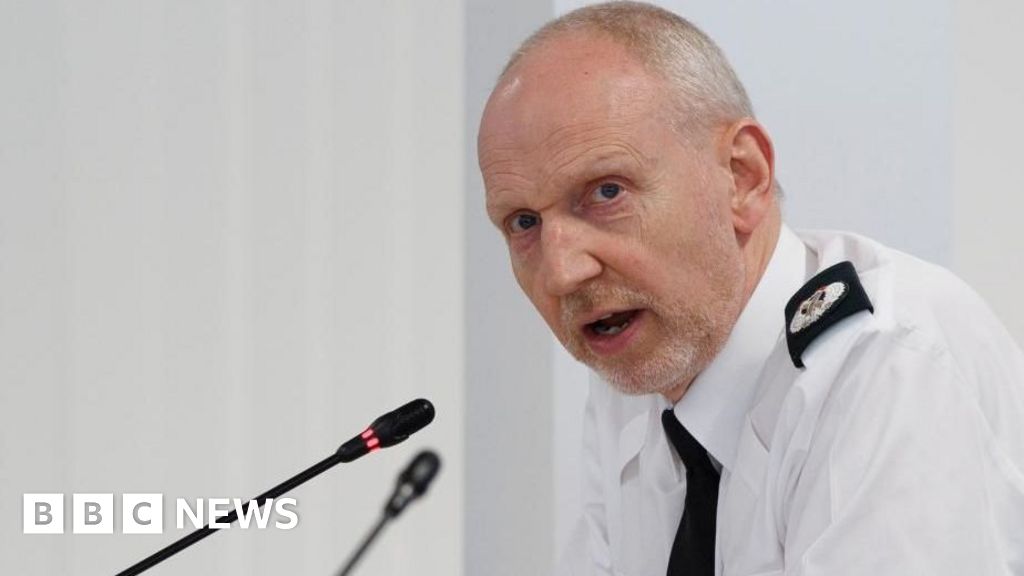
Assistant Chief Constable Davy Beck said police had been "methodically working" through the evidence collected so far in its investigation.
He added: "This work will now proceed to the next phase where individuals will receive letters regarding the interview process. I am satisfied that this step does not have an impact on the ongoing Judicial Review, which I respect.
"As this is a live criminal investigation we will not be making any further comment at this time."
Earlier, politicians cautioned against escalating the parading dispute, following a warning from residents that it could lead to issues with other marches.
It's the twelfth day of deadlock between residents of the Garvaghy Road and the local district lodge of the Orange Order over the proposed march.
On Wednesday, the Garvaghy Road Residents Coalition (GRRC) said the disagreement was "no longer just about the Garvaghy Road" after meeting 11 other nationalist residents' groups.
Several politicians have said they do not want the dispute to spark other disagreements about parades in other locations.
Claire Hanna, the leader of the Social Democratic and Labour Party (SDLP), told the BBC's Good Morning Ulster programme there was a need to "get a grip" of the situation "before it engulfs the wider political system".
She called on the Secretary of State, Sir Chris Bryant, to withdraw permission for the parade but said that "sensible voices within unionism" should "ask the lodge to reconsider, because there is the potential for this to scale out into other areas".
Jon Burrows, the leader of the Ulster Unionist Party (UUP) said he thought it would be a "mistake" for the secretary of state to get involved, but said politicians should make a "collective appeal to contain" the dispute in Drumcree.
"What we need to hear is political leaders saying we must not open these disputes across the country."
The Northern Ireland Office (NIO) has said the secretary of state is continuing to engage with all parties for a resolution.
Sinn Féin MP Chris Hazzard said there had been warnings that "opening up Drumcree" could "unravel agreements everywhere else".
"Accommodating sensitive parades relies entirely on mutual respect. We have to see an injection here of mutual respect," he added.
Jonathan Buckley, the Democratic Unionist Party (DUP) MLA for Upper Bann, said he wanted to see "mediated outcomes where residents can live and accommodate one another".
"I want to de-escalate. I want to see accommodation, and I want to see this issue resolved."
In Londonderry, dialogue around parading has come to be seen as crucial, and has resulted in an accommodation between residents, businesses and the Apprentice Boys.
That accommodation, developed in the late 1990s and early 2000s, has become known as the Derry Model.
It relies on direct engagement rather than a reliance on Parades Commission rulings.
East Londonderry DUP MP Gregory Campbell told BBC Radio Foyle's North West Today programme he did not believe that model was in jeopardy.
"No, I don't think it will be – there seems to be an attempt to completely change the narrative here," he said.
But Foyle Sinn Féin MLA Ciara Ferguson said there is " genuine nervousness" in Derry.
"I would be slightly fearful that it has got the potential to unravel," she said.
The Apprentice Boys' hold two parades in Derry city centre - in August and in December – each year, marking the beginning and end of the 1689 Siege of the city.
It is more than a week since the decision to allow an Orange Order march down the Garvaghy Road on Sunday, 27 September.
That morning, up to 1,000 people - including politicians such as Northern Ireland First Minister Michelle O'Neill - blocked the road, preventing Orangemen marching from Drumcree Church a mile to the west.
Since then, residents have maintained a constant presence around the road while Orangemen have also repeatedly tried to march the route before being turned back by police.
The stand-off has caused considerable political fallout in Northern Ireland, with First Minister O'Neill facing a vote of no confidence over her involvement in the protest.
The vote is due to fail due to it requiring cross-community support at the Northern Ireland Assembly.
Drumcree was one of Northern Ireland's most serious parading disputes, when stand-offs in the mid-to-late 1990s over attempts by the Orange Order to march along the Garvaghy Road were accompanied by riots, roadblocks and killings.
When the Orange Order was prevented by police from walking down the route in July 1995, there was a tense stand-off. It was the same for the next three years.
The Parades Commission began operating in 1998 to regulate parades and try to defuse tension around marches.
Its decision not to allow a march down the Garvaghy Road that summer has been challenged by the order for the past three decades.
Earlier this year the Parades Commission decided that the march could go ahead with restrictions in place after its original decision to stop the march was overturned in court.
Meanwhile, the Court of Appeal is considering its ruling in a legal challenge brought by the residents to block the march going ahead.
Drumcree dispute could lead to issues with other marches, say residents
Topics in this story
Gathered from external sources. Rights to this text belong to whoever originally published it.