Seven Italian students built a paper aircraft with a 20-metre wingspan and successfully flew it inside a hangar
A paper aircraft measuring more than 20 metres across its wings has set a Guinness World Records title after successfully flying inside an aeroplane
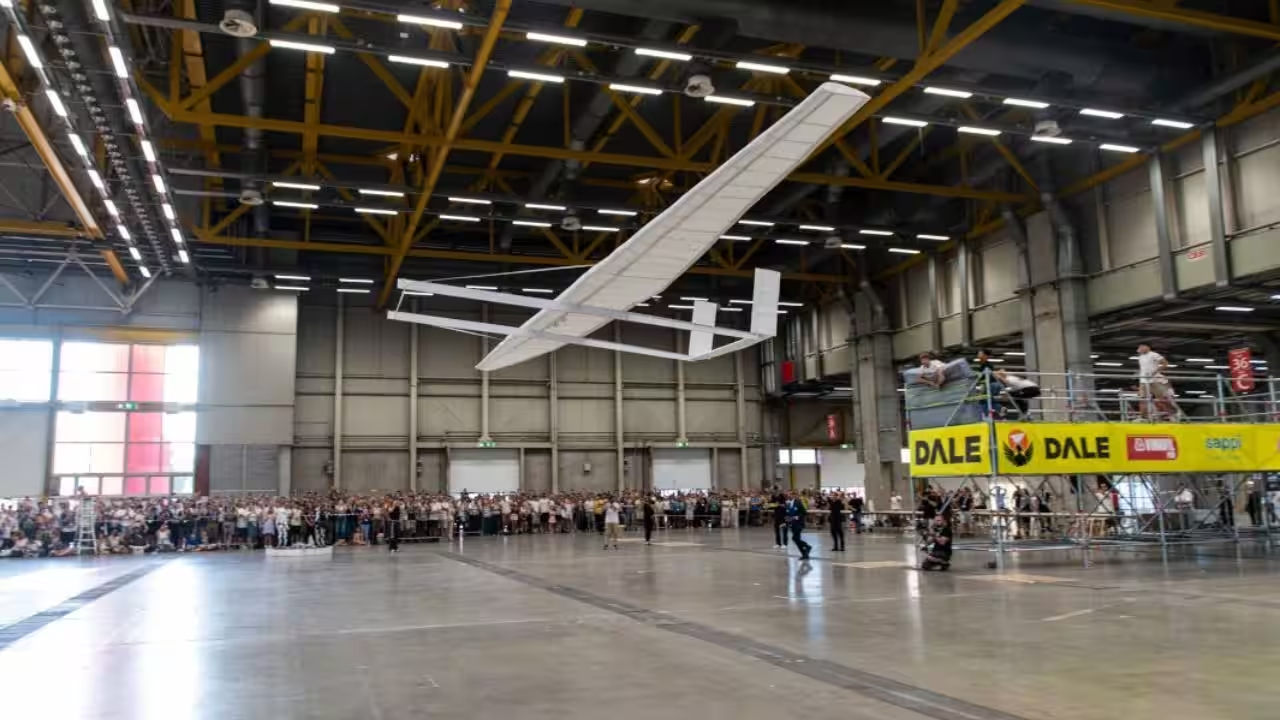
A paper aircraft measuring more than 20 metres across its wings has set a Guinness World Records title after successfully flying inside an aeroplane hangar in Bologna, Italy. Created by students from the University of Pisa, the giant aircraft, named Icarus, was made entirely from paper and glue. Its successful flight on 25 June 2026 marked the end of months of planning, testing and construction. According to the University of Pisa, the aircraft travelled 59 metres, surpassing a record that had remained unbroken since 2013.How did seven Italian students build the record-breaking paper aircraftAccording to Guinness World Records, the project began with a simple idea shared by engineering students during their university lectures. The group discovered the existing record while studying for exams and decided to attempt something that had previously seemed difficult to achieve on such a scale.The previous record belonged to the Braunschweig Institute of Technology in Germany, whose paper aircraft had a wingspan of 18.21 metres. That achievement had stood since 2013, giving the Italian students a clear target to beat.The University of Pisa reported that the project was developed by its engineering students with support from science communicator and content creator Jakidale. What started as an informal idea developed into a substantial engineering challenge involving design, calculations, testing and construction.The team eventually expanded its efforts beyond the original seven students, bringing in 16 additional helpers to contribute to the technical and production work. The collaboration helped turn the idea into an aircraft large enough to challenge the existing world record.Icarus is different from an ordinary paper planeThe finished aircraft measured 20.04 metres from one wingtip to the other and approximately seven metres in length. Guinness World Records lists its weight at around 28.5 kilograms, making it a substantial structure despite being constructed using only paper and glue.The scale of Icarus presented a different challenge from making a conventional paper plane. A small model can be folded and thrown by hand, but a structure measuring several metres requires careful planning to maintain its shape and travel through the air successfully.According to Guinness World Records, the students used computer simulations to predict how their design might perform before committing to the final construction. These simulations helped them explore the aircraft's proportions and consider how the finished structure could be made to fly.The University of Pisa confirmed that the final aircraft was built by hand using paper and glue. Keeping to these materials was central to the challenge, as the team needed to produce a record-breaking aircraft without relying on a conventional frame or other structural materials.How did the team develop the aircraft before its record attemptThe journey towards Icarus involved several stages rather than one successful design from the beginning. Guinness World Records reported that the team built two earlier prototypes before arriving at the final version.The first large model was named Prometheus, after the figure from Greek mythology associated with bringing fire and technology to humanity. It helped the students explore the structural elements needed for a much larger paper aircraft.Their next attempt, Daedalus, measured 8 metres in length and was also constructed from paper and glue. Although it did not perform perfectly, it gave the group practical experience with the materials and highlighted areas that needed improvement.The team then developed a smaller model measuring four metres. This version successfully glided through the air, offering an important demonstration that their approach could work.These experiments allowed the students to learn from earlier designs before committing to the final aircraft. The final aircraft was named Icarus, after the mythological son of Daedalus who attempted to fly. The name reflected the project's central ambition, although the students approached the challenge through careful preparation rather than relying on a single attempt.What happened when the giant paper aircraft finally flewThe record attempt took place on 25 June 2026 at the We Make Future event at BolognaFiere in Bologna. The event, associated with the European Institute of Innovation and Technology's business and entrepreneurship activities, provided a public setting for the aircraft's first major flight.According to Guinness World Records, the team positioned Icarus on scaffolding before preparing to launch it across the hangar. One of the students carried the aircraft into position and prepared to throw it towards the opposite side of the indoor space.The launch required a coordinated effort because of the aircraft's size. Once it was ready, the student ran along the scaffolding and released the plane.The aircraft briefly caught the air before gliding forwards and gradually descending towards the concrete floor. Its movement resembled that of an ordinary paper plane, although its enormous dimensions made the flight a unique sight for the watching crowd.The University of Pisa confirmed that Icarus travelled 59 metres during the successful attempt. Guinness World Records lists the achievement under the title of largest paper aircraft, with the record officially established in Bologna on 25 June.Importance of the achievement for the University of PisaThe successful flight brought an end to a 13-year wait for a new holder of the largest paper aircraft record. According to the University of Pisa, the achievement returned the title to Italy after the previous record had remained with the German institution since 2013.Guinness World Records adjudicator Lorenzo Veltri presented the team with its record certificate after the aircraft's successful launch. He praised the combination of engineering knowledge, teamwork and technological creativity that had made the achievement possible.You use AI every day. Now get your AI Quotient. Take the AIQ test.
Topics in this story
Gathered from external sources. Rights to this text belong to whoever originally published it.