The Backstory: When 'Tau' Devi Lal won the PM race, and then gave it away with a twist
NEW DELHI: On December 1, 1989, the newly elected Janata Dal parliamentary party gathered in Parliament's Central Hall to decide who would lead the
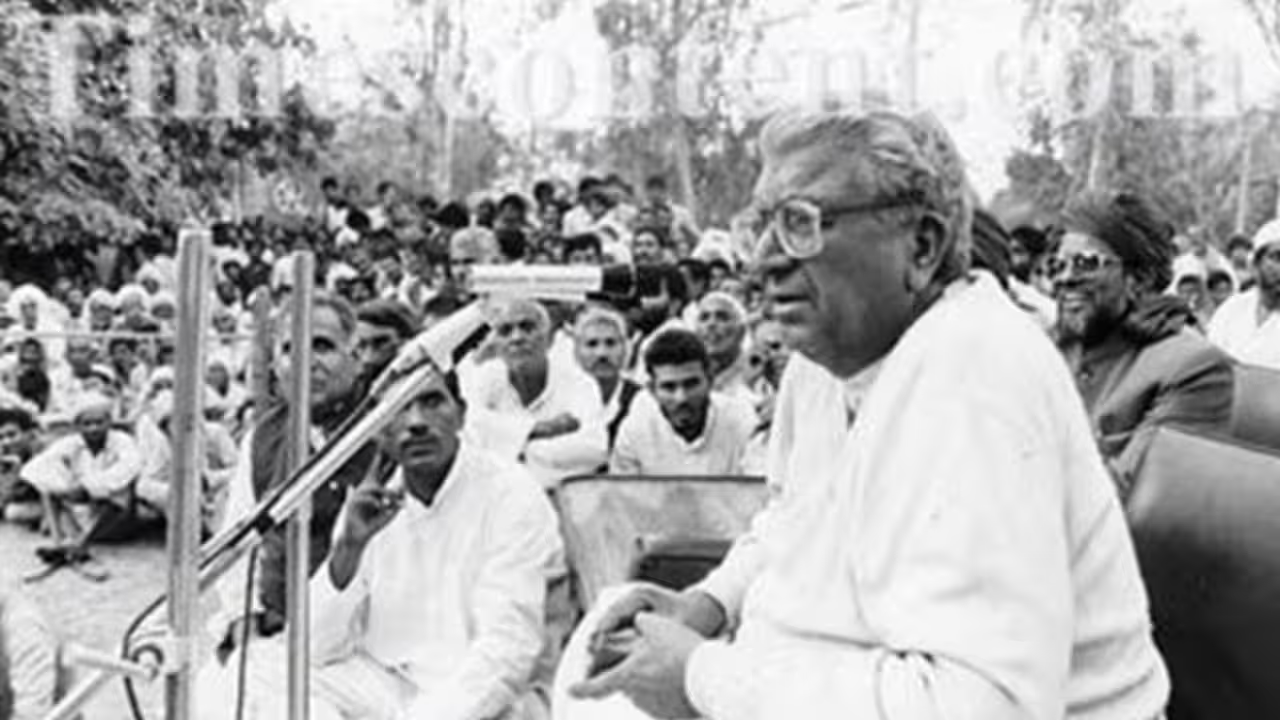
NEW DELHI: On December 1, 1989, the newly elected Janata Dal parliamentary party gathered in Parliament's Central Hall to decide who would lead the government that was about to replace Rajiv Gandhi's Congress. The leadership contest had already become a tug-of-war between VP Singh and Chandra Shekhar, with neither side willing to concede the top job.Then came an extraordinary political manoeuvre.VP Singh proposed Chaudhary Devi Lal's name. Chandra Shekhar seconded it. Devi Lal was declared elected as leader of the Janata Dal parliamentary party. And then the 75-year-old Haryana veteran stood up and proposed VP Singh for the Prime Minister post.Within minutes, the man who had just been chosen to lead the government had handed the job to someone else.VP Singh was elected leader and would become India's seventh Prime Minister. Devi Lal became deputy Prime Minister.The episode, one of the more remarkable leadership reversals in political history, has been recounted in several accounts of the 1989 transition. But this story is about Chaudhary Devi Lal, a man whose influence was built far from Delhi's power corridors and whose appeal rested heavily on Haryana's farmers and rural voters.The Central Hall manoeuvreThe drama of December 1 was the culmination of days of uncertainty following the 1989 Lok Sabha election, which had ended Rajiv Gandhi's five-year tenure and produced a fractured mandate.The National Front, led by the Janata Dal, was in a position to form the government with outside support from the BJP and the Left parties. But before the government could be formed, the Janata Dal had to settle its own leadership question.VP Singh was the obvious national face of the anti-Congress campaign, having broken with Rajiv Gandhi and built his reputation around allegations of corruption in the previous government. Chandra Shekhar, meanwhile, had his own ambitions and was deeply reluctant to accept Singh as the party's leader.Devi Lal sat at the centre of the equation.A detailed account of the episode in journalist Neerja Chowdhury's 'How Prime Ministers Decide' describes a political formula worked out at Odisha Bhavan shortly before the parliamentary party meeting. The plan was simple but dramatic: Singh would propose Devi Lal's name, Devi Lal would then withdraw and propose Singh, and Chandra Shekhar would be persuaded to second Devi Lal's nomination.Chandra Shekhar agreed to second Devi Lal's name after being told that Devi Lal would be the candidate. He did not, however, know the full plan.When the meeting began in Central Hall, the arrangement played out almost exactly as planned. Singh proposed Devi Lal. Chandra Shekhar seconded him. But after Devi Lal's nomination, the Haryana leader proposed Singh instead. The assembled parliamentarians broke into applause and Singh was declared leader of the Janata Dal Parliamentary Party.Chandra Shekhar was furious.According to the account, he believed he had been assured that Devi Lal would become Prime Minister. After the meeting, he reportedly warned that the episode would have consequences for the future.That warning proved prescient. Less than a year later, Chandra Shekhar and Devi Lal would join forces against VP Singh, helping bring down the government they had helped create.The OG 'Tau'Born on September 25, 1914, in what was then Punjab, Devi Lal entered politics through the freedom movement and went on to become one of Haryana's most influential leaders.He served as Haryana chief minister twice, from 1977 to 1979 and again from 1987 to 1989, before becoming deputy Prime Minister at the Centre.His political persona was very different from that of the Delhi establishment. Devi Lal cultivated the image of a rustic, accessible farmer leader and became popularly known as 'Tau', or elder uncle.Former IAS officer Ram Varma, who spent more than three decades in Haryana's administration and worked under all three of the state's famous political Lals, provides an insider's account of Devi Lal in his 2017 memoir 'Life in the IAS: My Encounters with the Three Lals of Haryana'.Varma describes Devi Lal as having the "aura of a kingmaker" and as a "leader of farmers", while portraying him as a warm and genial personality with an exceptionally strong mass following.Varma's description also places Devi Lal in the distinctive political tradition of Haryana's three Lals. In the book's foreword, he notes that Bansi Lal was the only one of the three to possess a university degree, while Devi Lal and Bhajan Lal acquired their political education through the "rough and tumble" of village-level politics. He records that Devi Lal had earlier served as parliamentary secretary under Punjab CM Partap Singh Kairon, giving him administrative experience before Haryana was created in 1966.That combination of grassroots politics and governmental experience helped turn Devi Lal into a formidable political operator.From Haryana's farmer leader to national kingmakerDevi Lal's influence had grown sharply by the late 1980s, when opposition parties were attempting to unite against Rajiv Gandhi's Congress.He became one of the principal forces behind the formation of the Janata Dal and helped bring disparate opposition groups into a common political platform. His enormous rural base in Haryana gave the anti-Congress coalition an organisational strength that leaders in Delhi could not easily ignore.His political stature was also on display in September 1989, when his 75th birthday became the occasion for a massive opposition rally in Delhi. VP Singh and several other opposition leaders attended, underlining the importance of Devi Lal in the emerging National Front coalition.Yet the relationship between the two men was more complicated than their public alliance suggested.VP Singh was the face of the anti-Rajiv Gandhi campaign at the national level, while Devi Lal possessed something Singh lacked: a formidable rural organisation and an established mass base in north India.By the time the election results were out, the question was no longer simply whether the opposition could form a government. It was who would control it.The shifting dynamicsAt around 7 pm on December 1, 1989, VP Singh met President R Venkataraman at Rashtrapati Bhavan with the documents establishing his election as leader of the National Front parliamentary party, along with letters of support from the BJP and Left parties. Venkataraman invited Singh to form the government and set December 2 for the swearing-in.The following day, VP Singh took oath as Prime Minister and Devi Lal took oath as deputy Prime Minister.But the political bargain did not bring lasting peace.The relationship between Singh and Devi Lal deteriorated rapidly as their competing political interests collided. Devi Lal became increasingly critical of the Prime Minister and emerged as the most powerful internal challenger to Singh.In August 1990, Singh removed Devi Lal from the Union cabinet. The following months saw the Janata Dal split, the BJP withdraw support and the VP Singh government fall.On November 9, 1990, Chandra Shekhar became Prime Minister with Devi Lal once again serving as deputy Prime Minister.Legacy that became a political dynastyDevi Lal's influence did not end with his death. It flowed into one of Haryana's most prominent political families.His son Om Parkash Chautala became one of Haryana's most consequential politicians and served as CM five times. Devi Lal's political legacy was subsequently carried through the Indian National Lok Dal, the party associated with the Chautala family.The next generation entered politics as well. Om Parkash Chautala's sons Ajay and Abhay Chautala became prominent leaders, while Ajay's sons Dushyant and Digvijay Chautala also entered electoral politics.But the family eventually split politically. Ajay Chautala and Dushyant Chautala broke away and formed the Jannayak Janta Party in 2018, while the INLD remained with Om Parkash Chautala and Abhay Chautala.The split fractured what had once been a formidable political inheritance. In the 2024 Lok Sabha election, neither the INLD nor the JJP won a seat in Haryana, while the BJP and Congress won five seats each in the state.The contrast with Devi Lal's own era is striking. The man whose political clout once helped determine who would become India's Prime Minister left behind a family whose branches now operate through separate political formations.Devi Lal died in New Delhi on April 6, 2001, aged 86, after a political career that had taken him from the freedom movement and Haryana's villages to the centre of national coalition politics.Get the latest India News and Live updates. Download the TOI app.
Topics in this story
Gathered from external sources. Rights to this text belong to whoever originally published it.