In 2002, Lundy began removing invasive rats; 11 years later, Manx shearwater pairs had risen from 300 to 3,000
Rest of World News: Conservation groups began a campaign to remove invasive rats from Lundy, a rocky island in the Bristol Channel in 2002. Ten years later, surveys found.
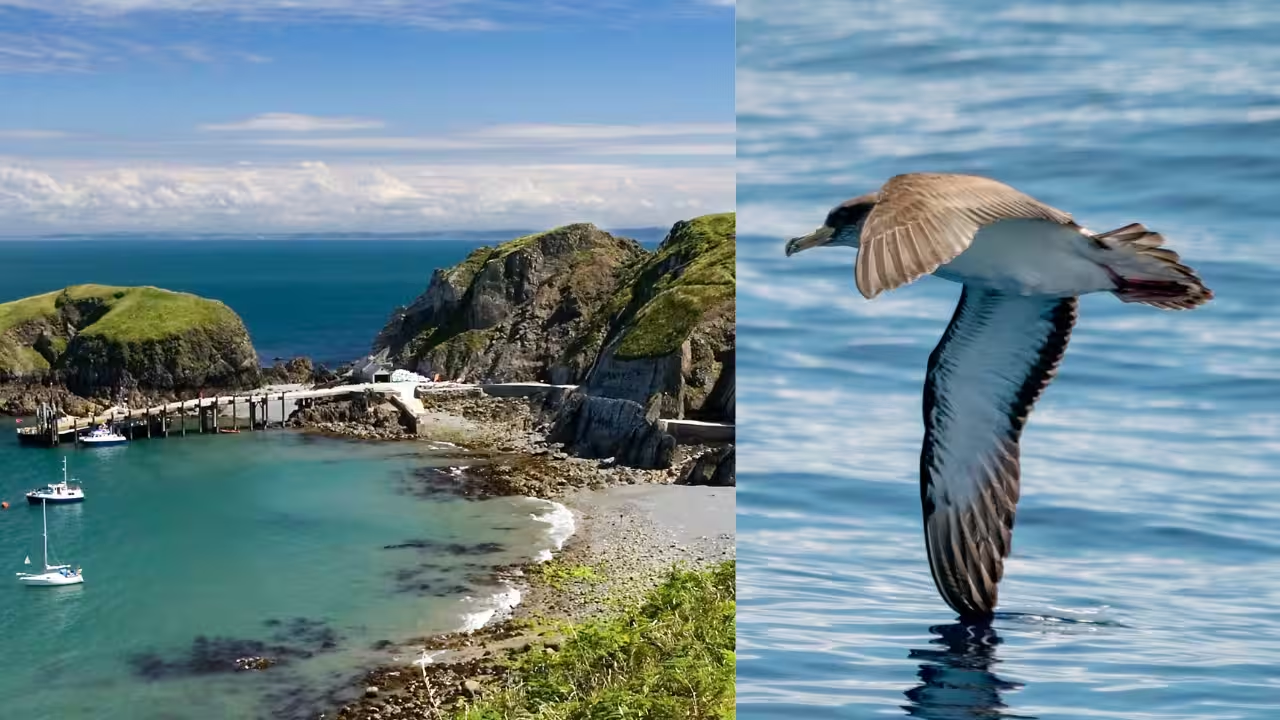
Conservation groups began a campaign to remove invasive rats from Lundy, a rocky island in the Bristol Channel in 2002. Ten years later, surveys found about 3,000 breeding pairs of Manx shearwaters, up from roughly 300 when the recovery project began. Guillemots were also using breeding sites on cliffs and areas that had previously been accessible to rats. The project was launched because rats were preying on seabird eggs and chicks. Lundy had suitable nesting habitat, but several bird populations had fallen sharply. The removal effort eventually made the island rat-free, and subsequent surveys recorded increases across several seabird species. The same basic problem is being tackled on islands thousands of miles away. In the Marshall Islands, a rat-eradication campaign completed in 2024 was followed by the return of thousands of native seedlings and a colony of about 2,000 sooty terns within a year.Why rats became a problem on LundyRecords cited by the Lundy Bird Observatory say both brown rats and black rats were present, and the animals were known to prey on seabirds, their eggs and young. That mattered particularly for burrow-nesting species, since Manx shearwaters spend much of their lives at sea but return to land to breed, and use underground burrows to raise their chicks. The seabird recovery project brought together Natural England, the RSPB, the National Trust and the Landmark Trust. Its objective was to remove the rats and give nesting seabirds a better chance of reproducing successfully.The eradication operation itself ran from November 2002 to March 2004, with work concentrated during two winters. The timing was chosen because natural food available to rats was lower during winter, increasing the likelihood that they would take the bait. Lundy was later confirmed rat-free, with the island formally declared free of rats in 2006. When RSPB survey teams returned in 2013, they found that the number of breeding Manx shearwater pairs had risen from 300 to 3,000. Puffins had increased from five birds to 80, while razorbills and shags had also recorded gains.Guillemots began using more of the cliffsLundy Bird Observatory records show that guillemots were breeding at the island after the rat eradication, with their numbers rising substantially in later surveys. In 2013, researchers recorded 4,114 individual guillemots at breeding colonies, compared with 3,302 in 2008. The observatory also noted that guillemots had begun appearing at new breeding sites in areas of broken ground close to the grassy slopes. Those locations had previously been relatively accessible to rats.The evidence does not mean every change in the guillemot population can be attributed to rat removal, since food availability and other environmental factors also affect seabird numbers. The observatory describes the role of rat removal as a likely factor rather than the sole explanation. By 2021, the breeding census recorded 6,198 guillemots at Lundy, the highest total in the regular survey record at that point. Breeding was confirmed again in subsequent monitoring. The Manx shearwater population also continued to rise well beyond the 2013 survey. A later RSPB-led census estimated 12,638 apparently occupied nesting sites in 2023, equivalent to more than 25,000 individual birds.A similar result appeared in the Marshall IslandsConservationists were dealing with the same type of problem on Bikar Atoll and Jemo Islet in the Republic of the Marshall Islands more than 7,000 miles from Lundy. In 2024, the Marshall Islands government and conservation partners carried out a campaign to remove invasive rats from the two islands. Island Conservation provided technical support as part of the wider Pacific Regional Invasive Species Management Support Service program.In 2025, conservationists reported a colony of about 2,000 sooty terns on Bikar Atoll, where no such colony had been recorded during the previous monitoring. The birds were feeding hundreds of chicks. Conservation teams counted thousands of native Pisonia grandis seedlings across 60 monitored 12-by-12-meter plots. In 2024, they had found none in those plots. Island Conservation's report also notes that Jemo had traditionally been used by people from nearby Likiep Atoll to gather natural resources. Rats had reduced those resources, including coconut crabs, so the restoration effort was intended to have practical benefits for nearby communities as well as ecological ones.The two projects differ in scale, geography and methods, but their monitoring has produced a similar sequence: remove an introduced predator, then watch what happens to species that had been struggling in its presence. In Lundy, the changes have continued for more than two decades. The island now supports tens of thousands of breeding seabirds, while the Marshall Islands project is only beginning its longer-term monitoring. For both sites, the next challenge is keeping rats from returning and tracking whether the early gains persist.Catch the latest World News and Live updates. Download the TOI app.
Topics in this story
Gathered from external sources. Rights to this text belong to whoever originally published it.