In December 2019, Australia unveiled a 4-meter underwater statue that glows with real-time ocean temperature data from a Great Barrier Reef monitoring station
Rest of World News: Explore Australia's Ocean Siren, a stunning 4-meter statue in Townsville that changes colors based on real-time ocean temperature data from the Great Barrier Reef, raising awareness of coral bleaching and marine sustainability.
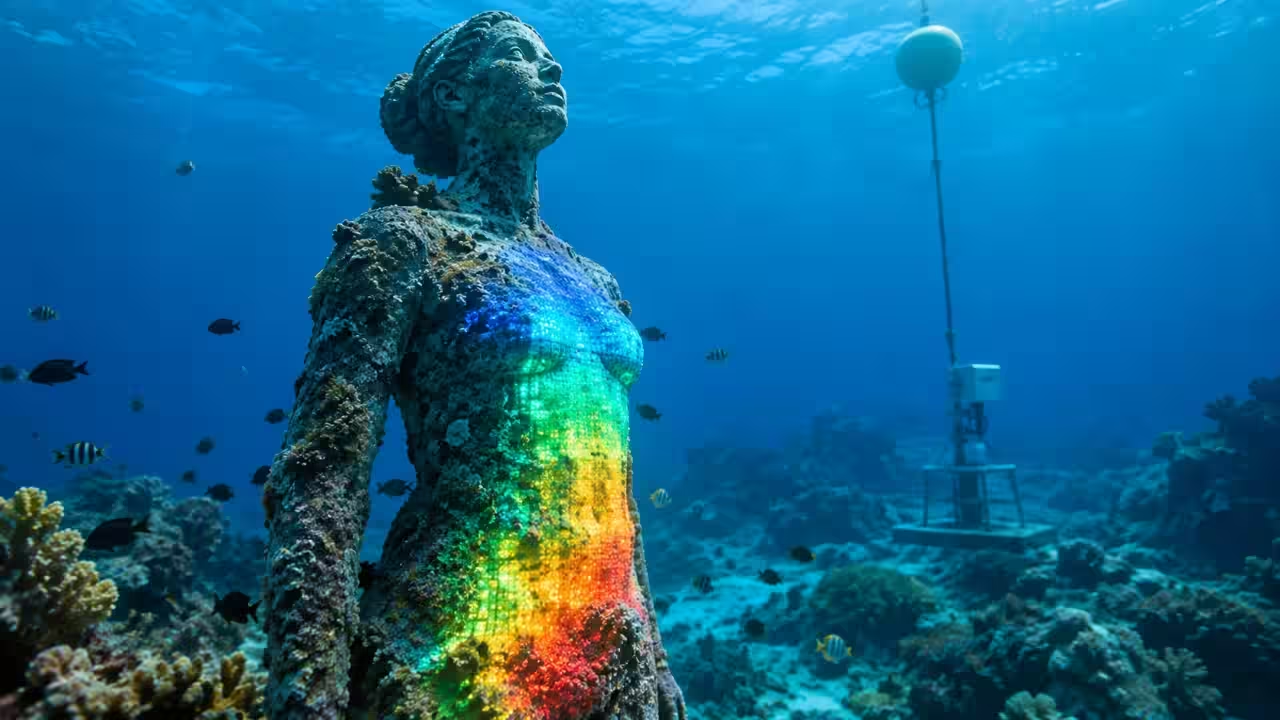
Ocean Siren, an illuminated sculpture standing four meters tall, can be found at the Strand jetty in Townsville, Queensland, though the name 'underwater' may mislead many into thinking that it is underwater. It rises out of shallow foreshore waters, visible above the surface at any time of day. What the sculpture does share with a genuine underwater installation is its purpose: its LED lights change color continuously, reflecting live sea temperature readings pulled from a Great Barrier Reef monitoring station. It was unveiled in December 2019, according to the Museum of Underwater Art’s official site.The sculpture was modeled on a local Wulgurukaba girlThe Ocean Siren sculpture was designed by British sculptor Jason deCaires Taylor in partnership with James Cook University and the Australian Institute of Marine Science (AIMS), according to the Museum of Underwater Art's website. It was created as a tribute to Takoda Johnson, an Indigenous custodian of the site and a 12-year-old girl from the Wulgurukaba community. Ocean Siren was the first installation created for the Museum of Underwater Art (MOUA), a non-profit foundation established by the Australian and Queensland governments.The statue draws its data from the Davies Reef weather stationThe Ocean Siren is made of stainless steel, which has been joined by welding, together with the help of translucent acrylic with 202 LEDs, which get power from the energy generated through the use of solar panels. The color of these lights varies from dark blue to dark red depending upon the temperature recorded through the weather station at Davies Reef, which is one of the numerous weather stations set up by AIMS since 1987 in the Great Barrier Reef region.Coral bleaching research shows why this kind of monitoring mattersThese color changes reflect temperature increases linked to recurrent mass bleaching events in the reef. The results of the paper published in Nature and titled ‘Global warming and recurrent mass bleaching of corals’ indicate that the degree and the geographical distribution of the bleaching event in 1998, 2002 and 2016 corresponded closely with the distribution of increased sea surface temperatures during those years. What made 2016 a unique case is the fact that local water quality and local fisheries had little impact on the bleaching distribution, while the previous bleaching events did not provide any protection against bleaching. The authors suggest that reducing warming is essential to limiting future bleaching events.Public art has a measurable role in raising awareness of ocean issuesTaylor himself has stated that his purpose for designing Ocean Siren was to bring attention to the changes occurring underwater, which are rarely experienced first-hand by anyone. This concept is supported by scientific research, since a systematic review published in Cambridge Prisms: Coastal Futures titled ‘The Role of Art in Coastal and Marine Sustainability’ showed that the viewers of the environmental art were more likely to increase their awareness of the problems in the coastal and marine areas, as well as show their engagement with the topic later on. In the review, the researchers screened 1,352 articles from Scopus and Web of Science and selected 79 papers out of those, only 19 of which were impact measurement articles. According to the review, visual art was represented by 40% of the dataset, while engagement was the most prevalent outcome sought out by the artists.Ocean Siren was not the only installation at the Museum of Underwater Art. Another, called Coral Greenhouse, followed in 2020. It is located at a depth of about 16 to 18 meters at John Brewer Reef, which is an approximate distance of two hours' boat ride from Townsville. Such information was taken from the Museum of Underwater Art webpage. Contrary to the previous sculpture, this installation was developed from pH-neutral concrete and stainless steel.The project reflects a broader shift toward data-driven environmental artAccording to the review of Cambridge Prisms, environmental art normally affects the perception of people indirectly through pictures and symbols rather than the actual data. In this case, this particular art is different from other environmental art since Ocean Siren does not have an indirect means of affecting people's perception, but rather it is the transformation of a real measurement from the device into a visible symbol for the people.Catch the latest World News and Live updates. Download the TOI app.
Topics in this story
Gathered from external sources. Rights to this text belong to whoever originally published it.