110 years since tanks entered the battlefield; how they have evolved
News News: A machine built to cross trenches became one of the defining weapons of modern ground warfare. For 110 years, tanks have evolved in response to changi.
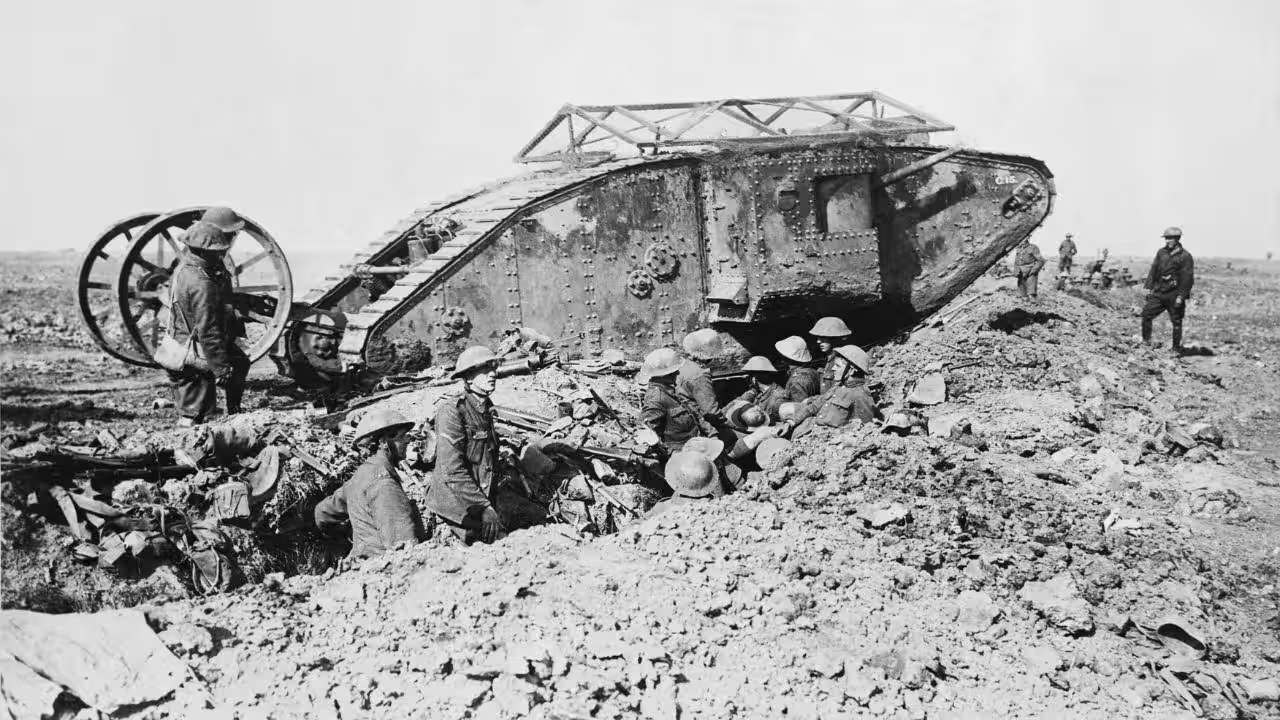
A machine built to cross trenches became one of the defining weapons of modern ground warfare. For 110 years, tanks have evolved in response to changing battlefields, from the first Mark I vehicles used by Britain in 1916 to today’s main battle tanks.Today, September 15, marks 110 years since tanks were first used in combat at the Battle of Flers-Courcelette during the First World War. Britain deployed Mark I tanks to support the infantry assault, marking the beginning of tank warfare.The first tank was developed to address a specific problem on the western front. To move across trenches, barbed wire and enemy fire while supporting advancing infantry. Britain’s Mark I was fitted with armour and weapons and was designed to cross trenches that conventional vehicles could not. Its development brought together mobility, protection and firepower in a single tracked vehicle.The experience at Flers-Courcelette led the British Army to continue developing tanks and their use on the battlefield. By the end of the war, the tank had moved beyond its original role as a vehicle for crossing trenches. The British Army was developing tactics around armoured formations, infantry cooperation and battlefield mobility.Tanks become a combined-arms weaponSecond World War changed the role of the tank from an infantry-support vehicle into the main manoeuvre element of armoured formations. Germany organised panzer divisions with tanks, motorised infantry, artillery, engineers, reconnaissance and signals, allowing these units to conduct operations as combined-arms formations.The United States created its armored force in 1940 and formed its first armoured divisions. During the war, US armoured divisions were used as combined-arms formations, with tanks serving as the main manoeuvre element while infantry, artillery and other units supported their operations.The war also changed tank design, as tanks faced better enemy armour and anti-tank weapons, armies increased gun power, armour protection, mobility and communications.Cold War: The golden age of the tankThe Cold War turned the tank into a major focus of military development. The United States, Soviet Union and their allies invested in tanks designed to fight large armoured formations in Europe, while improvements in guns, armour, engines, fire-control systems and communications changed their capabilities.The period also saw the emergence of the main battle tank (MBT) concept, combining the firepower of heavier tanks with the mobility of lighter designs. The Soviet T-54/55, T-62, T-64 and T-72 families and western tanks such as the M60 and later the M1 Abrams reflected this shift.By the end of the Cold War, the tank had become more than a tracked vehicle carrying a gun. Its effectiveness increasingly depended on the interaction of armour, weapons, sensors, fire-control systems, communications, mobility and crew training.At the same time, anti-tank weapons had also evolved, with guided missiles, improved warheads and other systems designed to penetrate or bypass tank protection.Tanks on today’s battlefieldThe tank remains part of modern ground warfare, but its use has changed as the battlefield has become more exposed to drones, precision fires and anti-tank weapons.The war in Ukraine has shown the difficulty of using large armoured formations in areas where drones can detect and target vehicles. A 2025 US Army study noted that the widespread use of drones has made it difficult to concentrate forces without exposing them to accurate fires.Drones have added a new threat to tanks because they can attack from directions where traditional tank armour is weaker, including the top, sides and rear.Royal United Services Institute (RUSI) assessment of the Ukraine war found that large-scale use of armour had declined, while tanks continued to be used at smaller unit levels for their firepower, protection and ability to support infantry operations.
Topics in this story
Gathered from external sources. Rights to this text belong to whoever originally published it.