In 2002, professor Ian Giddy and librarian Jenny Giddy bought a Costa Rican cattle farm to restore its cloud forest; 50,000 trees later, more than 300 bird species had been recorded
Rest of World News: Discover how Ian and Jenny Giddy transformed a degraded cattle farm in Costa Rica into a thriving nature reserve, home to over 305 bird species and all six wild cats of Costa Rica.
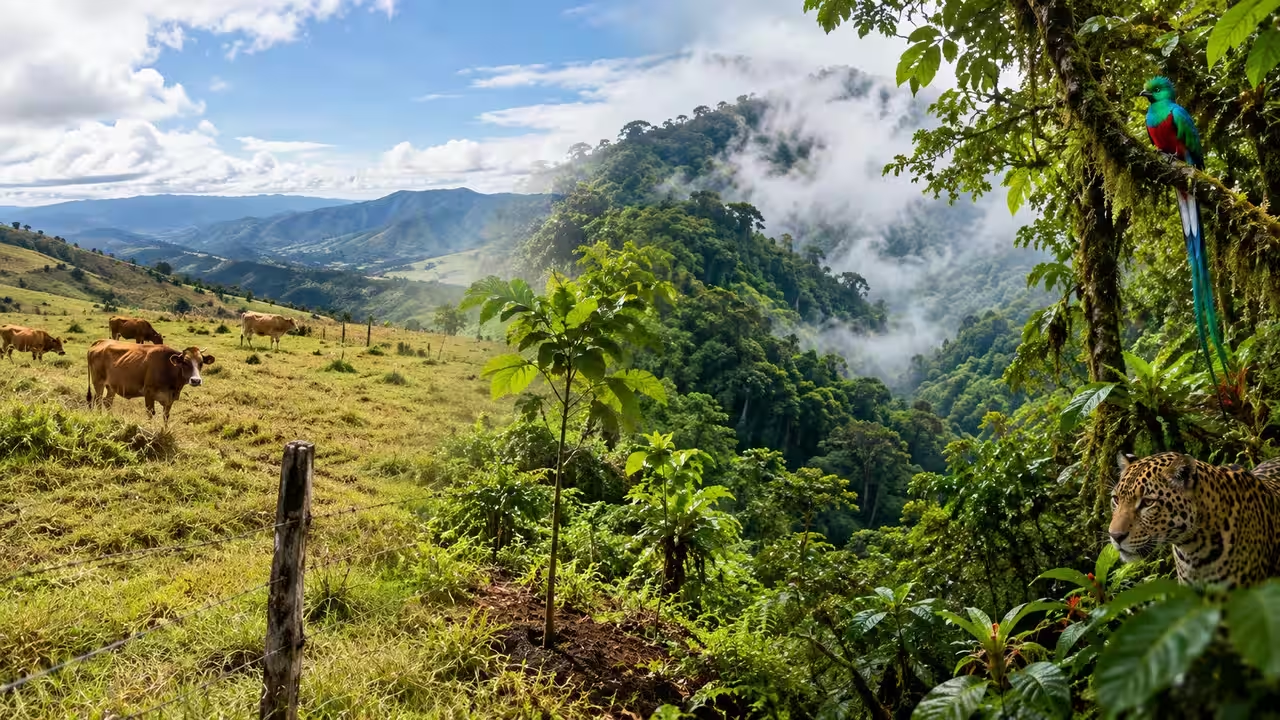
In December 2001, Ian Giddy and his wife Genevieve (Jenny) climbed Cerro Chirripó, Costa Rica’s highest peak, purely for the challenge of it, according to the Cloudbridge project history and a 2023 Mongabay profile of the reserve. During their descent from the mountain’s height of 3,821 meters above sea level, they stopped and looked out at the valley, through which there appeared a rich cloud forest that suddenly ended at an exposed cattle pasture. Ian asked Jenny if they could come back and purchase that land.They actually followed their instincts and the following year they did just that. This spontaneous decision has evolved into one of the best-studied grassroots reforestation projects in Central America: a nature reserve that now houses over 300 bird species and all six of Costa Rica's wild cat species, on land that was once grazed by cattle.A 2002 land purchase born from a mountain hikeIan Giddy was a finance professor who spent much of his career at New York University’s Stern School of Business, according to his faculty page; Jenny Giddy previously worked as a research librarian for Environment Canada, as described in Cloudbridge project materials. None of them had any experience of tropical ecology at the time they acquired the first piece of land, which they did in 2002, acquiring a farm of about 60 hectares dedicated to cattle ranching close to Chirripó National Park, and which is a fact noted by the Cloudbridge Nature Reserve, where the couple founded their reserve. They gave the name Cloudbridge to their new piece of land, and over the next two decades, they bought six more farms. Mongabay, the independent non-profit news organization covering environmental stories, reported in 2023 that the reserve had grown to about 283 hectares (700 acres), while the Cloudbridge Nature Reserve's own website lists the total at closer to 200 hectares, plus an adjoining tract of virgin forest.Early failures and a change in strategyHowever, things did not work out well during the first attempts made by the couple to reforest the site. After three years of trying, they ended up losing almost 90% of the planted trees owing to the poor adaptation of the purchased seedlings from the commercial nursery to the high-altitude conditions at the site, as attested to by Tom Gode, president of the board of directors of the U.S.-based Cloud Forest Conservation Alliance (CFCA), the nonprofit that operates Cloudbridge Nature Reserve. Rather than giving up, the team tried a completely different approach to the task. Instead of buying the nursery stock, they began harvesting seeds from the adjacent old-growth forest and producing their own seedlings, which increased the survival rates of the planted trees to about 50%. Further improvements through the use of cardboard as mulch and mycorrhizal fungi in the soil saw the survival rates go up to about 90%.The team has also come up with an innovative way that is called island planting. Under this method, a small number of sturdy pioneer trees are planted in a completely barren field. Birds are attracted to the trees, and while perching on them, deposit seeds from other parts of the forest onto the ground below, eventually seeding a much larger area than the original planting covered. According to the Mongabay report mentioned above, the project has seen the planting of over 50,000 trees in more than two decades, which might not have been possible if bought from nurseries due to their poor survival rate.Two decades of returning wildlifeThe ecological payoff has been substantial. Jenny Giddy's colleagues recall that in the reserve's early years, sightings of birds were rare enough that staff could count the local species on one hand. As of the 2023 reporting period, staff at Cloudbridge had cataloged 305 bird species within the reserve, a figure Mongabay described as roughly a sixtyfold increase in under twenty years, and one that had already surpassed 270 species at an earlier point in the count. Among the returning species is the resplendent quetzal, a brightly colored cloud forest bird listed as near threatened by the International Union for Conservation of Nature.Mammal recovery has followed a similar trajectory. The reserve now hosts confirmed sightings of all six wild cat species found in Costa Rica: the oncilla, margay, jaguarundi, ocelot, puma, and jaguar, along with a resident female puma that has successfully raised young there, a sign researchers point to as evidence the forest can now support an apex predator. Camera traps have even recorded transient visits from the jaguar and from Baird's tapir, the largest wild land mammal in Central and South America, though researchers note the forest likely needs more time to mature before either species can be considered a true resident.A project that outlived its founderGiddy passed away in 2009 when he was 61, spending his last days balancing teaching finance in New York and paying visits to the reserve he had established along with Jenny. Jenny continued the project after his death, delivering speeches about their work in the United States and Canada, according to the memorial compiled for Ian Giddy by Cloudbridge staff. In 2019, she transferred ownership of the reserve to the Salish Coast Land and Marine Conservation Association, a U.S.-based nonprofit, while the Cloud Forest Conservation Alliance continued to manage day-to-day operations at the site. These days, Cloudbridge focuses on conservation, long-term research, and education rather than tree planting on a large scale, observing how the forest that did not exist two decades ago is growing year after year and developing into something similar to what Giddys saw above Chirripó.Catch the latest World News and Live updates. Download the TOI app.
Topics in this story
Gathered from external sources. Rights to this text belong to whoever originally published it.