China's panda diplomacy: How Beijing uses exclusive animal to reinforce soft power
Chinese President Xi Jinping, currently on his state visit in US, announced at the White House that China will send two giant pandas to the United States,
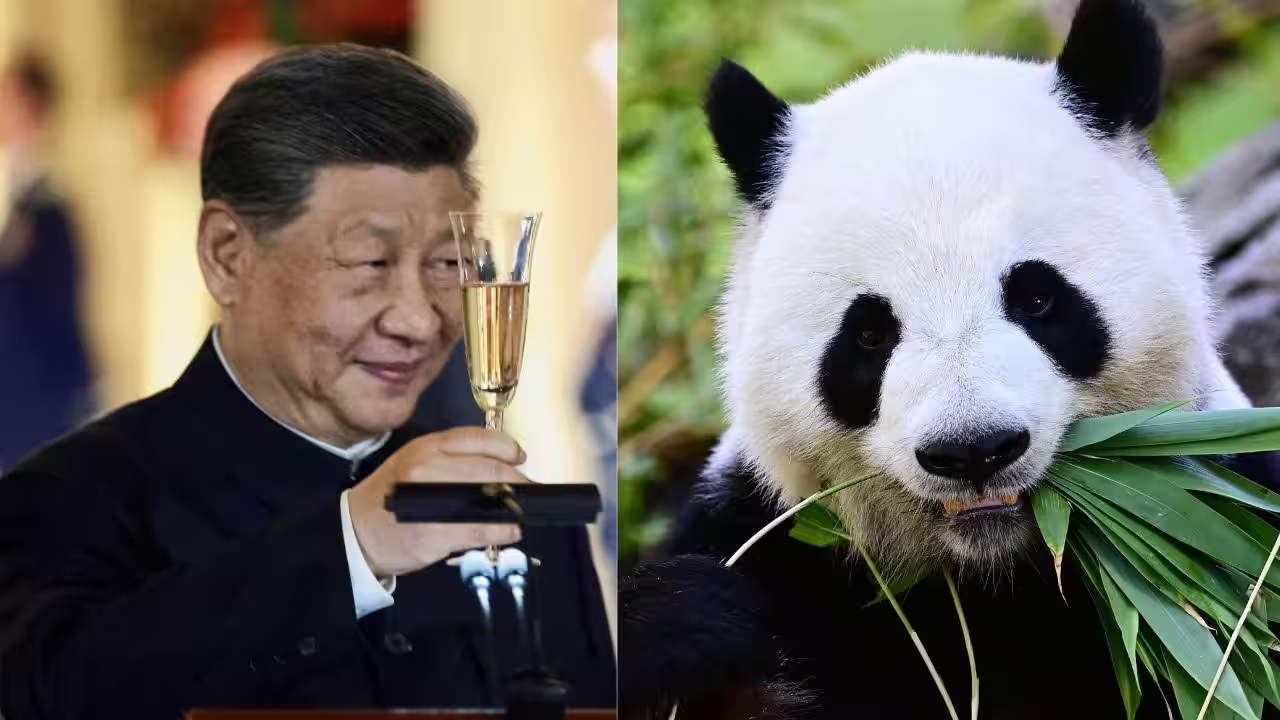
Chinese President Xi Jinping, currently on his state visit in US, announced at the White House that China will send two giant pandas to the United States, telling his counterpart Donald Trump: "Here, I have a piece of good news. In a few days, two pandas, Ping Ping and Fu Shuang, will come to their new home in Zoo Atlanta and meet with the American people."Xi added that the giant panda has "always been an envoy of friendship between the Chinese and Americans", a language that echoes decades of Chinese messaging around the animals.The names carry their own symbolism: according to Chinese media reports, Fu Shuang translates to "double blessing," while Ping Ping means "peace, peace."That the announcement came directly from Xi, in front of cameras at the White House, rather than through a foreign ministry statement, reflecting how much weight Beijing continues to place on the gesture.The pair's arrival, expected within days, will make Zoo Atlanta the only US zoo housing giant pandas. A milestone in a program that has for more than fifty years doubled as one of Beijing's most effective and most closely watched instruments of soft power.A Cold War icon rebornThe practice traces back to 1972, when Beijing gifted two giant pandas to the United States following President Richard Nixon's historic visit, a gesture that has long served to enhance the country's soft power, with the animals lent to zoos around the world as goodwill ambassadors, and each new transfer often read as a signal of Beijing's approval of stabilised ties with Washington.Since the 1990s, the program evolved from outright gifts into structured, fee-based loans tied explicitly to conservation research. This shift gave Beijing continued leverage while framing the arrangement as scientific cooperation rather than pure political theater.Pandas as a political barometerThe comings and goings of China's pandas have increasingly tracked the temperature of its bilateral relationships. A February 2024 agreement between the San Diego Zoo and China's Wildlife Conservation Association, paving the way for pandas to return to the US, was widely read as more than a zoo transaction as it signaled a warming in US-China relations and an attempt by Beijing to shore up its struggling economy.That reading was reinforced by contrast after China's 2023 withdrawal of its pandas from Washington's Smithsonian Zoo had symbolized just how strained the relationship had become.Atlanta's zoo holds particular significance in that story. It became the only US zoo with pandas after Washington's three bears were flown back to Chengdu aboard a cargo jet under police escort, departing at a moment of strained US-China relations. Ping Ping and Fu Shuang's arrival there, under a 10-year agreement, effectively reopens a channel that had been narrowing for years — and doing so via a leader-to-leader announcement gives it added diplomatic heft.The soft-power calculationPandas are seen not merely as cute animals but as embodiments of a kind of diplomatic tool that China sends abroad, using the gesture to enhance its global image, ease difficult negotiations, and signal friendship or alliance. However, Beijing loans these as gifts to channel significant revenue back into conservation of the panda's native habitat.As of mid-2026, that strategy remains firmly in place. Panda diplomacy continues to function as a cornerstone of China's international soft-power strategy, balancing conservation with geopolitical signaling, even as loan agreements shift toward younger, domestically bred pandas and new breeding partnerships are negotiated with Europe and Southeast Asia.A double-edged swordWhile panda diplomacy remains an effective soft-power tool for Beijing, it also exposes China to public backlash whenever the animals become entangled in political disputes or welfare controversies.That tension surfaced starkly in Japan when the twin pandas Xiao Xiao and Lei Lei were returned to China on January 27. After that Japan was left without a single giant panda for the first time since Tokyo and Beijing normalised relations in 1972.Even so, the animals' pull was undeniable in their final days abroad as roughly 178,000 visitors flocked to Tokyo's Ueno Zoo in the month after the pandas' return was announced, forcing the zoo to cap daily viewing to 4,800 people with one-minute visits.Beijing's careful, tightly managed generosity with a handful of bears, on strict loan terms, deployed at politically opportune moments ensures pandas remain both a diplomatic asset and, occasionally, a domestic and international liability, as debates over animal welfare and nationalist sentiment continue to shadow the program.You use AI every day. Now get your AI Quotient. Take the AIQ test.
Topics in this story
Gathered from external sources. Rights to this text belong to whoever originally published it.