Vermont taxes 2.4 million acres of private forest on what it grows rather than what a developer would pay; owners who break the deal repay a decade of the difference
US News: Explore Vermont's Current Use tax program, which taxes forest land by its productivity rather than market value, offering benefits for sustainable land management while imposing penalties for early withdrawal. Understand how this initiative preserves over 2 million acres of forest and farmland in the state.
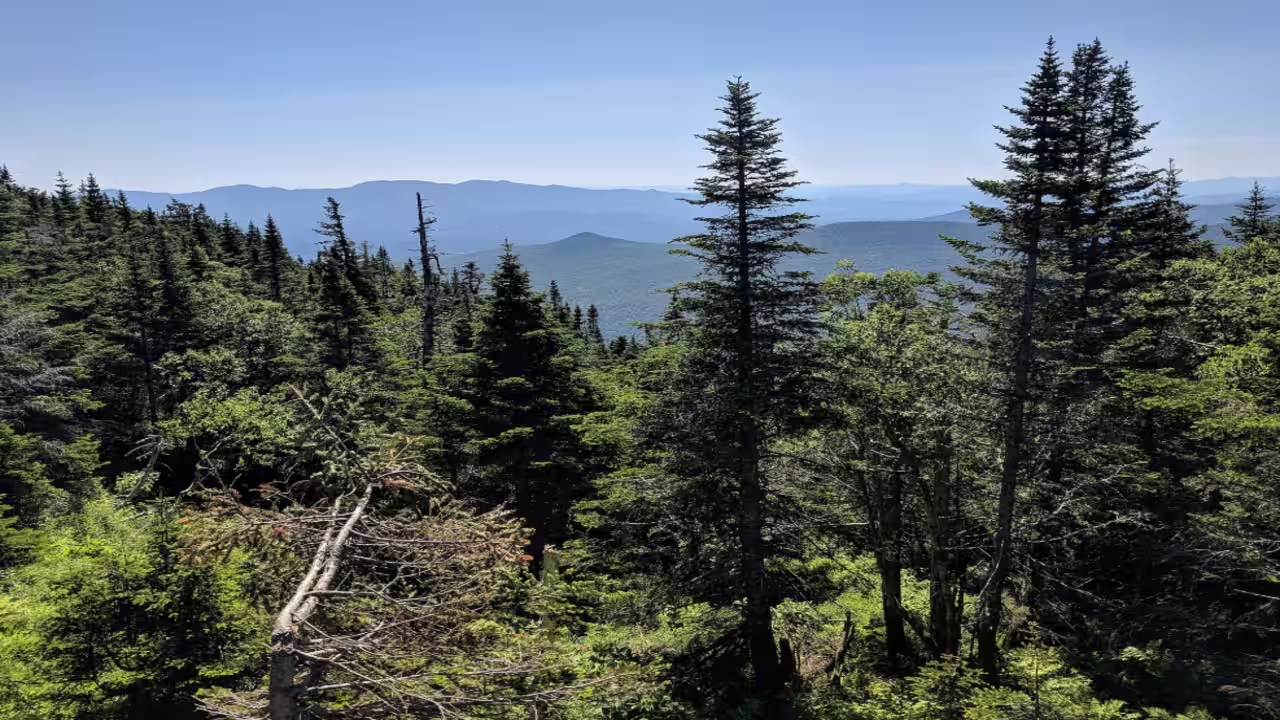
Most property tax bills center on one question: what is the fair market value of this land? Vermont, however, asks a completely different question with regard to its forests and farmland. Instead of taxing lands at their value if developed, the state levies taxes on forest lands according to their productivity as working timberlands, a policy that now applies to more than half of Vermont’s privately owned forestland, according to the Vermont Department of Forests, Parks and Recreation. This trade-off comes with a rather high price for anyone who decides to break the deal early. Those who sign on to the program will benefit from considerably reduced property tax bills, while the State puts a lien on the property from the moment of acceptance into the program, which remains active until the land use change tax is paid.The 1978 law behind the programThe system was set up by the Vermont Legislature in 1978 under the name Use Value Appraisal, but today it is more commonly known as Current Use, according to the Vermont Department of Taxes. The administration of the scheme is conducted by the Division of Property Valuation and Review at the Vermont Department of Taxes with the cooperation of the Department of Forests, Parks and Recreation and county foresters in the forestry aspects of the enrollment. The aim of such a scheme was simple: to maintain farmland and forestland in use, to slow down their transition to development, and to provide a more equitable tax assessment for land that remained untouched due to the rise in real estate prices. Benefits of the program were obtained by landowners already in 1980 and the number of enrollments has increased continuously ever since. Enrollment in Current Use just for forestry totaled nearly 2 million acres across more than 16,000 parcels as of January 2022, accounting for more than one‑half of all privately owned forestland in Vermont, as mentioned in the Vermont Department of Forests, Parks and Recreation. This magnitude makes Current Use one of the largest such land management tax programs in the country in relation to the size of the state.Taxing production value instead of market valueIn regular Vermont taxation, land is taxed according to its fair market value, which is largely dependent on the real estate transactions in the locality and on what the purchaser may have paid to subdivide and develop it for commercial or residential uses. The Current Use system does away with the valuation of land at fair market value and establishes per-acre use values that supposedly equate to the actual value of the land as being productive forestland or farmland and not what developers will pay for the land. These use values are way lower than fair market values, thus resulting in tax breaks for the landowners.For a piece of land to qualify as forestland under Current Use, it must comprise at least 25 contiguous acres, excluding any house site and be covered by a state‑approved forest management plan that provides for continued forest management for 10 years, under 32 V.S.A. § 3755. This forest management plan must be done by a consulting forester duly licensed and approved by the county forester and it specifies how the forestland shall be continuously managed as such. The owner’s house and a minimum of two acres around the house are automatically excluded from the enrolled land and thus continue to be taxed at full market value, meaning enrollment is not an all‑or‑nothing commitment for the rest of a parcel, according to the Vermont Department of Taxes’ Current Use appraisal standards and the Department of Forests, Parks and Recreation’s forestland eligibility rules.The penalty for breaking the agreementParticipation in Current Use is not compulsory, yet it goes hand in hand with a lien registered in the municipal land records as soon as the parcel becomes a part of the program. This lien will remain there until either the land use change tax is paid, or the land is freed from it in some other manner. According to the relevant statute, 32 V.S.A. Section 3757, development and withdrawal of the enrolled land results in such a tax being levied, which is a percent of the whole fair market value of the land at the time it is withdrawn according to the text maintained on Vermont's official statutes site.That number was contingent upon the duration of time a piece of property had been in the Current Use Program. As per the 2009 Vermont Act and the Lincoln Institute summary of state source documents, the old 32 V.S.A. § 3757 allowed owners who had withdrawn or improved their lands before attaining ten consecutive years in Current Use an exemption of land use change tax at 20 percent of the fair market value of the changed lands, while those with more than ten consecutive years of current use would only pay 10 percent. This essentially meant that by staying in the Current Use Program after ten years, landowners would be taxed at half the price they would be if they chose to remove their land from the Current Use Program prior to ten years. The recent changes in the legislation have altered this structure to impose a flat land use change tax at a rate of 10 percent for all enrollments, irrespective of the period of land enrollment, as indicated by the current wording of 32 V.S.A. § 3757, amended June 19, 2023.This tax is limited to the area actually developed or withdrawn, not the entirety of the property ownership if just a fraction of it has been changed. If a landowner makes a two-acre building lot out of a larger enrolled piece of land, then the tax will only be applied to the fair market value of those two acres of land assessed independently as a lot. Also mentioned in this statute are exclusions to the law, which include land acquired via eminent domain, land transferred to the U.S. Forest Service under certain conditions, and a forced sale due to the farmer's death, illness, or hardship.A tradeoff built to last decadesThe math of Current Use is supposed to make patience pay off. The individual who signs up under Current Use, maintains their land productively through timber production and/or agriculture, and doesn’t bring about any development ends up paying a mere portion of the price that would otherwise be charged on the open market; in the case of large forested properties, the difference runs into the thousands of dollars annually, as demonstrated by Vermont real estate studies of hunting and acreage lands. The compromise is that the state wants a true commitment, for decades, backed up by a lien against the property and rapidly rising tax bills if the landowner should change their mind. It is Vermont's forests, protected against development pressures in one-third of the state's land area, that have come about through this deal.Catch the latest World News and Live updates. Download the TOI app.
Topics in this story
Gathered from external sources. Rights to this text belong to whoever originally published it.