A Canadian company and its predecessors used a neighbour's land as a driveway for over 30 years, why an Ontario court ordered his fence removed
Imagine buying a home, using the driveway outside it every day, and then finding a fence installed down the middle of that driveway.
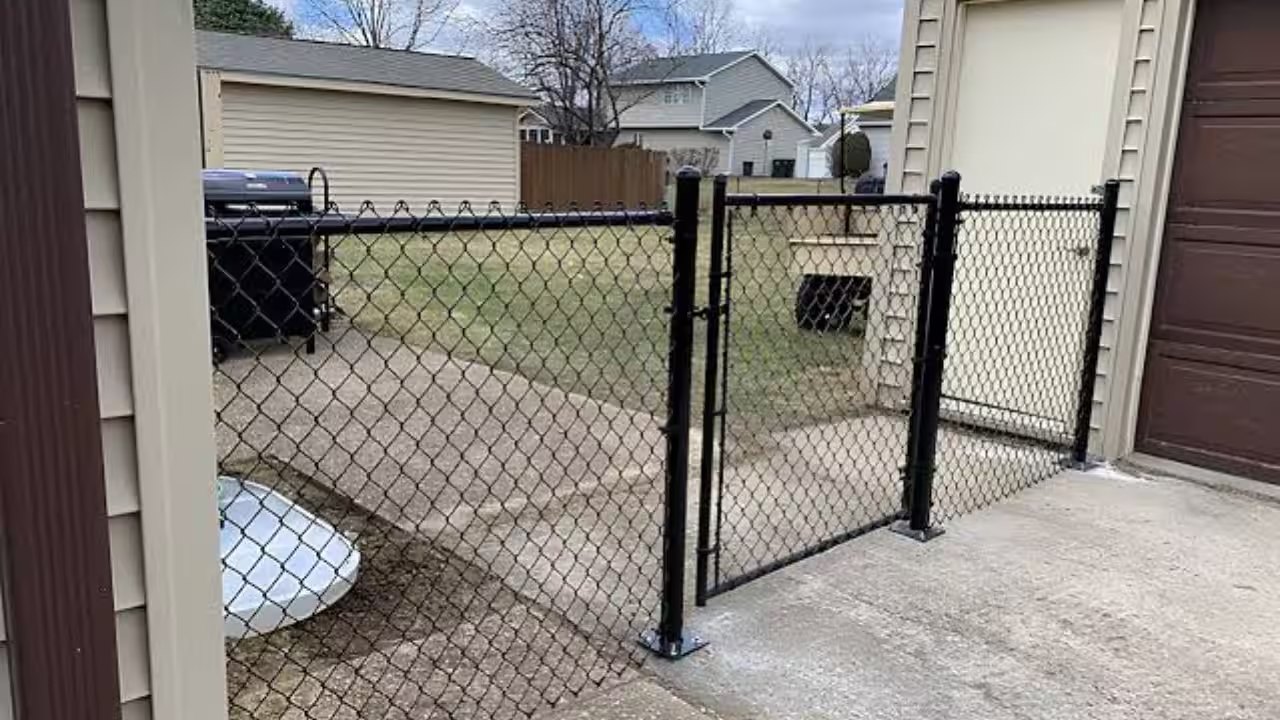
Imagine buying a home, using the driveway outside it every day, and then finding a fence installed down the middle of that driveway. That is what happened in Ontario in December 2024, when a landowner built a fence along a strip of land that a neighbouring company and its predecessors had used for more than thirty years. The Ontario Superior Court of Justice has now ruled on the dispute, ordering the fence removed. The decision offers a fascinating look at how long-standing use, silence, and fairness collide with property rights. Read on to learn what the court decided and why.Fence across a driveway, how a registered easement and a disputed strip of land led to an Ontario courtAccording to the written reasons of Justice Flaherty, as reproduced on MiniCounsel, the dispute pitted a corporate property owner, 9409394 Canada Incorporated, against its neighbour, Ghislain Lascelles. Lascelles has owned his land since 1981, and the court notes that it was vacant throughout the period at issue. The company bought the neighbouring property on 17 November 2015. That property enjoys a registered easement, a legal right to cross part of Lascelles's land, across a corridor of about 15 feet. The company uses roughly 10 feet of it as a driveway. However, the driveway is about 18 feet wide overall, so around 8 feet of it sits on an adjacent strip outside the easement. Until December 2024, nothing visibly separated the two sections, and the whole surface worked as one driveway.Over thirty years of driveway use, previous owners installed interlocking brick across the full widthBrenda Giroux affirmed that she and her husband owned the home from 1993 to 2003 and found a single driveway already in place. About a year later they paid for interlocking brick across the entire surface, and she says she never sought the neighbour's permission to use the full driveway. Robert Dawson, who owned the property until 2006, supplied a photograph showing the same unbroken brick surface. Marc-André Labelle, who lived there from 2006 to 2015, reportedly told an assistant to the company's lawyer that the full driveway was used, though the judge noted that evidence was hearsay. The company repaired the brick in 2016 without notifying Lascelles. Then, between 20 and 24 December 2024, weeks after listing the property for sale, Lascelles installed a fence down the centre of the driveway, damaging some brick.Why adverse possession failed, using vacant land as a driveway did not block the owner's intended useThe company first argued adverse possession, a doctrine under which long, open use of someone else's land can extinguish the owner's title after ten years. Justice Flaherty explained that because the land entered Ontario's Land Titles system on 22 August 2010, the relevant period ran from 22 August 2000 to 22 August 2010. The claimant must prove it possessed the land exclusively, intended to exclude the owner, and effectively excluded him. Because the judge could not find a mistaken belief about ownership on either side, the company had to show its use was inconsistent with Lascelles's intended use, which was keeping the land vacant. Following binding Court of Appeal decisions, the judge held that driving on the strip did not interfere with leaving land unused. The court therefore dismissed the adverse possession claim.Why proprietary estoppel succeeded, decades of silence, reliance on the driveway, and a narrowing fenceThe company succeeded on its second argument, proprietary estoppel, an equitable doctrine that can stop an owner from enforcing strict legal rights when doing so would be unfair. The company needed to show encouragement from the owner, detrimental reliance, and unconscionable conduct. Justice Flaherty found that for more than 30 years Lascelles stayed silent while knowing the strip was used, which reasonably led the company to believe he would not insist on his rights. The company relied on that by buying a home with an 18-foot driveway and maintaining and improving the surface. The judge acknowledged that courts do not lightly interfere with property rights, yet found the fence, erected without notice or consultation, unconscionable: it narrowed access to about eight feet, making entry difficult and hazardous for ambulances and delivery trucks.What the court ordered, fence removal, brick repairs by 15 April 2026, and lessons for property ownersJustice Flaherty's disposition is practical. Lascelles must remove the fence immediately and, by 15 April 2026, repair the interlocking brick damaged during installation. The company's claim for general damages was dismissed because there was no evidence of non-monetary losses. The judge left one question open: whether the disputed land should transfer to the company or become the subject of an easement, a legal right to use another's land. The parties may return to court if they cannot agree and, if they cannot agree on costs, may file brief written submissions. For homeowners and businesses alike, the case is a reminder that decades of silence can carry legal consequences, and that dividing a long-used driveway without notice or consultation can prove costly.You use AI every day. Now get your AI Quotient. Take the AIQ test.
Topics in this story
Gathered from external sources. Rights to this text belong to whoever originally published it.