The race to stop England running out of water
Who is to blame for the summer drought, and can England future-proof its water supplies?
One evening in early August, farmer Daniel Sizer's phone buzzed with a message.
It was from his local water board and it read: "River levels are low but have recovered enough to allow one night of irrigation tonight."
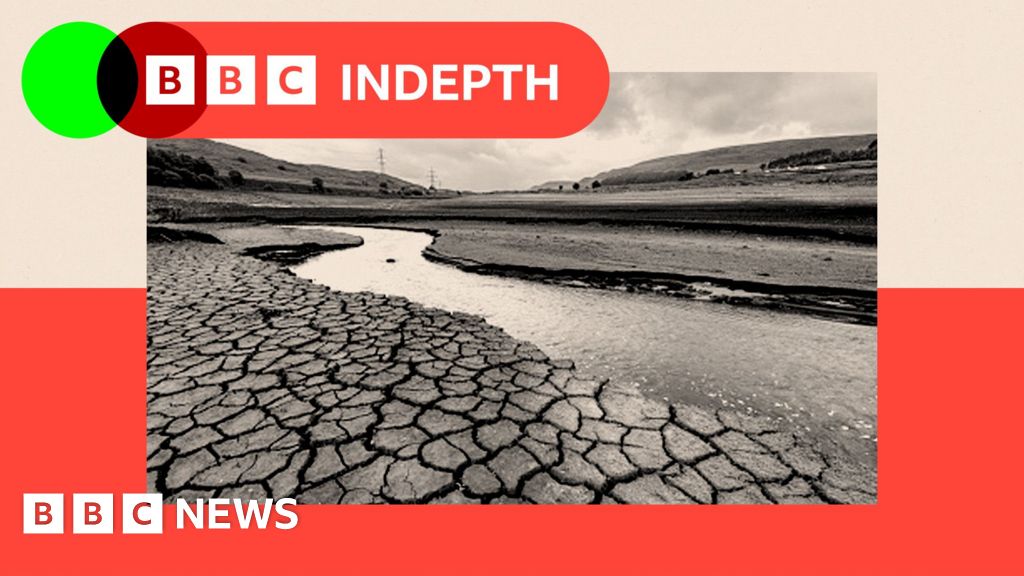
Like much of the lower half of England, Daniel's fourth-generation farm had seen barely any rain in nearly three months.
He shows us what is left of the peas and wheat crop at his 300-hectare site in Suffolk.
"There's no water in the river so half my crop is completely and utterly ruined."
With river levels falling so low that taking any more water out of them risked endangering wildlife, in July the Environment Agency (EA) temporarily stopped Daniel and thousands of other farmers from watering their crops from the river.
England has long been used to hosepipe bans over the summer.
But what Daniel has experienced points to something newer and more worrying. The kind of increasingly frequent heatwaves and greatly reduced rainfall that we have seen over successive summers, plus a projected increase in demand for water, have raised the prospect that England could at some point run out of water.
The result could be that by 2055 England will face a shortfall of five billion litres in public water supply a day, almost enough to fill Wembley Stadium four and a half times daily. A mixture of low rainfall, high temperatures and demand put pressure on water supply in England more so than elsewhere in the UK.
It is all a far cry from when, in 1818, John Keats wrote: "It is impossible to live in a country which is continually under hatches… Rain! Rain! Rain!"
But what is really to blame for England finding its water supply so under threat? And are there ways of securing its future?
Back in the 1980s, people in England and Denmark were using water at a similar rate. But no longer.
Residents in Denmark now consume 97 litres of water per person per day, according to Danva, the country's water and wastewater industry body. The daily consumption per person in England is 136.5 litres.
"We've actually doubled the amount of water we use per person, on average, in the last 50, 60 years," points out Nicci Russell, who runs Waterwise, a water efficiency campaign organisation.
She points to changing habits over generations - from a family having a shared bath once a week to having multiple showers a week, sometimes a day.
Households are responsible for nearly 60% of water use in England and Wales. If we had domestic water consumption patterns more like Denmark, Russell says, more than half the 2055 shortfall would be wiped out.
So how could water use in England come down to the levels seen in Denmark?
Russell says, even with projected population growth, if everyone in England knocked a minute off their shower time, for example, it would save nearly one billion litres of water a day by 2050.
But water companies have been running campaigns urging us to use less water, seemingly with limited success.
Will Willoughby, director of water supply at Wessex Water, acknowledges that the negative public perception of the water industry has limited the impact of the message, and the government may be better placed to deliver it.
"I think that would absolutely go a long way to… undoing some of the disdain towards the water companies and get people on board to help look after our water resources."
What really separates England and Denmark is price. As well as water meters being mandatory in Denmark, they also pay far more for their water than we do here.
Despite climbing water bills across the UK - and with them outrage aimed at water companies who stand accused of paying dividends to shareholders when they should have been investing in infrastructure - there is an argument to be made that consumers are actually not paying enough.
In Denmark, the average cost of water and wastewater is £9.45 per cubic metre, here it is significantly lower. Thames Water - one of the cheapest - charges £4.21 and Southern the most expensive at £7.06.
Daniel Johns, managing director of Water Resources East, an organisation working with farmers, water companies and local authorities, says water in England is "too cheap".
"People assume that it will always be readily available. And we need to wean ourselves off that kind of idea that water will always be there."
As it happens, price increases in Denmark were originally implemented for improved sewage treatment, the same reason people in England now face rising bills.
The behaviour change followed naturally as people became more careful with using the newly expensive utility, and it became embedded in the culture. School children have outings to waterworks to understand how precious the resource is, and households have embraced water-saving devices for shower heads and toilet cisterns.
This summer commentators have been discussing surge charging in England - higher rates for those using more water - but as prices are fixed in advance this is not possible under industry regulations.
Feargal Sharkey, former frontman of punk band The Undertones turned frontman of the water quality movement, summed up the feeling of campaigners towards efforts to raise prices and cut households consumption on Radio 4's Today programme earlier this month.
"All of this is nothing more than window dressing on the part of companies why they continue to abuse and exploit their customers."
Overconsumption of water is not just an issue for households. Businesses are estimated to use nearly a third of the water supply in England and Wales, with just under half of that coming from only 1% of companies.
And businesses have actually been receiving discounted charges from water companies that offer reduced rates the more water they use. Five of the nine water companies are now phasing this out over concerns it "might be sending the wrong signal on water efficiency", the industry regulator Ofwat has said.
And there is another question - are we doing enough to make sure businesses are using the right kind of water?
Potable water is water that is free of harmful bacteria and chemicals and is considered safe to drink and cook with. Non-potable water has not been treated to the same levels and is not safe for drinking but can be used in industrial settings and for irrigation.
"At the moment, we're using world-class drinking water to cool data centres, to irrigate our golf courses," Daniel Johns says.
He wants the regulator to look at removing access to drinking water for some businesses.
"We should simply ban data centres from using potable water supplies. We should require them to use closed-loop systems".
Despite recent well-publicised problems around burst water mains, water leakage has actually been cut by 43% since 1989 according to Ofwat, the water regulatory body for England and Wales.
However, more than 45 litres per person per day is still being lost from England's water network, nearly a fifth of all the water in the system.
And this is why following Denmark's lead by making meters mandatory could have an effect that goes beyond tying consumers' actual water usage to their bills.
When metered customers get higher than expected bills, that can be the clue water companies need to identify a leak and fix it. Without the meter, leaks are far harder to detect within pipes on private property.
Lightsonic is a company working with Affinity Water to speed up identification of leaks, and their secret weapon is fibre optic cables.
Internet cables often lie close to our water supply, and when water leaks it creates vibrations which interact with the cables and change the characteristics of the light travelling down the fibre optic, explains James Ramsay, chief technology officer at Lightsonic.
"We are just three months into our deployment and the technology has already helped locate over 100 leaks, which has saved the equivalent of two million litres of water every day."
Applied across the whole water network of England and Wales he boldly estimates it could reduce leakage "by as much as a billion litres a day".
England is already experiencing wetter winters, something climate models predict will continue. This prompts the question of whether we could just store more of this excess water for when we need it?
To do this, new reservoirs would be needed. But England has built no major new major reservoirs for more than 30 years.
The reason for the lack of new storage sites has been hotly debated between water companies and campaigners, the latter saying there has been a lack of investment from the privatised sector, the former arguing they were not given permission to spend the money by the regulators because of the impact on water bills.
The government's landmark independent Cunliffe review into the water sector in 2025 accepted that both arguments were true.
Now 10 reservoirs are planned in England by 2050. But even with financial and political backing, building new reservoirs is not straightforward.
"Building enough reservoirs to hold all that water requires good places, which means places where the land is sloping, where we can find a valley," explains Dr Ross Woods, associate professor of water and environmental engineering at the University of Bristol.
"I don't think that's realistic countrywide."
One of the sites found to be suitable for a mega-reservoir serving 15 million people is near Abingdon.
This picturesque Oxfordshire town on the banks of the River Thames, was until recently, perhaps most famed for its bun-throwing traditions, but it is now at the centre of a national debate.
Public opinion on the reservoir has been split - some have objected to using the site for water, fearing high environmental costs from the destruction of ancient woodlands.
The government has now designated it and one other reservoir as Nationally Significant Infrastructure Projects, bypassing some local decision-making processes.
But these designations do not overcome the environmental hurdles.
Reservoirs, as water bodies, have to achieve "good" status for water quality under environmental law - meaning it must be free from pollution such as from agricultural runoff and invasive species - which just 14% of bodies currently in England have achieved. The Environment Agency told the Cunliffe Review that "the treatment costs of meeting 'good' may render the new reservoirs infeasible".
Even if these challenges are navigated, most of the reservoirs are not set for completion for at least a decade and once all are built they will only make up 7% of that 2055 shortfall.
We do have access to natural reservoirs - underground stores of water called aquifers.
This groundwater provides about one third of the public water supplies in England, and for some regions as much as 100%. They are vital sources of water supply to rivers, which are the first to struggle in summer droughts, and could be another solution to water shortages.
These underground stores can be recharged artificially during wet periods, providing a constant supply through drier summers, by encouraging excess rainfall to soak into soils rather than enter drainage networks as happens in heavily built-up urban areas.
These sustainable drainage systems, which include measures such as expanding grass areas and soakaways, are encouraged in new developments. However, this is predominantly where there is a risk of flooding not as a drought-prevention measure - and there is no legal requirement to have them.
When water supplies are no longer plentiful, tough choices have to be made.
As well as Daniel Sizer's Suffolk farm, the EA has now suspended or limited 1,327 farm licences for abstraction - taking water from rivers.
Paul Tomkins, the Deputy President of the National Farmers' Union of England and Wales, says the problem is there are legal frameworks in place to ensure there is enough water for nature and to protect the supply for households, but none for growing food.
"Farming is the poor brother of the triplets," says Paul.
How a new era of heatwaves could shake up the school calendar
How the UK's extreme heat is shifting the conversation about air-con
After record heat, could the Atlantic make Britain's weather even more extreme?
With no rain and no river water, farms like Daniel's are facing insurmountable water shortages now - not in 2055.
"We can't afford to have another year like that. We're pretty much on the edge of of bankruptcy."
Woods says this will only be solved if society can agree how water should be used. "The limits that we're up against at the moment are environmental limits. It's not just how much water, it's how we use it as a society, and what values we put on the different uses of water. This is going to be one of the big challenges for water in the next 20 or 30 years".
BBC InDepth is the home on the website and app for the best analysis, with fresh perspectives that challenge assumptions and deep reporting on the biggest issues of the day. Emma Barnett and John Simpson bring their pick of the most thought-provoking deep reads and analysis, every Saturday.
Topics in this story
Gathered from external sources. Rights to this text belong to whoever originally published it.