Lockheed Martin refines design of stealth unmanned fighter Vectis, as India readies its CATS Warrior
International News: As the realm of aerial combat moves towards greater automation, US firm Lockheed Martin's Skunk Works has lifted the veil further on Vectis, a stealth.
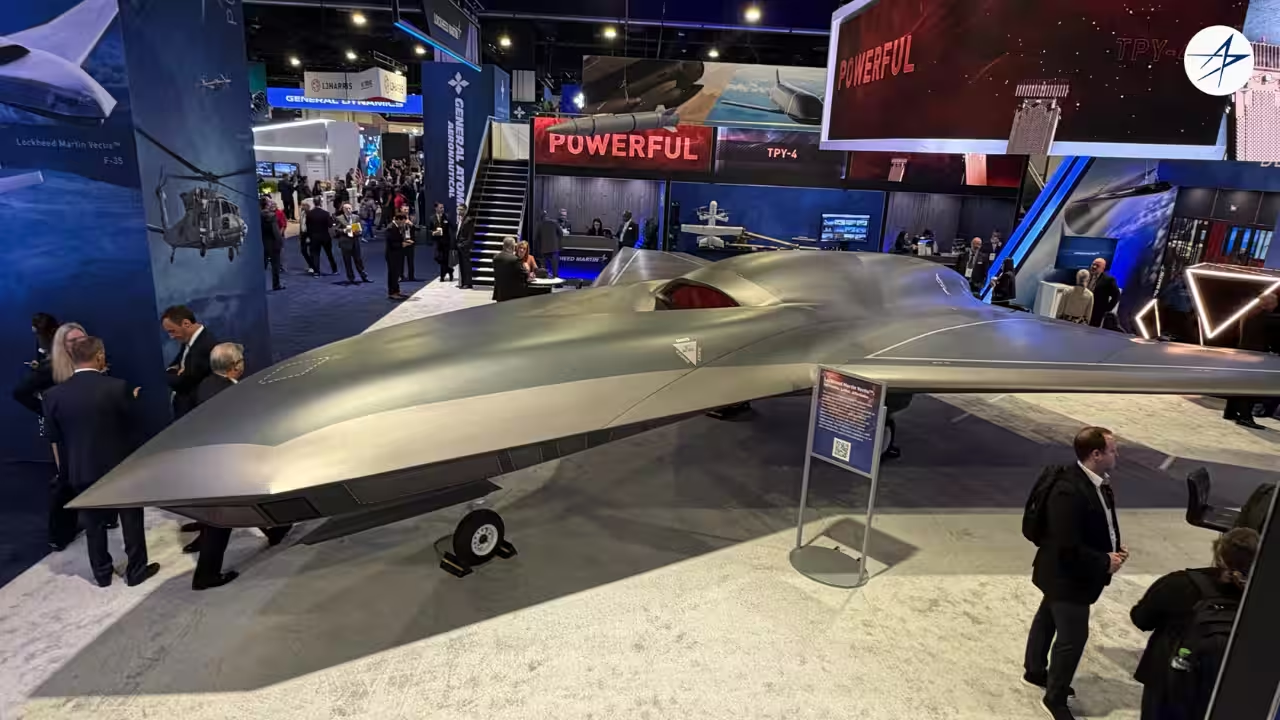
As the realm of aerial combat moves towards greater automation, US firm Lockheed Martin's Skunk Works has lifted the veil further on Vectis, a stealthy Collaborative Combat Aircraft (CCA) first unveiled in September last year, revealing new details ahead of the Air, Space & Cyber Conference. The standout feature is its air intake, deeply recessed into the top of the fuselage behind a downward-sloping v-shaped channel, a configuration that is far more elaborate than earlier renderings of the aircraft suggested, this approach is very different from the intake of the domestically still underdevelopment CATS Warrior.Vectis is also notable for being the first tailless CCA design to emerge from a US manufacturer, featuring a lambda wing planform, a prominent set of chine lines and a arrowhead shaped nose. At roughly 34 feet long with a 38-foot wingspan, it's comparable in size to the Navy's T-45 Goshawk trainer. According to Skunk Works, the department of the company that works on stealthy aircraft, the submerged inlet reduces frontal drag for better range, while also protecting against foreign object debris when operating from austere runways in the Pacific, a nod to the Air Force's Agile Combat Employment (ACE) concept.Construction of the first prototype is already underway, with Lockheed targeting a first flight by the end of next year, and four more prototypes planned using internal funding. The firm has highlighted the speed of development, from napkin sketch to wind tunnel validation in under two months, first digital build in six months and first part release in eight, crediting advanced digital engineering and a technique called minimal tooling determinant assembly, which has reportedly cut labour hours by up to 80%.On capability, Vectis is expected to handle both air-to-air and air-to-ground missions, with promotional visuals showing it launching AIM-120 AMRAAMs and GBU-53/B StormBreaker glide bombs from an internal weapons bay accommodating at least two munitions, alongside an electro-optical/infrared sensor turret.India is building its own answer to this technology through two parallel programmes. The Ghatak stealth drone, a flying-wing unmanned combat aerial vehicle powered by a dry variant of the indigenous Kaveri engine, is being developed by DRDO to carry precision-guided munitions deep into contested airspace, without risking a pilot.Alongside this, HAL is working on the aforementioned CATS Warrior under its Combat Air Teaming System programme, a twin-engine unmanned platform powered by the domestically developed PTAE-7, designed to fly alongside existing fighters like the Tejas Mk-1A, Su-30 MKI and Jaguar, as well as future platforms including the Tejas Mk-2 and India's fifth-generation AMCA. Together, these efforts mark a serious push toward self-reliance in advanced unmanned combat systems.With China, Russia, Turkey and France all pursuing similar flying-wing designs, Vectis stands out as arguably the closest thing to a stealthy uncrewed combat aircraft to emerge from the CCA programme so far.
Topics in this story
Gathered from external sources. Rights to this text belong to whoever originally published it.