Five ways Trump has changed immigration in the US
This is how his signature policy has played out after returning to power promising a closed border and mass deportations.
Immigration has always been central to Donald Trump's message.
When he famously stepped onto the golden escalator at Trump Tower to announce his candidacy for his first presidential term in 2015, he accused Mexico for of sending drugs and crime north of the border - and it's been a constant rallying cry ever since.
Some of his first-term ambitions to stem the flow of would-be immigrants were constrained by the courts.
But restraints have been weaker in his second term, with a more accommodating Supreme Court and tens of billions of additional enforcement money from Congress.
Who should be allowed to live in the US remains a big issue on the minds of voters in the upcoming midterm elections, which are largely seen as a referendum on the Trump presidency.
He promised a closed border and mass deportations in his successful 2024 campaign - and few can deny that he's delivered on both.
But even among those who voted for a tougher stance, there is a concern that the crackdown has gone too far.
His signature policy has played out in five key ways.
Crossings exploded during Joe Biden's presidency, with over 4.5 million migrant "encounters" recorded at the southern border in 2023 and 2024 alone, reflecting the massive numbers of people headed north to the US border.
His administration eventually brought the monthly figures down significantly by restricting asylum claims and removing migrants entering the US illegally without processing.
When Trump returned to office, that stream of migrants became a trickle. Border encounters plummeted.
By the end of Trump's first year in office, the chaotic scenes that had generated headlines around the globe during the Biden administration had largely gone.
On a trip to the border city of El Paso, Texas, in November 2025, for example, the BBC found quiet streets where there had previously been makeshift camps housing thousands of migrants granted parole in the US to await immigration proceedings.
To achieve what he often describes as the "most secure" border in US history, the Trump administration has taken an aggressive, multi-pronged approach.
That has included effectively freezing asylum applications at the border, ending "catch and release" of detainees into the US, deploying troops to the border and pressuring Mexico to clamp down on the flow of migrants headed north.
"President Trump promised the American people a secure border, and the data proves he delivered," Homeland Security Secretary Markwayne Mullin said in a statement on 16 October.
"The results could not be clearer: strong enforcement works."
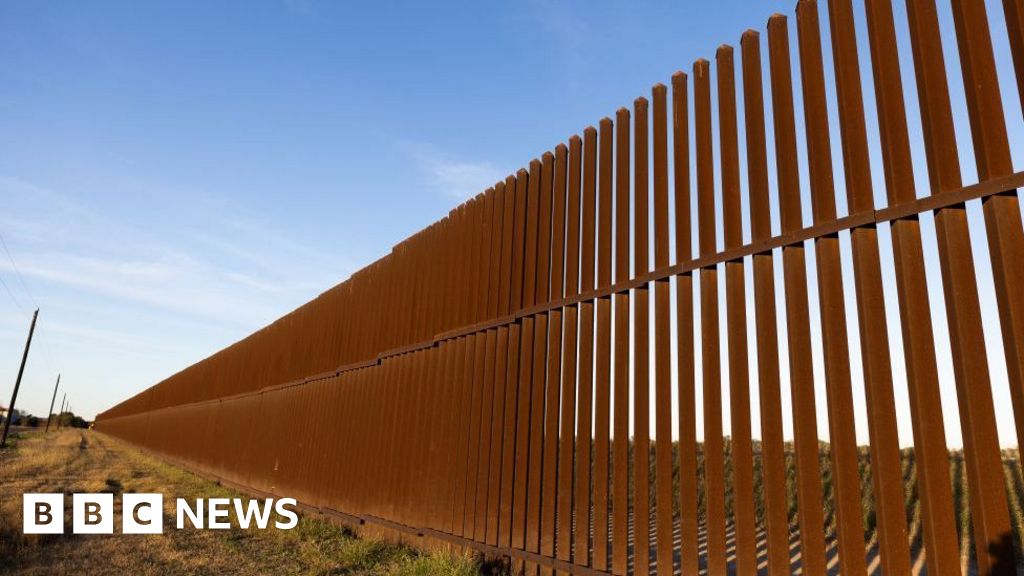
A vow to build a "big, beautiful wall" at the nearly 2,000-mile (3,218km) US-Mexico border was a signature promise of Trump's 2016 campaign.
Progress on it has speeded up in his second term, boosted by $46.5bn (£34.7bn) in new funding from Trump's "One Big Beautiful" spending bill.
According to government figures , about 644 miles of "primary wall" - closest to the border - existed before Trump returned to the White House, in addition to 75 miles of "secondary" wall set slightly further inside the US.
Since then, 250 more miles of new wall have been completed, including primary, secondary and waterborne barriers, along with the technology that helps detect illegal crossings. An additional 1,443 miles of barriers are currently under construction.
Experts, however, paint a more complex picture of what has been actually built rather than just improved or updated.
Additionally, the impact the wall is itself having on the broader immigration figures is up for debate.
"Since new wall construction has really begun in earnest, there has been no significant change in the number of people crossing the border," said Aaron Reichlin-Melnick, an immigration enforcement expert at the American Immigration Council.
There is no indication the border wall has reduced migrant crossings, he added. The reduction has been more down to Trump's policies and messaging.
Trump, for his part, continues to point to the wall as a successful policy - and continues to claim that Mexico paid for it.
"I'm the King of the Wall," Trump said at a rally in Kentucky on 17 October. "By the way, Mexico did pay for that wall. I charged them tariffs and I charged them costs like they've never paid in history."
Hispanic voters helped bring Trump to power - in Texas, the tide may be turning
3. Detentions and deportations rocketing
Most of the headlines generated by Trump's immigration policies have come from the US interior, where operations by Immigrations and Customs Enforcement (ICE) agents to round up people they say are in the US illegally have rocked cities across the country.
During his campaign, Trump promised an immediate start to what he described as the "largest deportation operation in American history", which officials said would begin with people who have committed crimes first.
Arrests - and subsequent detentions in immigration facilities - have shot up significantly since Trump returned to office, including a record of nearly 50,000 in July this year alone, according to data obtained by the Deportation Data Project , a repository of US immigration data run out of University of California, Berkeley, and UCLA.
But the same data shows that a large chunk of the arrests involve people without criminal convictions. In July 2026, detentions of immigrants with criminal histories reached an all-time low of 27%.
Deportations have also ramped up significantly. By mid-July this year, ICE was removing an average of 1,255 people from the country per day, compared to about 770 in Biden's final months in office - although Biden's own removals had sharply risen in his final year in office.
But the tactics used by ICE in US cities have made many Americans grow uncomfortable, including many of those who supported stricter restrictions broadly. This became increasingly evident following Operation Metro Surge, a two-month large scale enforcement action in Minneapolis in early 2026 that left two US citizens dead.
A New York Times and Siena poll released on 21 October found that 50% of voters trust Democrats to handle the issue, compared with 46% for Republicans - despite the issue being a traditional Republican strength.
A separate poll, from Politico and Public First in late September, found deep splits between Republicans on the issue, with 31% of non-MAGA Republicans, meaning those not aligned with Trump's movement, believing that campaign has become too aggressive.
After returning to the White House last year, Trump almost immediately suspended refugee admissions, saying at the time these could only restart if they were shown to be in US interests.
In February, however, an executive order signed by Trump narrowly re-opened that process for Afrikaners from South Africa, who the White House has repeatedly said are being killed and "persecuted" - a claim that the government in Pretoria has denied.
The cap for refugee admissions for the 2026 fiscal year was initially set at 7,500, which was raised to 17,500 in May this year because of what the administration described as an "unforeseen emergency refugee situation".
Overall refugee admissions have slowed to a relative trickle. State Department data shows that 16,292 refugees were admitted into the US in the 2026 fiscal year - of whom 16,287 were South African.
By comparison, in the final two fiscal years of the Biden administration - 2023 and 2024 - 60,000 and 100,000 entered the country, respectively. In the 2024 fiscal year, the highest numbers came from Democratic Republic of Congo, Afghanistan, Syria and Venezuela.
Hundreds of thousands of people protected from deportation lost that protection when a humanitarian protection called Temporary Protected Status (TPS) was also ended in Trump's second term. It gave vetted individuals the right to live and work in the US if their home countries were deemed to be unsafe to return to.
One of those countries was Haiti. In June, the Supreme Court upheld the Trump administration's decision to end TPS for some 350,000 Haitians in the US.
Haitian migrants changed this US town - Trump's deportation drive is reshaping it again
5. A squeeze on visas - and a $1m golden ticket
Other legal pathways to come to live and work in the US have also been tightened up, through various policy changes.
Dozens of countries the Trump administration has deemed a security risk have been subject to a full or partial freeze on visas and travel.
Enhanced vetting and new rules that send people residing in the US back to their home countries to apply for green cards has slowed that process down.
And in September 2025, a $100,000 fee on new H1-B visas for skilled workers , mostly held by Indians, stunned the US tech industry. In May this year, the US Citizenship and Immigration Services said on X that registrations for 2027 were down 40%.
"The data is a clear sign that the days of abusing the program with mass, low-wage registrations are over, and that the program is better serving its intended purpose of attracting highly skilled foreign workers and protecting the wages, working conditions and job opportunities of American workers," the statement added.
While a court has blocked the $100,000 fee - for now - the threat of it appears to have deterred employers. But some experts have cautioned the administration's aim of protecting American jobs, raising wages and stopping firms from outsourcing may prove elusive.
One study, from the Wharton School of Business , found that the H1-B changes would have "no significant impact" on the wages of US-born workers, with any reduction in competition offset by reduced productivity growth.
Other pathways to the US have been opened, however - if you have a spare million.
The "Trump Gold Card" launched in 2025 sought to entice wealthy foreigners to come live in the US in exchange for a $1m "gift" to the US government, plus a non-refundable $15,000 application fee.
At the time, Trump said that the programme would boost the US economy. Its uptake, however, appears to be minimal so far. By April, only one applicant had been accepted.
Topics in this story
Gathered from external sources. Rights to this text belong to whoever originally published it.