7 Days, 7 Chakras, 7 Heavens: Why Does the Number 7 Keep Appearing in Spiritual Traditions?
At a Hindu wedding, the bride and groom take seven steps around the sacred fire. In Mecca, pilgrims circle the Kaaba seven times.
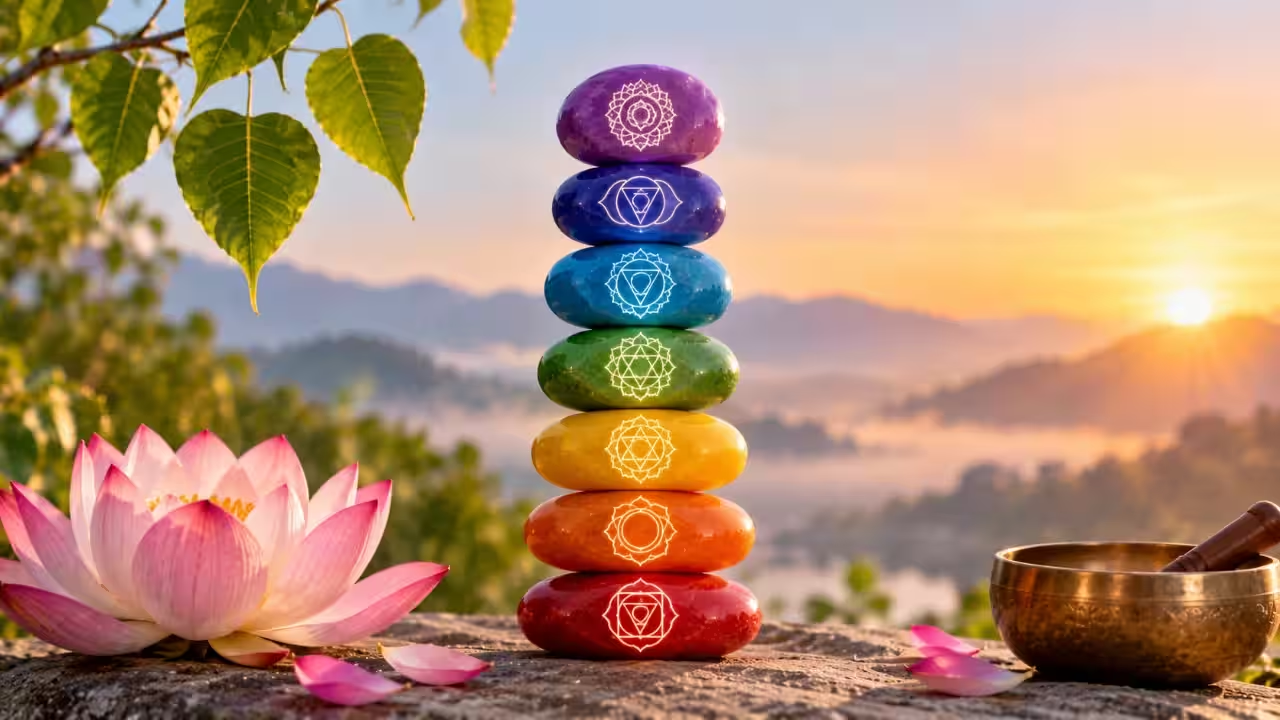
At a Hindu wedding, the bride and groom take seven steps around the sacred fire. In Mecca, pilgrims circle the Kaaba seven times. The Bible describes creation in seven days. Music in India rests on seven notes, from Sa to Ni. People raised in very different worlds keep landing on the same number. That pattern has fascinated scholars and spiritual seekers for centuries. Why seven?Seven Begins in the SkyThe simplest answer may be overhead. Ancient observers, without telescopes, could see seven moving lights against the fixed stars. These were the Sun, the Moon, Mercury, Venus, Mars, Jupiter and Saturn.Those seven bodies gave the week its shape. Sunday belongs to the Sun, Monday to the Moon, and so on through Saturday, named for Saturn. Indian weekday names follow the same pattern. Ravivar for Ravi, the Sun. Somvar for Soma, the Moon. Shanivar for Shani. Two cultures far apart built their calendars on the same seven lights.The Moon added support. Its main phases, from New Moon to First Quarter to Full Moon, come roughly seven days apart. So seven became a natural unit of time.The night sky offered one more seven. The Saptarishi, the seven great sages of Hindu tradition, are linked with the seven bright stars that many know as the Big Dipper.Seven in Indian TraditionHindu ritual is full of sevens. The best known is Saptapadi, the seven steps at the heart of a Hindu marriage. Each step carries a vow about food, strength, prosperity, family and lifelong friendship. A marriage is considered complete only after the seventh step.The Sun god Surya rides a chariot pulled by seven horses. Many read these as the seven colours of sunlight. Scriptures describe seven upper worlds, or lokas, and seven lower ones.The Rig Veda speaks of Sapta Sindhu, the land of seven rivers, often taken as an early name for northwest India. And yoga traditions describe seven main chakras, energy centres running from the base of the spine to the crown of the head.Music follows the same rule. The seven swaras of Indian classical music form the base of every raga.Seven in Other FaithsIn the Bible, God creates the world in six days and rests on the seventh. That rest day, the Sabbath, made seven a symbol of completion and holiness. Seven appears again and again in the Book of Revelation, with seven seals and seven churches.Islam describes seven heavens. During Hajj and Umrah, pilgrims perform tawaf, circling the Kaaba seven times. They also walk seven times between the hills of Safa and Marwah.Buddhist tradition tells that the newborn Buddha took seven steps, with lotuses blooming beneath his feet. In Japan, the Seven Lucky Gods are popular symbols of good fortune.Even science added a seven by choice. Isaac Newton divided the rainbow into seven colours, partly because he wanted it to match the seven notes of a musical scale.Seven in NumerologyGiven all this, it isn’t surprising that numerology treats seven as a spiritual number. In Western numerology, 7 is the seeker, the person drawn to understand what lies beneath surface events.Indian numerology assigns 7 to Ketu, the south lunar node. Ketu stands for detachment and moksha, release from worldly ties. Cheiro’s Chaldean system linked 7 with Neptune, the planet of mysticism and dreams.People strongly influenced by 7 often feel pulled toward meditation, research or quiet reflection. Many need time alone more than most people do. That solitude isn’t loneliness. For them, it’s how insight arrives.Seven also shows up as a measure of completion in everyday spiritual practice. Many people chant a mantra seven times, or keep a fast for seven Mondays. The idea is the same everywhere. Seven marks a full cycle, after which something new can begin.Get the latest astrology news and horoscope updates. Download the TOI App.
Topics in this story
Gathered from external sources. Rights to this text belong to whoever originally published it.