What can a global strike of dockworkers achieve for Gaza?
More than 25 dockworkers’ trade unions in 110 ports of 22 countries are going on strike on October 30.
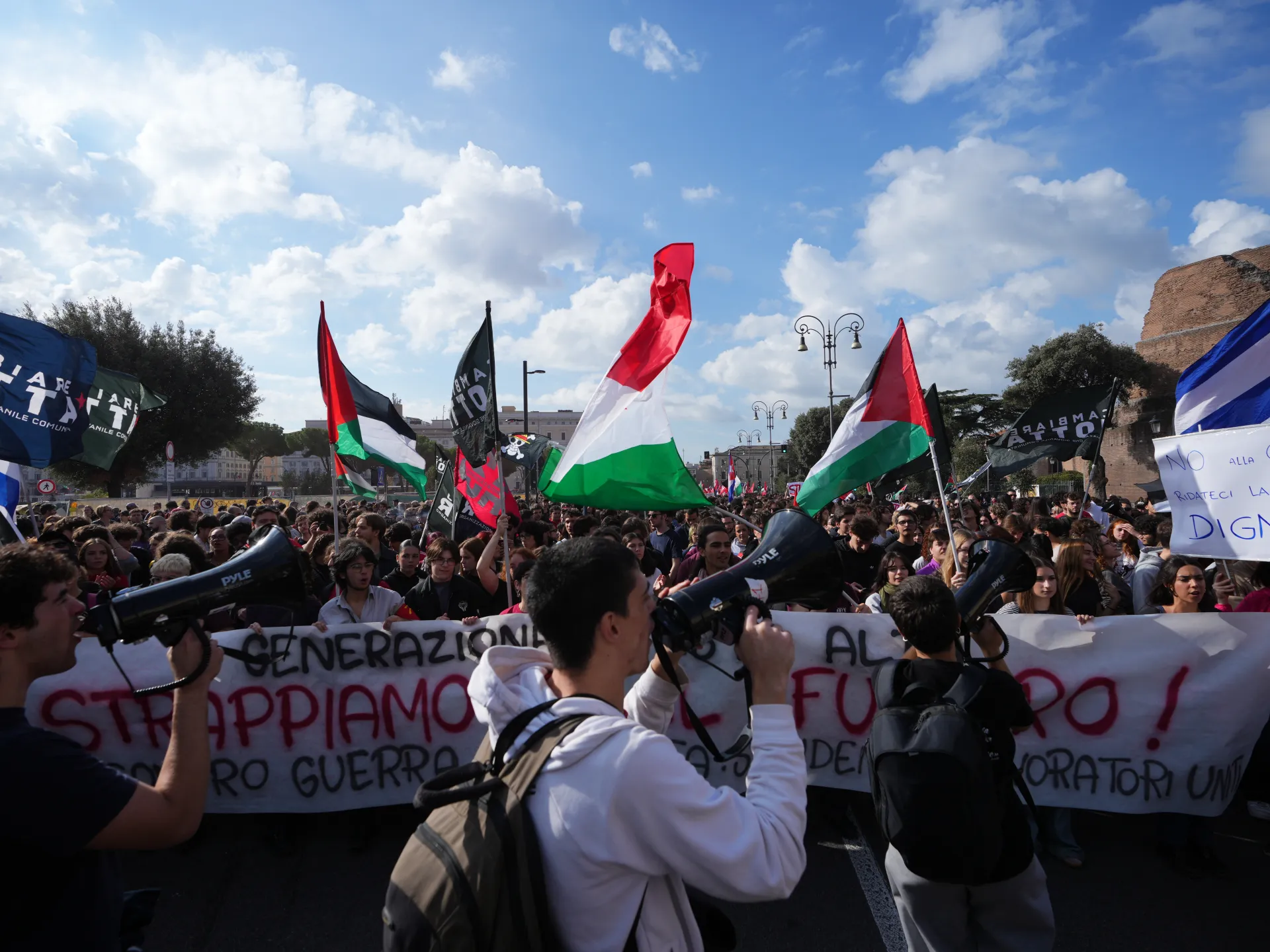
Dock and port workers have long had a tradition of solidarity with the oppressed, upheld by strong labour unions and workers’ rights.
In February 2025, nearly a year and a half into Israel’s genocidal war on Gaza , dockworkers’ unions from Mediterranean countries came together to disrupt weapons shipments to Israel and Western countries’ military support of the onslaught.
“Weapons need transport, infrastructure, and workers’ hands to reach their destination,” Markos Bekris, leader of Greece’s dockworkers’ union, ENEDEP, at the Port of Piraeus in Athens, told Al Jazeera. “That is where our power lies.”
Now, dock and port workers in 22 countries across five continents are holding a strike on Friday, which workers and researchers told Al Jazeera is expected to be “historic” in scale. The International Day of Action of Dockworkers and Port Workers – also called “Dockworkers do not work for war” – involves 110 ports and 25 trade unions.
“Every union will do what they choose, but be connected to the same principles and struggle,” Francesco Staccioli, the national secretary of transport and ports in Italy’s USB trade union, told Al Jazeera.
The unions’ main demand is “an immediate end to the genocide of the Palestinian people and all imperialist wars”.
Mohammed al-Attar, a dockworker who left Gaza in 2015 and is now based in Hamburg, Germany, said the workers “are the power”.
“We can save thousands of lives if we stop working just for two days,” he said.
Al-Attar feels hopeful about the global strike, but is “deeply disappointed” in his trade union Ver.di in Germany, which he accused of “incomprehensible silence” over Gaza .
What is the International Day of Action of Dockworkers and Port Workers?
In early 2025, dockworkers in the Mediterranean area came together to discuss how to concretely act “against privatisation, and against the genocide in Palestine”.
The original meeting included five unions organising in 20 ports across five countries, but continued to grow. The unions met several times, first in Athens, then in Genoa, and later in Istanbul. That was where unions from more than 35 ports published the Istanbul Declaration in May this year, and declared October 30 as their day of action.
In a statement, the unions called for the “recognition of an independent Palestinian state, recognised by the international community, within the 1967 borders and with East Jerusalem as its capital”, and “an end to the US-Israeli wars of aggression in the Middle East and against Iran, and full solidarity with the peoples of Cuba, Venezuela and Sudan”.
“Refusing the war is giving humanity a chance to live better. This is what I’m really convinced about,” the USB’s Staccioli told Al Jazeera.
How many ports and unions are taking part?
More than 25 dockworkers’ trade unions, representing more than 110 ports in 22 countries and regions across five continents, are taking part. Most of the strikes will happen at regular working hours, but in France, Italy, India, Greece and Turkiye, 24-hour strikes have been called.
Strikes of up to two hours have also been announced in Morocco, Cyprus and other ports.
Organisers told Al Jazeera that workers and trade unions from other sectors have been called on to join with port workers, notably in Greece, while in Italy the USB has called for a general strike.
“It’s bigger than we thought,” Staccioli said. “This has spread all over the world.”
No Harbour for Genocide (NHG), a campaigning collective that researches weapon supply chains, supports the action. A spokesperson told Al Jazeera that maritime infrastructure was important in “facilitating military trade within the context of the genocide in Palestine”.
Dockworker unions in India, Sweden, Denmark, Australia, Brazil, Mexico, Uruguay and the west coast of the United States have all pledged to take part, the spokesperson added.
The Palestinian labour movement endorsed the strike and called on more to join, urging unions to “escalate Boycott, Divest, Sanctions (BDS) pressure to end all state, corporate and institutional complicity in Israel’s illegal occupation, apartheid and genocide.”
Of the ports participating, Genoa, Livorno and Gioia Tauro in Italy, Marseille in France, Piraeus in Greece, and Tangier in Morocco all have proven links to weapons shipments to Israel, according to No Harbour for Genocide.
The group said that between August 2025 and September 2026 it tracked 315 shipments of components for Elbit Systems, Israel’s largest arms manufacturer, moving through 56 commercial ports in 29 countries. All these 56 ports are expected to be on strike on October 30 , representing a major disruption, even if only for a day.
NHG said it expects that more than $2bn worth of cargo will sit idle on October 30 .
“Up to 95 percent of Israel’s imports and exports travel by sea, relying on port infrastructure across the Mediterranean, ” the campaign’s spokesperson said. “Tangier, Piraeus, Gioia Tauro and Genoa, where the largest vessels unload containers onto smaller ships for the rest of the sea, are a few of the Mediterranean’s most frequently used transshipment hubs. All four are taking part on Friday.”
“The participating Mediterranean ports handle 63 percent of all container activity in the sea,” the spokesperson added, noting that “between southern France and Piraeus, the striking ports hold 74 percent of container activity. Worldwide, the ports taking part [in the strike] handle 13.5 percent of global shipping.”
Linda Maggiore, an Italian journalist and activist, said that she has discovered several examples of increasing weapons shipments from Italy’s major ports to Israel since the start of the war on Gaza.
“In Europe, a regulation on military mobility is about to be approved, which will make it even easier for arms to be transferred without scrutiny,” Maggiore told Al Jazeera. “Blockades are essential actions, because they make it clear that civil society does not wish to be complicit.”
From the Vietnam war to Iraq, the USB’s Staccioli said that “dockworkers have a long tradition of rallying against any imperialist war or aggression in the world.”
In Greece , union leader Bekris is facing prosecution for a protest in which he and other workers blocked the loading of a container holding 21 tonnes of ammunition destined for Israel in October 2024.
“We carry forward the tradition of workers who refuse to load weapons against other people,” Bekris told Al Jazeera on the eve of the global strike. “Our hands get covered in grease and sweat every day. We refuse to let them be stained with the blood of other people.”
Topics in this story
Gathered from external sources. Rights to this text belong to whoever originally published it.