In 1900, North American tall goldenrod was introduced to Japan for gardens and honey production, but it escaped cultivation and overran native grasslands nationwide
Rest of World News: Explore how the North American tall goldenrod, originally introduced to Japan for gardening and honey production, has become one of the country's most notorious invasive species, impacting native grasslands and ecosystems.
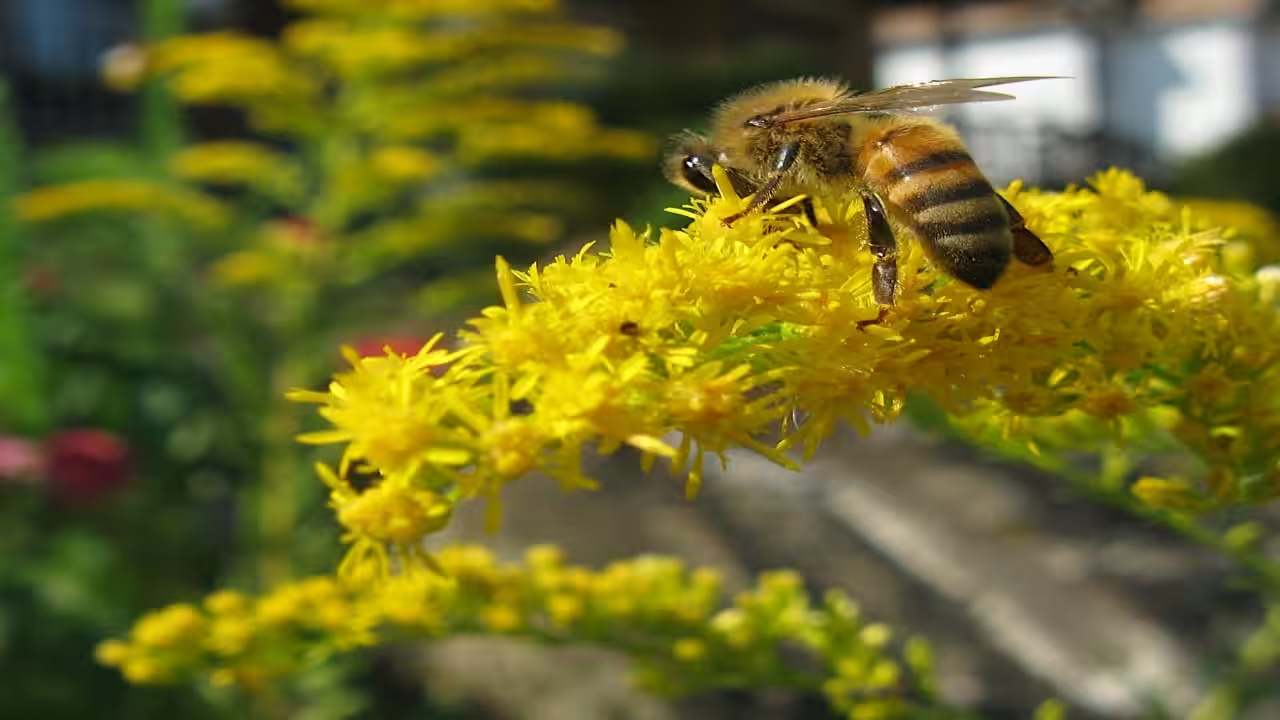
The majority of plants brought in for beekeeping and gardening remain exactly where they are planted; thus, they rarely receive any attention. Occasionally, however, a species that appears innocuous in a flower bed has very different ambitions when it comes to open space. One of the most obvious instances of that pattern in the world is the tall, late-blooming perennial tall goldenrod, which is native to North America. Japan has been observing the effects of this pattern throughout its countryside for more than a century.Japan's National Institute for Environmental Studies records the first introduction of tall goldenrod at around 1900, when it was deliberately brought in as an ornamental plant and nectar source. It was intentionally introduced as an ornamental garden plant and a nectar source for honeybees because it blooms unusually late in the year, from October through December in much of Japan, when few other plants are still flowering.A plant that flourished precisely where no one wanted itIn its first several decades in Japan, tall goldenrod did much of what gardeners expected of it, staying mainly limited to the plots where it was planted. This changed abruptly in the years after the Second World War, when the plant grew swiftly throughout the country, going well out of gardens into riverbanks, vacant lots, the boundaries of farmland and roadsides. Today, it is established across almost the entire Japanese archipelago.Its success is partly a matter of raw biology. According to the CABI Compendium, tall goldenrod is an international scientific reference maintained by the nonprofit research organisation CABI. Tall goldenrod produces huge numbers of wind-dispersed seeds and also spreads aggressively through underground rhizomes, allowing a single colonising plant to expand into a dense stand within a few growing seasons. It also exudes allelopathic molecules from its roots, chemicals that restrict the germination and growth of competing plants nearby. This gives tall goldenrod an edge over the natural flora in the same patch of soil. Studies comparing Japanese populations with those in the native range have found that the invasive plants tend to grow taller, produce more leaves and release higher concentrations of suppressive compounds, suggesting they have become more aggressive since arriving in Japan.Choking out the grasses that get in firstJapan’s natural grassland populations have mostly borne the ecological penalty. Once established, tall goldenrod forms dense stands that crowd out native grasses and wildflowers that would otherwise share the open ground. The National Institute for Environmental Studies mentions competition with native species and allelopathic suppression as the two known effects of the plant, with native grasses specifically identified among the affected plant. The institute classifies tall goldenrod as one of the 100 worst invasive alien species in Japan, a list of introduced organisms that are considered to cause substantial and enduring damage to the country’s ecosystems.Tall goldenrod remains widespread in Japan, despite its classification as one of the country's 100 worst invasive alien species. NIES lists competition with native species and allelopathic effects among its impacts and notes that pulling and repeated mowing can be used to control established plants. Part of the rationale comes from the very stuff that made the plant desirable in the first place. Its late-season blooms continue to provide a key source of nectar for honeybees and other pollinating insects as they enter the winter months, and wholesale removal from a landscape can leave those insects with fewer options at a time of year when alternatives are already few. They have a dilemma, an unwelcome invader battling a plant that some elements of the ecology and the beekeeping industry have discreetly grown to depend on.A plant still adapting to JapanScientists examining tall goldenrod in Japan have revealed that the populations there are not just frozen copies of those in North America. A reciprocal transplant study summarised by the National Center for Biotechnology Information found evolutionary differences between the two regions, including changes in the resistance of Japanese populations to local insect pests compared with plants in their native range. For example, a species of lace bug that arrived in Japan from the United States fairly recently reacts differently to the goldenrod's resistance mechanisms there than it does to the same plant species back home, a sign that a century and a quarter of separation has already started to alter the way the species defends itself. More than a century after tall goldenrod was brought to a few Japanese gardens for its late flowers and its value to bees, it is one of the most obvious examples in the country of how a plant chosen for one thing can do something else altogether when left to its own devices in unfamiliar soil.Catch the latest World News and Live updates. Download the TOI app.
Topics in this story
Gathered from external sources. Rights to this text belong to whoever originally published it.