Japanese World War II destroyer Teruzuki discovered in 2025, 83 years after sinking; the 134-metre wreck lies 800 metres beneath the Pacific
For more than eight decades, the Japanese destroyer Teruzuki lay hidden beneath the waters off the Solomon Islands, its final resting place unseen by
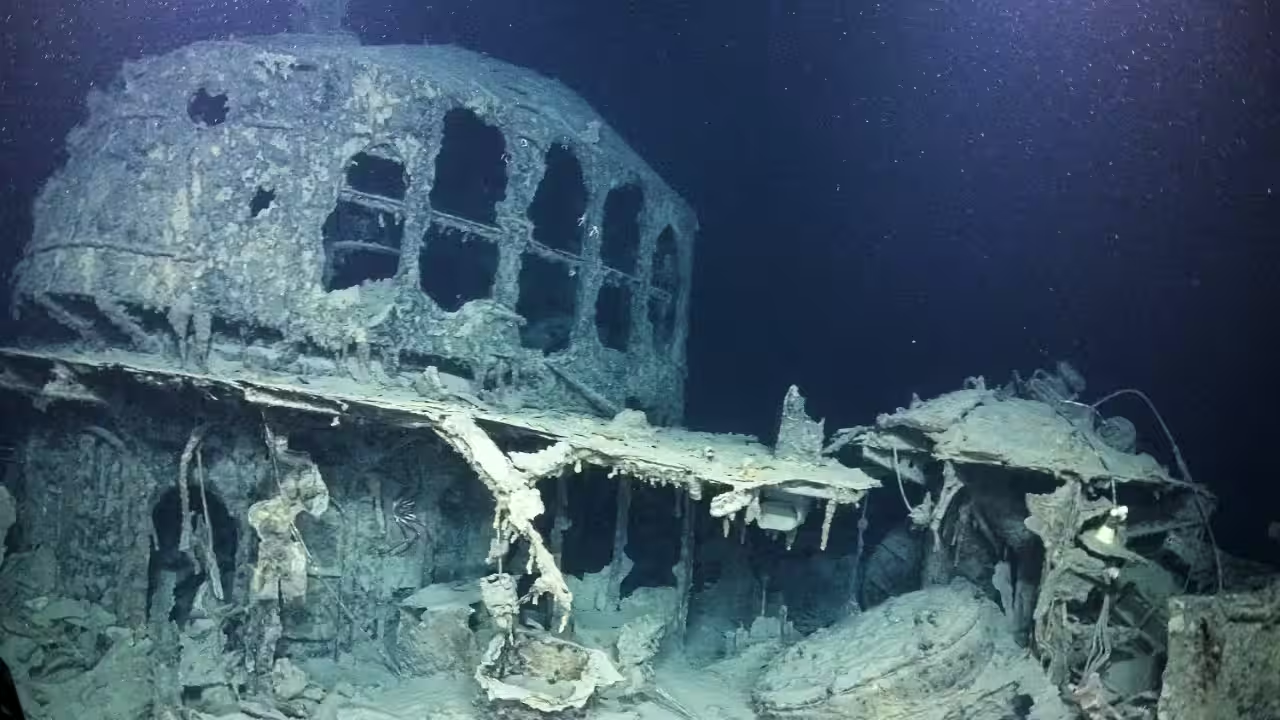
For more than eight decades, the Japanese destroyer Teruzuki lay hidden beneath the waters off the Solomon Islands, its final resting place unseen by modern explorers. That changed in July 2025, when an international research team located the World War II warship on the seabed of Iron Bottom Sound. According to the Ocean Exploration Trust’s Nautilus Live, the vessel was discovered using underwater robots after seafloor mapping identified a promising target. The 134-metre-long destroyer sank in December 1942 during the Guadalcanal campaign. Its discovery has brought renewed attention to a naval battle that claimed thousands of lives and left numerous wrecks beneath the Pacific.The Teruzuki was discovered for the first time since its sinking in 1942The discovery of the Teruzuki offered researchers their first opportunity to examine the Japanese destroyer directly since it sank during the Second World War. In an account published on 12 July 2025, the Ocean Exploration Trust reported that its team aboard the exploration vessel E/V Nautilus had located the wreck in Iron Bottom Sound, off Guadalcanal in the Solomon Islands. The discovery came 83 years after the vessel disappeared beneath the waves. The Straits Times also reported the finding on 21 July 2025, describing how the survey team identified the wreck using evidence from its structure and historical records. The discovery was particularly significant because researchers could finally study the vessel’s surviving features rather than relying solely on wartime accounts to understand its final hours.The 134-metre destroyer sank after American torpedo boats attacked itCommissioned in 1942, the Teruzuki was an Akizuki-class destroyer measuring 134 metres in length. According to Nautilus Live, it was designed to protect larger warships, particularly aircraft carriers, from aerial attacks. Its final mission, however, involved escorting supply ships supporting Japanese forces on Guadalcanal. In the early hours of 12 December 1942, American patrol boats intercepted the convoy near Cape Esperance. Two torpedoes struck the destroyer’s stern, damaging its rudder, disabling the ship and starting fires. Most of the crew were rescued or managed to swim ashore, but nine men died as the vessel sank. The Straits Times similarly reported that the ship was immobilised by American torpedoes while escorting vessels carrying food and other supplies to the island.Underwater robots and seafloor mapping helped researchers locate the wreckFinding the Teruzuki required researchers to combine seafloor mapping with remotely operated underwater vehicles. The University of New Hampshire’s uncrewed surface vessel DriX first mapped the seabed and identified a target consistent with the destroyer’s reported sinking location. The exploration team then deployed the remotely operated vehicles Hercules and Atalanta to investigate the site. The Straits Times reported that the main wreck lay approximately 800 metres underwater, while the broken stern was found at a separate location about 200 metres away. Researchers compared the visible damage with survivor testimonies and examined the number and positions of the gun turrets. These details, alongside historical records identifying other sunken Akizuki-class destroyers, helped confirm the vessel’s identity.The wreck lies in Iron Bottom Sound, a major site of Pacific War historyThe Teruzuki rests in Iron Bottom Sound, a stretch of water between Guadalcanal, Savo and the Nggela Islands in the Solomon Islands. According to Nautilus Live, the area witnessed five major naval battles between August and December 1942, resulting in the loss of more than 20,000 lives, 111 naval vessels and 1,450 aircraft. The Straits Times reported that the discovery offers researchers another way to examine the hardships faced by Japanese forces attempting to supply troops on Guadalcanal after losing air superiority in the Pacific. The expedition also demonstrated how modern underwater technology can document maritime heritage without recovering wrecks from the seabed. As Nautilus Live noted, the survey brought researchers face-to-face with a warship that had remained unseen since its wartime sinking.You use AI every day. Now get your AI Quotient. Take the AIQ test.
Topics in this story
Gathered from external sources. Rights to this text belong to whoever originally published it.