Meet Chico, the man who has lived alone in the Amazon for 38 years; planted 1,500 Brazil nut trees, hunts wild pigs and built a life far from the modern world
Deep in the Amazon rainforest, far from supermarkets, banks, social media and the conveniences of modern life, a man named Chico has built a life almost
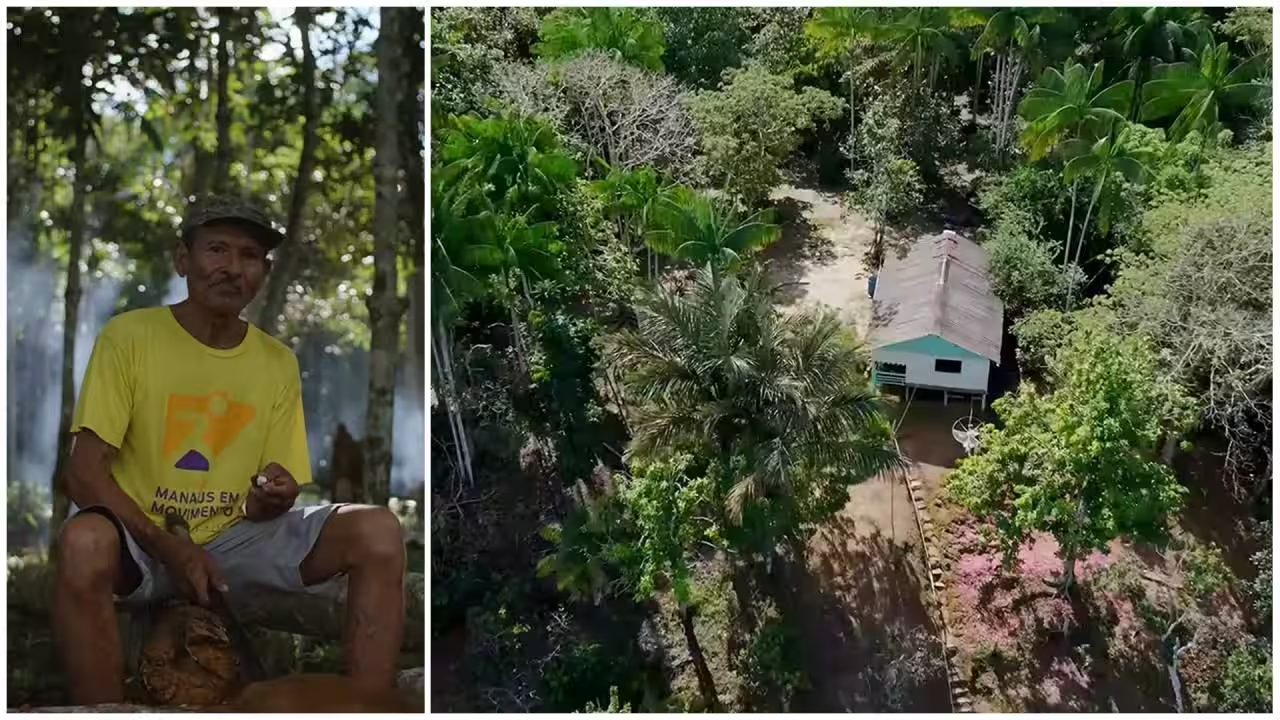
Deep in the Amazon rainforest, far from supermarkets, banks, social media and the conveniences of modern life, a man named Chico has built a life almost entirely on his own terms.For 38 years, he has lived in the rainforest, cultivating the land around his home, collecting rainwater, hunting for food and growing fruit and Brazil nut trees. His extraordinary life was documented by the Yes Theory expedition team on their YouTube channel, after the group travelled deep into the Amazon to meet the man they had heard about but knew very little about.The expedition members admitted they were apprehensive when, after days of travelling through the Amazon River region, they finally stepped off their boat and onto Chico's land.But their first encounter quickly put them at ease.Chico had been waiting for them. He had gone hunting and prepared a wild pig for their arrival, even though he did not know exactly which day they would reach him.It was an early glimpse into a life where survival depends on preparation, patience and an intimate understanding of the land.He planted 1,500 trees and waited 38 yearsOne of the biggest surprises for the visitors was discovering that much of what looked like untouched jungle around Chico's home had actually been planted by him.Chico had planted approximately 1,500 Brazil nut trees 38 years ago. The trees take years to mature, making the decision an extraordinary exercise in patience.And then came the payoff.This year, for the first time, Chico was able to harvest Brazil nuts from the plantation he had started nearly four decades earlier."38 years ago he planted them and this year was the first time he was able to harvest anything from them," the expedition members observed during their visit.The significance of that moment was not lost on the visitors.Chico had spent decades working for a harvest he might not see for many years. He did not seem to be in a hurry."Many people they don't care, they don't plan, they don't deal with nature," Chico explained, describing the difference between his way of life and the modern world's relationship with resources.For him, the forest isn't simply something to take from.It is something to cultivate.'Money doesn't have any value here'Chico's philosophy is rooted in self-sufficiency.There is no supermarket nearby, no convenient online delivery and no refrigerator stocked with food. He collects rainwater for drinking and depends on crops, fruit and hunting to survive.Explaining the reality of life in the rainforest, Chico said, "You got a job and you make money and then you buy what you want. Here there money doesn't have any value."Instead, he explained, people living in such remote areas have to produce what they need."It's more like you have to produce what you need and this is how they live here," he said.That philosophy can be seen everywhere around his home.Bananas, mangoes, Brazil nuts and other crops form a natural food supply. What looks like wild forest from a distance is, in many places, the result of decades of Chico's labour.One member of the expedition summed it up humorously: Chico had essentially "planted an entire grocery store."His supermarket has no aislesChico's plantation is not just a source of food. It is evidence of how deliberately he has constructed his life.As the team explored the property, they realised that almost every tree in the cultivated area had a purpose."Everything here was planted by him. Every tree here was planted by him," one of the visitors remarked.Chico corrected their perception of the landscape: "This is not jungle."What looked like an untouched forest was, in fact, his plantation, a carefully developed collection of Brazil nut and fruit trees.For the visitors, it was difficult to imagine waiting 38 years for something as ordinary as a harvest.For Chico, it was simply part of life.Survival means eating whatever the forest gives youThe difference between Chico's world and the outside world became particularly obvious at mealtime.He had prepared wild pig for his guests. Since he has no electricity or freezer, the meat had been preserved with salt.The visitors wondered what someone living so remotely could eat and whether there was any possibility of choosing between different meals.Chico's answer was simple."When you live here, you don't have much choices," he explained. "You go hunting, whatever you find, it's fine."There is no menu in the rainforest."It's not like a matter of choices," Chico said. "That's the only thing you have to eat."For the visitors, accustomed to being able to order almost anything with a few taps on a phone, the idea was striking.For Chico, it was survival.The Amazon can be beautiful and deadlyHis knowledge of the rainforest also comes with an awareness of its dangers.The expedition members were warned to watch for snakes as they walked through the forest. They also learned about jaguars, caimans, piranhas and other creatures that inhabit the region.Even the Brazil nut trees that Chico had spent decades cultivating could pose a threat.The heavy fruits fall from considerable heights and can cause fatal injuries.The visitors were told that people have died after being struck by falling Brazil nuts.Chico also reportedly told them that he had shot three jaguars during his years living in the Amazon.The revelation changed the mood as the group ventured deeper into the forest.The visitors joked nervously about their chances of surviving if they encountered one.For Chico, however, this was simply another part of the environment he had learned to navigate.'There are less than 2 million people living' in this vast regionAs Chico showed the visitors around, he also explained why so many people who live in the Amazon stay close to the rivers."There are less than 2 million people living in 3.5 million square kilometres," he said while describing the vastness of the region.According to Chico, rivers are essential to life in the Amazon."Everybody who lives in the Amazon, they live near the river," he explained. "They need it."Living deep inside the forest, away from waterways, presents enormous practical difficulties."There's no way to live," Chico said.His own existence is therefore something of an exception.Behind the solitude is a painful pastPerhaps the most intriguing question for the expedition wasn't how Chico survives in the rainforest, but why he chose to remain there for so long.The team learned that his isolation may be connected to his past and that he had not seen his children for a long time.One interpretation shared during the expedition was that Chico's solitude could represent a form of self-imposed punishment.The man who had created such a self-sufficient life in the rainforest appeared to carry emotional weight from his past.That made his decision to remain there more complicated than a simple rejection of modern civilisation.His forest may provide food, shelter and independence, but it also appears to hold memories he has chosen not to leave behind.Someone claims to own his landThere was another uncertainty hanging over Chico's future.The expedition was told that a man had recently arrived claiming to be the owner of the land and telling Chico that he would have to leave.The visitors were shocked."Bought it from who?" they asked.They did not appear to receive a clear answer.For Chico, who had spent 38 years planting trees and creating a home there, the land represents far more than property.His Brazil nut plantation alone is the product of decades of work.Leaving would mean walking away from a life he had spent nearly four decades building.For a few hours, Chico was no longer aloneThe expedition members eventually joined Chico on a canoe ride, explored the forest and shared meals with him.The language barrier made communication difficult, but laughter often bridged the gap.At one point, the visitors even shared cold drinks with him. Chico had reportedly said he enjoyed a cold beer but did not have a refrigerator to keep one chilled.For a man whose life is defined by isolation, the arrival of five visitors transformed his normally quiet surroundings.And that may have been the biggest revelation of the entire journey.The team had arrived expecting to meet the "loneliest man in the Amazon."Instead, they found a man who appeared genuinely happy to see other people.'This is the life he chooses'After spending the day with Chico, the expedition members prepared to leave.They planned to return the following morning to say goodbye and said they would leave money to help him purchase a generator.They also promised that people from the region would check on him.Then came the moment when the visitors had to return to their boat.Once they disappeared, Chico would once again be surrounded by the forest he had cultivated for decades.The team reflected on the strange contradiction of his existence: a man living almost completely alone, yet seemingly at peace in a world he understands better than anyone around him."This is the life he chooses," one member of the expedition reflected.And perhaps that is what makes Chico's story so compelling.He didn't merely disappear into the Amazon.He planted himself there.For 38 years, he planted trees, waited for them to mature, learned the dangers of the forest, hunted for food, collected rainwater and built a life beyond the systems that govern most of the modern world.Now, those 1,500 Brazil nut trees stand as a living record of his patience.The harvest finally came.And for Chico, after waiting nearly four decades, perhaps there was never any need to rush.You use AI every day. Now get your AI Quotient. Take the AIQ test.
Topics in this story
Gathered from external sources. Rights to this text belong to whoever originally published it.