Scores detained in Paris as protestors clash with police during nationwide demonstrations in France
More than 100 people have been detained in Paris, as officers deploy tear gas in cities up and down the country. Follow live updates.
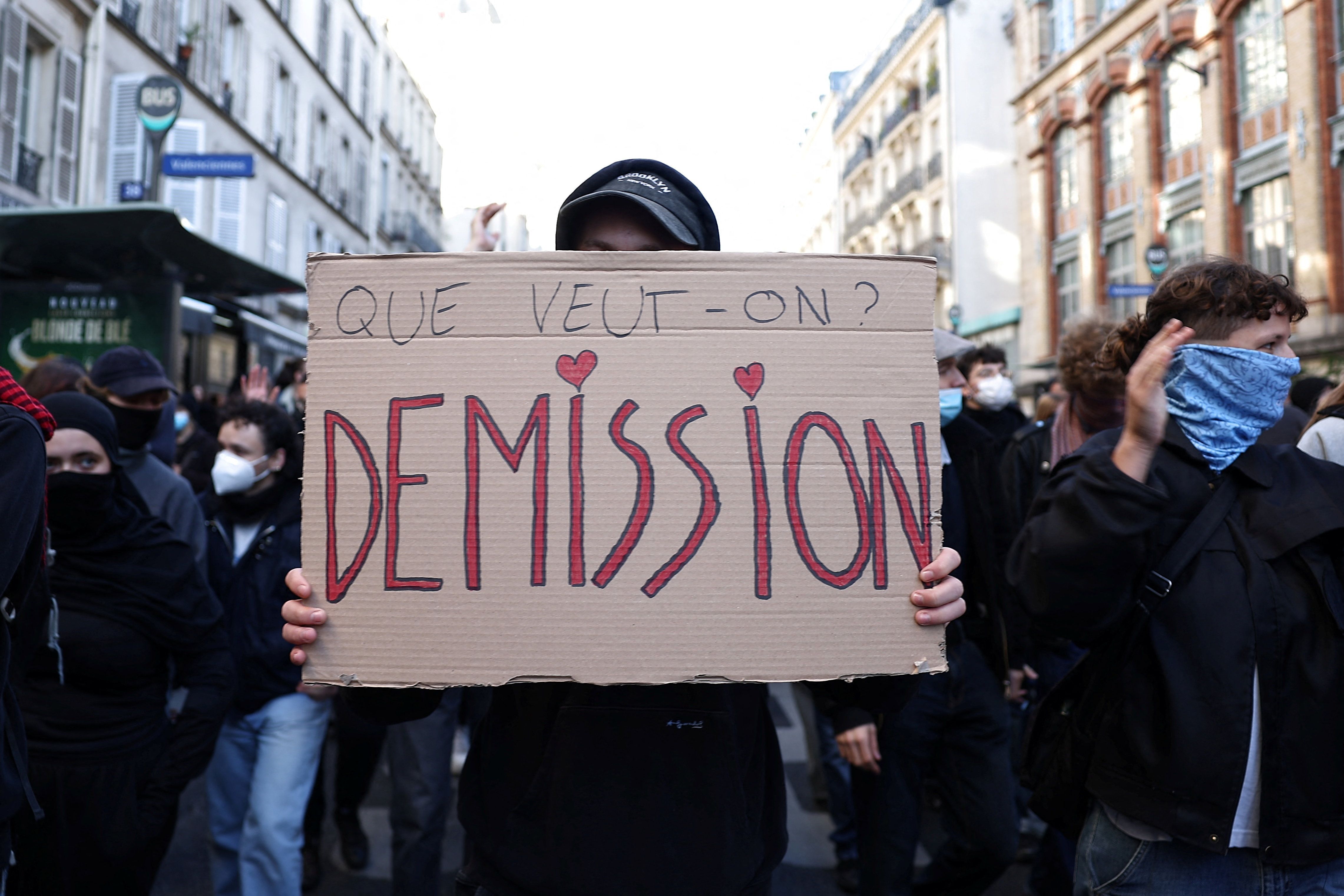
• Huge protests : Far-left groups, unions, farmers and Yellow Vest protestors are expected to join students in France today in what could be one of the largest nationwide mobilizations since protests erupted in September. Officers have already deployed tear gas in several cities, including Paris, while around 100 people have been detained.
• Police under scrutiny: Anger among those on the streets has been fueled by tactics deployed by officers in recent weeks, which have resulted in serious injuries.
• Simmering anger: The government has struggled to contain the student protests, which started in support of striking teachers at a suburban high school, before snowballing into a national crisis and attracting global attention, including from President Donald Trump .
More than a half hour before the march was due to start, riot police charged onto the square multiple times under volleys of tear gas.
A student or orchestra was playing as the tear gas was fired, before they were escorted off the square by a human chain to protect them.
The crowd is a real mix of old and young, with placards calling for better returns for taxes and French President Emmanuel Macron’s resignation.
Today’s demonstrations in France are expected to be the biggest yet, with tens of thousands of activists from multiple movements joining an estimated 60 marches, and around 250 planned actions including roadblocks and building blockades, across the country.
Here’s a rundown of who is expected to participate.
Yellow Vests: The gilets jaunes, or Yellow Vests, are part of a grassroots citizens’ movement established in 2018, when more than 250,000 people protested a hike in fuel tax. Named after the yellow high-visibility jackets French motorists must carry in their vehicles, the Yellow Vests are comprised of people from across the political spectrum and have contributed support to a range of protests since they emerged almost a decade ago.
Students: High school students demanding more teachers, reduced class sizes and better building conditions will make up a significant portion of those on the streets. They have been protesting since late September.
Far-left groups: Jean-Luc Mélenchon’s La France Insoumise has backed the student movement and is expected to show up at demonstrations in support of the protesters and their demands. The party also described the protests as a potential starting point for a much broader movement, and is demanding a cap on fuel prices.
Farmers: Some farmers have discussed staging tractor protests.
Taxi drivers: Drivers have already begun staging rolling roadblocks and blockades around Paris airports and say they intend to continue through Saturday.
CNN’s Saskya Vandoorne and Catherine Nicholls contributed reporting.
Amid the tens of thousands of protesters expected to take to the streets across France today are the gilets jaunes , or Yellow Vests, part of a grassroots citizens’ movement that began almost a decade ago.
The movement dates back to 2018, when more than 250,000 people protested a rise in fuel tax announced by the government, which it said was to fight against climate change.
The protests – named after the yellow high-visibility jackets French motorists must carry in their vehicles – morphed into broader demonstrations against French President Emmanuel Macron and his government in the weeks following November 2018.
They often turned violent, with at least 10 people dying in connection with the protests in their first six weeks.
The French government made many concessions in the first weeks of the initial Yellow Vest protests, including scrapping the initial fuel tax, and implementing a 10 billion euro ($11.05 billion) package of wage rises and tax relief for the poorest.
The Yellow Vests have taken to the streets several times since those first protests died down. In 2020, police took more than 250 people in for questioning and fired tear gas during violent scenes involving the movement in Paris.
People from across the political spectrum have taken part in Yellow Vest protests, including anarchists, anti-immigration populists and hard-core fascists.
There are even groups on social media claiming to be environmental “yellow jackets,” a direct contradiction of the original protesters’ demands to scrap a new eco-tax.
Some have blamed a radical fringe of the Yellow Vest movement for a rise in anti-semitism in France.
A 2019 study conducted by the Fondation Jean Jaures showed that 50% of those who participated said they believed in a “global Zionist conspiracy.”
CNN’s Melissa Bell, Saskya Vandoorne and Gianluca Mezzofiore contributed to this reporting.
Things have quickly escalated at Paris’ Place de la République, from where today’s main march is expected to begin.
Police have deployed tear gas in the square and charged into the crowd. A small group of protestors have aimed fireworks at police lines.
The square is blocked off on several sides to funnel protestors along the permitted route, although the march is not set to begin for more than an hour.
Police in Lyon launched tear gas grenades to disperse around 300 people who have mobilized outside the city’s Jean Moulin University earlier, according to CNN’s French affiliate BFMTV.
Protests have also begun in Rennes, and in Marseille where officers have also deployed tear gas to disband the crowds.
Around 100 people have already been detained across the Paris region, BFMTV has reported, mostly for the possession of prohibited protective gear.
Hundreds of people have gathered at Paris’ Place de la République, where today’s main march is expected to begin.
Police have fired tear gas towards the crowd, which is currently peaceful.
A smattering of Yellow Vests protesters is also present.
US President Donald Trump joked about “joining the revolution” ahead of the mass protests planned today in Paris, while French President Emanuel Macron called for “calm and respect.”
Speaking from a rally yesterday in Georgia , Trump joked, “Let’s go to France and join the revolution and spend our $5000 there”, touching on the dividend promised if the Republicans win the US midterms.
Last night, speaking from the European council in Brussels , French President Emmanuel Macron asked for “calm” with reference to today’s planned protests.
“There is a constitutional right to protest, but what goes along with this right is respect,” he added.
A challenging summer of heatwaves cast disarray across France’s education system as classrooms without air conditioning became unbearable and examination timetables were disrupted.
This, plus long-standing concerns over inadequate staffing and school conditions, prompted thousands of teenagers to flood the street and demand change.
So, what is it that French students want?
Student union leaders representing the teenaged protesters have urged a €10 billion investment (around $11.2 billion) in high school and university-level education.
Major priorities include more teachers; reduced class sizes and buildings appropriately adapted to withstand climate change, ensuring they remain fit-for-purpose throughout the year.
Students also wish to negotiate their workloads, end a controversial university admissions system, create more student accommodation and end police violence against students.
Protests were initiated after students joined teachers to protest understaffing and a lack of resources at just one school in a Paris suburb on September 21. When demands were met, and extra staff were deployed to the school, demonstrators mobilized throughout Paris and across the country, signaling a nationwide appetite for change.
The government has been criticized as too slow to respond to the requests made by demonstrators, with some suggesting government inaction is emblematic of the students’ frustrations at going unheard, and a reason for their sustained anger.
CNN’s Melissa Bell, Saskya Vandoorne, Lucie Lepellec and Billy Stockwell contributed reporting.
Protests are underway across France this morning, with demonstrations taking place in a number of cities, including Paris and Marseille.
In Marseille, a fire was burning before today’s demonstration began, with one person photographed waving the French flag as they walked by the flames. Meanwhile, in Paris, protestors carried placards, including one reading “What do we want? Resignation.”
Police officers were photographed standing guard near the protests. Take a look at the latest images we’re seeing, below.
Meanwhile, student demonstrations were also held across Italy yesterday to protest against the precarious state of public schools and Italian Prime Minister Giorgia Meloni’s recent cap on foreign students in classrooms.
Several events turned violent, including in Rome, Bologna and Turin, where police used tear gas to break up the crowds. In Rome, police say thousands of people marched from the Colosseum to the ministry of education building where they set fires and were met by police in riot gear.
“This is not a democratic expression of dissent, nor a defense of schools, but an attack on institutions and political hooliganism,” said Minister of Education Giuseppe Valditara, who was the subject of many of the posters.
Other signs showed Meloni and other ministers hanging upside down in a nod to the demise of fascist dictator Benito Mussolini with “killing a fascist is not a crime” written below.
Many protesters held signs that had phrases in French or that said “do it like the French” in solidarity with student protests there.
In several cities, protesters lit trash cans, set off paper bombs — Molotov cocktails — and used fireworks against police. In Turin, many teachers joined the marches.
The day of mobilization came after schools were occupied in Milan, Naples, Turin, Genoa, Bologna and Rome.
Protests have begun this mid-morning local time, in Rennes, Lyon and Marseille, with 40 people detained in the Paris region, according to authorities.
Police used tear gas to disperse crowds in Marseille and Lyon, while the majority of the detentions in Paris were linked to possession of weapons or prohibited protective gear, police said.
Paris police have banned gatherings in a string of locations across Paris, including government sites and train stations.
Speaking this morning on French TV channel Franceinfo, Bally Bagayoko, the mayor of Paris suburb Saint-Denis who has become something of a symbolic figurehead for protests, spoke to their objective.
Bagayoko has been applauded for defending students from police on the streets, while some critics have slammed his comments legitimising some violence.
Police violence has come under heavy scrutiny during the weeks-long student lead protests across France, as scores of demonstrators have sustained police-inflicted injuries.
In Paris, riot police appear to have strayed from their typical intimidation tactics with officers advancing towards protesters instead, prompting questions about police tactics and the use of weapons.
Videos of police officers beating students, launching tear gas, water cannon and baton charges at crowds of young people have shocked France in recent weeks.
Images of a teenager in Lens, north France, who reportedly lost a hand to a police grenade and another who was shot in the face with a police tear-gas grenade at near-point-blank range have left many reeling.
Interior Minister Laurent Nuñez ordered the temporary suspension of one type of stun grenade by police following the loss of the boy’s hand. That ban - which still allowed police to use several different grenades - has now been rescinded.
There have been signs of the police trying a new approach. Some police units have taken to removing their riot helmets to present a softer image, although officers without helmets still clashed with young protesters outside Paris on Friday morning.
While student representatives remain fixed on obtaining tangible results for the education sector, police violence and a government many feel is not listening to them is fuelling the anger of many on the streets.
Given the call for Yellow Vest protestors to join Saturday’s events, there are fears of more violence. Some 900 police officers have been injured in the recent weeks’ protests. According to the interior ministry, only 248 students have been injured, prompting public skepticism.
Some police units have been confiscating handmade signs at protest events, eliciting accusations of limits on free speech. In a conversation with high schoolers organised by French newspaper Le Parisien, Nuñez said that such practices (when signs were not insulting or could not be used as a weapon) was “not normal.”
France is braced for massive protests after weeks of student-led anger on the streets.
But today’s protesters are set to be broader, with the far left, unions, farmers and Yellow Vests having promised to join students Saturday, with some 500 protest events planned nationwide.
Many will be marching in solidarity with the weeks-long student protests, which have faced heavy handed policing.
Calls for protests have also been driven by the high price of gas. Authorities are warning of a “convergence of causes” according to CNN affiliate BFMTV.
Authorities expect up to 100,000 protestors on Saturday outside the capital, with tens of thousands more within Paris. The student-led protests have been the largest in years in France, with no sign yet of an off ramp for the anger coursing through France.
Paris’ police have banned marches targeting Place de la Concorde, which sits beside the presidential palace.
“It’s not normal,” Coppélia Moreau, from the organising committee of the Paris region Interfac student organisation, said Friday of the decision to ban some of the proposed routes, accusing the government of hypocrisy.
Stay with us on this page as we bring you the latest developments.
Topics in this story
Gathered from external sources. Rights to this text belong to whoever originally published it.