When Mount Vesuvius erupted in AD 79, a round loaf of bread in Herculaneum was buried under volcanic debris; it was found carbonised nearly 2,000 years later, still showing its eight segments and a baker’s stamp
When Mount Vesuvius erupted in AD 79, a loaf of bread was still inside an oven in the Roman town of Herculaneum.
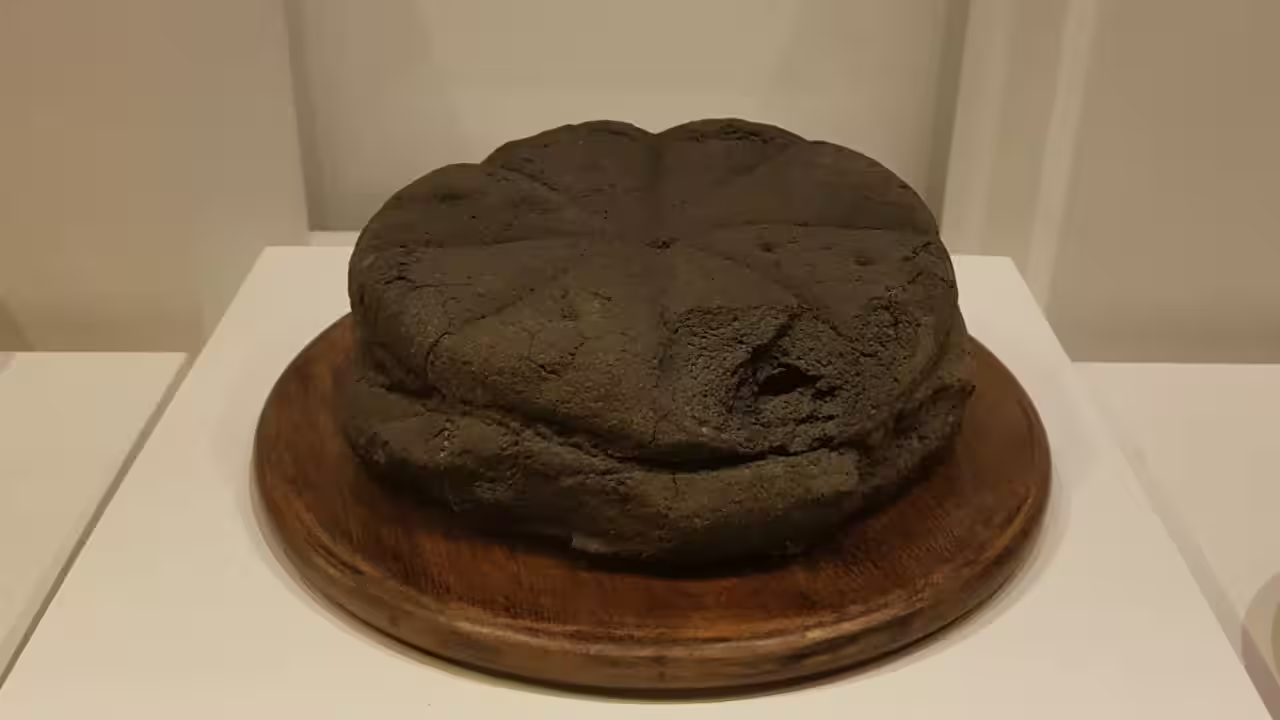
When Mount Vesuvius erupted in AD 79, a loaf of bread was still inside an oven in the Roman town of Herculaneum. The eruption buried the town, leaving the bread trapped beneath volcanic material. Nearly 2,000 years later, archaeologists found the loaf during excavations in 1930. Although it had turned black and become carbonised, the bread had survived, giving researchers a rare opportunity to examine food prepared by people living in ancient Rome.The discovery offered something that written records alone could not provide. It was an actual piece of food from the period, recovered from the place where it had been baked.The British Museum brought attention to the loaf during an exhibition on Pompeii and Herculaneum in 2013. The museum also invited Italian chef Giorgio Locatelli to prepare a version of the ancient bread. He recreated it in his London kitchen, following a recipe intended to reproduce the appearance of Roman loaves. The museum later shared the recipe and a video of the preparation process in July 2020.Information from Italy's Herculaneum Archaeological Park provides further details about the different types of bread recovered from the town, including their shapes, divisions and markings.Roman bakers cut bread into sectionsBread recovered from Herculaneum shows that bakers did not always leave the top of a loaf smooth. Many loaves were round and slightly flattened, with lines cut across the surface before baking.These lines had a practical purpose. They allowed the bread to be divided into portions more easily. One of the most common designs in the area around Mount Vesuvius had eight sections.This type of bread was called 'panis quadratus'. Its name was connected to the Latin word 'quadra', which referred to the division of bread into smaller parts. The loaf could first be divided into two halves and then into four portions, with further cuts producing eight sections.But the eight-section design was not the only one used. Archaeologists also recovered two well-preserved loaves with six sections each. One came from an area known as the House of the Brick Altar, while the other was discovered in the Palestra area.Some loaves carried marks Another detail found on Roman bread was the use of stamps. These were pressed into the dough and left marks that could remain visible after baking.The reason for these stamps becomes clearer when looking at how bread was made. In Roman towns around Mount Vesuvius, people often prepared dough in their own homes but used public ovens to bake it.With bread from different households being baked in shared facilities, markings probably helped identify who owned a loaf or where it had come from. Rectangular stamps were commonly used for this purpose.One surviving example was recovered from the House of the Brick Altar. The loaf, divided into six sections, has the letters “VM” stamped on it. The letters remain readable, although archaeologists have not established what they stood for.Chef recreated the ancient Roman loafThe British Museum's recreation offered a way to understand the preparation process. For its 2013 exhibition, chef Giorgio Locatelli made a round loaf using ingredients listed in a recipe later published by the museum.The ingredients included wholemeal or plain flour, spelt or buckwheat flour, salt, sugar, water and biga acida, a sourdough preparation.The flours were mixed before the sourdough and water were gradually added. After kneading, the dough was shaped into a ball, flattened and allowed to rise for approximately one and a half to two hours.The next stage gave the bread its distinctive appearance. A string was tightened around the outside to create a raised edge, while a knife was used to divide the top into eight sections.The museum also explained how a stamp could be added before baking. The loaf was then baked at 200 degrees Celsius for around 30 to 45 minutes.Other baked foods that survived The excavations did not reveal only large loaves. Archaeologists also found smaller flatbreads, providing further evidence of the food available in Herculaneum.Some of these were circular and resembled biscuits. They had hollowed centres and holes that may once have held strings. Their surfaces also carried geometric designs and patterns resembling plants.Three groups of these flatbreads were found stacked along the Lower Decumanus, a street in the ancient town. According to the archaeological park, they were probably displayed for sale in thermopolia, shops that sold prepared food.You use AI every day. Now get your AI Quotient. Take the AIQ test.
Topics in this story
Gathered from external sources. Rights to this text belong to whoever originally published it.