European buildings are collecting human urine and turning it into fertiliser, with systems processing 3 million litres a year
A toilet in an office or apartment building usually has a simple purpose: waste goes in, water carries it away and the sewage system takes over.
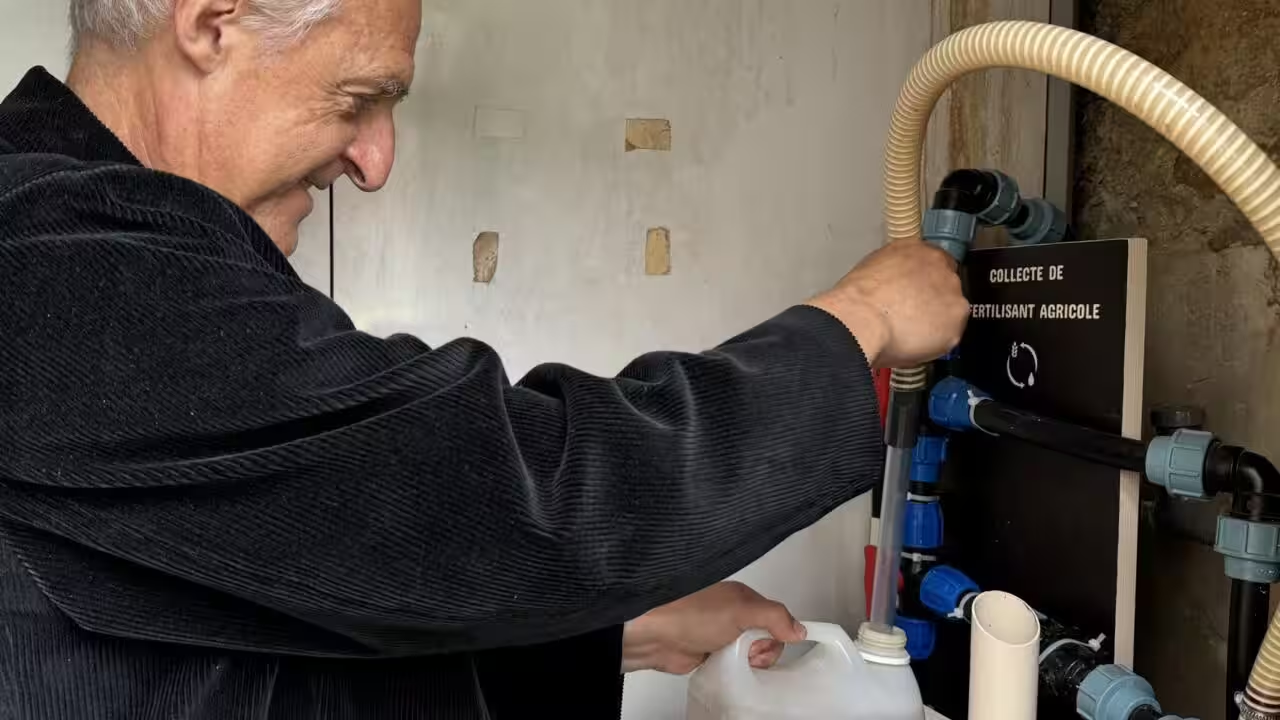
A toilet in an office or apartment building usually has a simple purpose: waste goes in, water carries it away and the sewage system takes over. In parts of Europe, that routine is being redesigned. Special toilets can separate urine before it is diluted with flushing water, allowing the liquid to be collected inside the building and treated as a source of plant nutrients. The approach is now operating in commercial and residential properties, including the European Space Agency's headquarters in Paris and a major private bank in Geneva. Across several installations, around 3 million litres of urine are being recycled each year. The resulting product can be used as fertiliser, while recovered water can return to the building's flushing system.The Swiss technology separating urine from ordinary wastewaterThe system depends on catching urine before it becomes part of a much larger stream of wastewater. Specially designed toilets and urinals direct the liquid through separate pipes without adding large amounts of flush water. That makes a difference because ordinary sewage contains a mixture of water, urine, faeces and other household waste. Separating the urine while it is still concentrated means the nutrients can be recovered without first treating an enormous volume of diluted wastewater.VunaNexus, a Swiss company developing this approach, has installed its technology in several large buildings. The treatment equipment can sit in the basement, turning what normally disappears into the sewer into a separate material that can be processed and reused.From building toilets to a bottle of fertiliserOnce collected, the urine goes through several treatment stages. The process removes unwanted substances, including micropollutants such as traces of medicines, while concentrating nutrients such as nitrogen and phosphorus.The liquid is then pasteurised at about 90C to deal with pathogens. Water is separated during the process and can be recovered for reuse, including for flushing toilets. What remains becomes Aurin, a liquid fertiliser produced from human urine. The product is not simply untreated urine being poured onto farmland. VunaNexus says its fertiliser has been approved for use on plants by authorities in Switzerland and France, and it is being sold for agricultural, gardening and household applications.How urine recycling is moving into major buildings across EuropeOne of the better-known installations is at the European Space Agency's headquarters in Paris. Instead of sending urine straight into the conventional sewage network, the building's toilets direct it towards a treatment unit.The technology is also operating in Switzerland, including at one of the country's largest private banks in Geneva. Taken together with other commercial and residential installations, VunaNexus says its systems are now recycling roughly 3 million litres of urine each year, as reported by European Space Agency (ESA). A larger development is also under way in Paris. The technology is being incorporated into a newly developed eco-neighbourhood, which is expected to become the company's biggest urine-recycling project in Europe.The nutrients are valuable because plants need themHuman urine contains nitrogen, phosphorus and potassium, the same broad group of nutrients associated with conventional plant fertilisers. The attraction is less about the urine itself than about recovering these nutrients before they are lost into the wastewater stream.There is already a wider European push to make use of this resource. In France, Toopi Organics has been collecting urine from places including motorway service areas, public venues and music festivals and processing it into microbial plant biostimulants. The company has said it wants to distribute more than 5 million litres of urine-based biostimulants across Europe by 2029. Projects in the Netherlands and Sweden have also explored urine collection for agricultural use. At the Dutch Zwarte Cross festival, for example, around 60,000 litres of urine were collected and converted into ammonium sulphate fertiliser.How Wales is testing recycled urine fertiliser for new forestsThe idea is moving beyond food crops. In Wales, a three-year Forestry Commission-backed project is testing urine-derived fertiliser on young native trees. Bristol-based NPK Recovery has been collecting urine from portable toilets at events including the London Marathon and Boomtown Festival. Its treatment process uses nutrients recovered from the liquid to produce fertiliser that has already been tested on grass and crops.The new trial involves Stump up for Trees and a nursery near Abergavenny. The partners plan to use the fertiliser while growing 4,500 native British trees, including beech and Scots pine, before planting them in Bannau Brycheiniog National Park. The project has received a £435,627 Forestry Commission grant.It is a different setting from a bank or office, but the basic principle is similar: keep urine separate, recover its nutrients and put them back into a useful biological cycle.How festivals are turning toilets into nutrient recovery systemsLarge public events produce an unusual opportunity for urine recovery because thousands of people use temporary toilets within a concentrated area. Instead of transporting the waste as conventional sewage, collection systems can capture some of the nutrients where they are produced.NPK Recovery has used events such as the London Marathon and Boomtown to build experience with collection and processing. Other European companies are pursuing similar arrangements with festivals, public toilets, motorway facilities and other high-use sites.The approach also changes the role of the toilet itself. Rather than being only the first stage in a waste-disposal chain, it becomes part of a system designed to recover materials.Why scaling urine recycling remains difficultThere are limits to how far the technology can go. Recovering nitrogen from urine remains more expensive than producing synthetic fertiliser in some small-scale systems, particularly when the cost of collection and treatment is included. VunaNexus has said that scaling up the technology and recognising the wastewater-treatment benefits will be important to its economics.The collection problem is also real. A treatment plant needs a reliable supply of separated urine, while buildings need specially designed plumbing and toilets. Transporting large quantities over long distances can undermine some of the benefits.That helps explain why buildings, festivals and other places where urine can be separated at source are becoming important test sites.A different route for nutrients that normally disappearVunaNexus estimates that recycling urine across Europe could provide around 30% of the region's nitrogen requirement. That is a company estimate rather than an indication that urine recycling could replace the fertiliser industry, but it illustrates the scale of the nutrient stream being considered. The technology is therefore being tested as part of a wider shift in how cities handle waste and resources. Urine is mostly water, but the small fraction containing nutrients can be isolated before it becomes mixed with everything else.At the European Space Agency's headquarters, in a Geneva bank and in new developments in Paris, that process is already happening inside buildings. In Wales, a related idea is being taken into a tree nursery. And at festivals, the same material is being collected from temporary toilets before it is lost to the conventional sewage system.You use AI every day. Now get your AI Quotient. Take the AIQ test.
Topics in this story
Gathered from external sources. Rights to this text belong to whoever originally published it.