Is an 'AI war' complicating your job search?
How fair are AI recruitment tools that help decide our future, and what happens when we click "apply"?
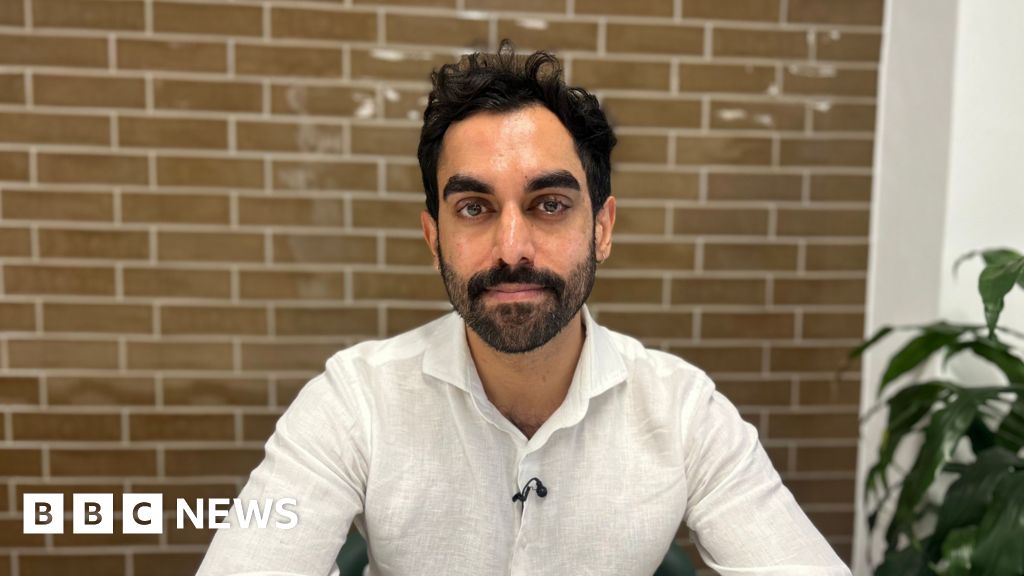
I have lost track of the number of people who have told me they have applied for hundreds of jobs, only to be met with rejection after rejection.
Often, they said it felt like a human had not even looked at their applications.
There are lots of different types of recruitment tools. Some match candidates to jobs, others grade and screen CVs. Employers use them to save time sifting through applications, but there are growing concerns that these tools could be biased.
I want to find out how fair AI recruitment tools being used to help decide our futures really are - and what happens when we click "apply".
A London-based non-profit organisation, People Like Us, is raising awareness of people's legal right to challenge automated decisions when they disagree with the outcome.
A survey conducted by Censuswide among 2,000 UK workers who had applied for at least one job in the past 24 months found that 75% were unaware of their right to challenge an automated rejection.
Sheeraz Gulsher, CEO of People Like Us, is leading the campaign called Reject the Rejections, which calls on employers to improve transparency and accountability in the use of AI and automated recruitment systems.
He describes the current situation as an "AI war", with candidates "resorting to AI to bolster their applications" while "employers are dealing with huge amounts of applications".
Gulsher said: "We can't say for certain that every company is operating its automated or AI systems without bias. That's why we're calling for companies to audit these systems, publish the results and have them independently assessed.
"In our research, we found guidance from the Information Commissioner's Office stating that people subject to certain automated decisions have the right to request a human review. We're trying to remind people of that right, as many simply aren't aware of it."
The research also found 70% of ethnically diverse jobseekers had altered or concealed information on their CVs, including their country of origin, religion or name, out of fear that recruitment software or AI tools would reject their applications. This compares with 57% of white candidates.
Business consultant Vivi, who lives in Lewisham, was made redundant earlier this year. She says she has applied for so many jobs that she's given up and started her own company.
"There's one instance where applications closed on Friday and I got a reply on a Saturday morning basically saying that I should work on my skills and come back in six months. But it was so obvious that nobody had assessed my skills."
If she had known she could ask for a human to review her application, she might have done things differently.
"I would definitely go back and ask for a human to look at my application and if it is a 'no', that's fine, but feedback helps me as a jobseeker."
Hema, 49, from Surrey, is an HR and talent professional who has worked internationally across multiple sectors.
She was made redundant in June and has since tracked more than 100 job applications and recruitment opportunities.
"A lot of them have been automatically rejected within 24 to 36 hours."
She added: "I've always landed a job in 10 applications, so to be nearing 100 is completely out of this world."
While she is "hesitant" about asking for a human review in case she jeopardises her application, she believes "a human recruiter can see the fuller picture".
"If you've got an in-house recruitment team, they know the culture, they can see the type of language that you're using in your CV, in your cover letter, during a phone screen."
Of the 425 recruiters CV-Library spoke to, about 90 said they used AI in the CV screening stage.
Alec Stanwell, director of marketing, believes there is a "perception gap".
"Candidates almost universally believe that employers are using AI to screen their CVs, filter them and to screen them as they go through the process and that is happening but nowhere near as much as candidates think it is.
"That perception gap is a problem because candidates are now writing their CVs, and applications, through the lens of 'an AI bot is going to be reviewing this rather than a human'.
He adds this is a problem because recruiters are seeing all CVs look the same because "they're all written by AI, or polished by AI".
He says this creates a "perfect storm" because AI is then more likely to be used to filter through a large volume of applications.
"We're going to end up with computers hiring computers, but we're actually in the world of hiring people."
Some candidates were rejected from multiple roles more often than would have been expected if they had been assessed by each employer independently.
The analysis also indicated black and Asian applicants were recommended for jobs at lower rates.
But the evidence is limited. They only looked at one AI hiring tool, and other factors such as education and immigration status could have also played a role.
The hiring tool assessed did not respond to our requests for comment.
The people I have interviewed are not talking about any company in particular, but concerns over AI used in recruitment are also playing out in the courts.
One company, Workday, is facing legal claims in the US, alleging that its tools discriminated against job applicants.
The case is ongoing, but Workday denies the claims and says its tools do not make hiring decisions.
More generally, it says its tools "support rather than replace human judgement".
What makes this even more difficult is that AI hiring tools work in different ways, with some not even screening CVs in the first place.
I spoke to one company that grades candidates on text-based chat interviews.
Barb Hyman, founder of Sapia AI, said: "We don't know anything about you from a demographic perspective and we don't know whether or not you were hired or not hired for a previous role. So I think you've really got to look at the nature of the AI and how it's built. Not all AI is the same.
"At least in the enterprise space, every company we speak to is very conscious of the EU AI Act, even if they don't see themselves as having to comply with that yet. And that requires a level of accountability."
She added: "No company ever built a high-performing culture by monitoring its people, and you won't build a fair hiring process by policing candidates either.
"Start by earning candidates' trust: tell them what you're measuring, how they'll be scored, and give them feedback. Fraud gets smaller when people trust the process."
Can you tell when somebody has used AI on their CV?
Alec Samways, CEO of London-based Splendid Communications, says they usually get three to four hundred applications for three places on their annual intern programme but last year they saw triple the numbers.
"We saw a huge uptick in applications, but strangely, they all look the same. Our suspicion was candidates all of a sudden were using AI to make the applications themselves."
Samways used two different AI tools to help the company understand how much of the content was produced by AI but they "produced such a variety of responses".
"We found we couldn't trust them and we had to literally sift through those, applications in a human way in the end.
"It's just clear that at this point we're not prepared to trust AI for this kind of decision-making."
An ICO spokesperson said AI and automation could "make recruitment quicker and more efficient" but "must not come at the expense of people's rights".
They said: "Employers should be upfront about when automated decision-making is being used, how it works and how it could affect someone's application.
"Bias can appear at different stages of building and using AI products, and we expect all organisations to take steps to identify and mitigate it."
A government spokesperson said that "while AI can help employers manage large volumes of applications and reduce administrative burdens, it is vital that recruitment processes remain fair, transparent and accessible".
They added: "Existing legal protections, including equality and data protection law, already apply to AI systems, and we will act where additional protections are needed."
There seems to be a real fear of the unknown because we are often unsure what happens on the other end once we click "apply".
But given it seems AI is here to stay, how can we ensure it's fair?
Listen to the best of BBC Radio London on Sounds and follow BBC London on Facebook , X and Instagram . Send your story ideas to hello.bbclondon@bbc.co.uk
Topics in this story
Gathered from external sources. Rights to this text belong to whoever originally published it.