In 2026, Phoenix added 19 shade roofs at busy crossings; the desert-inspired structures now give pedestrians a cooler place to wait for traffic lights
Phoenix has installed 19 shade roofs at key pedestrian crossings to provide relief from extreme summer heat, improving safety and comfort for walkers as temperatures soar.
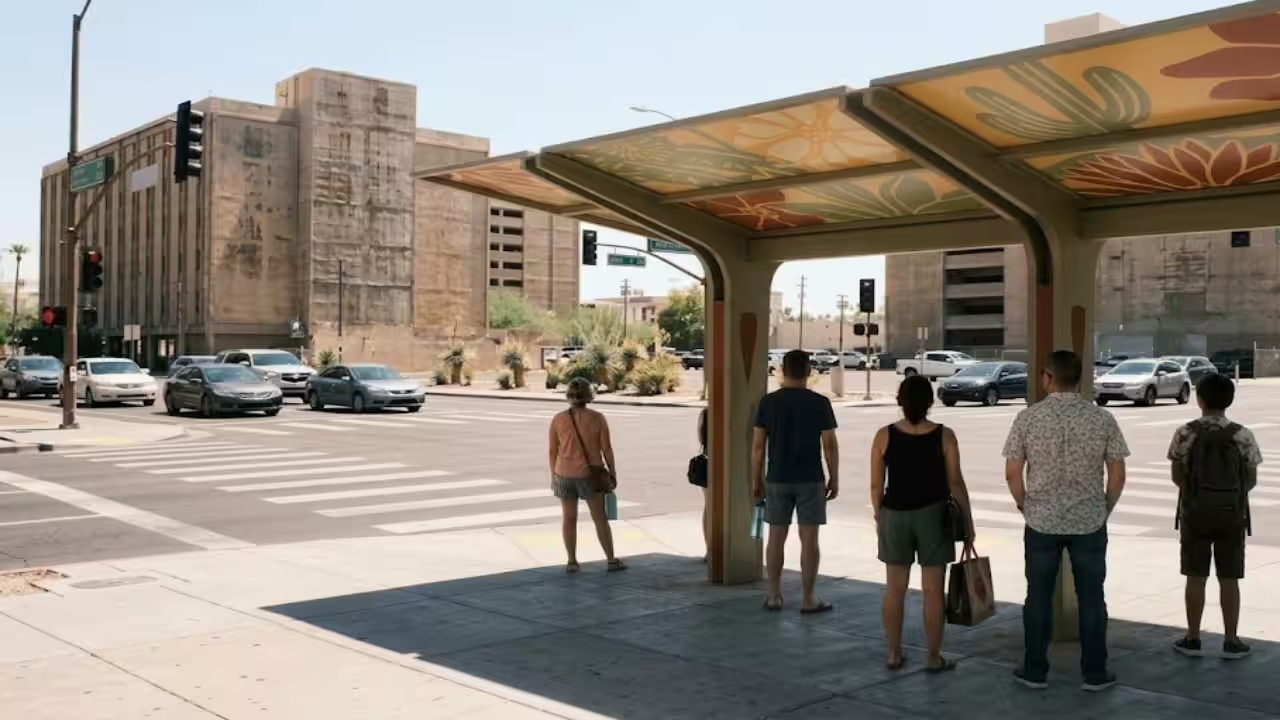
In July, a red pedestrian light in Phoenix is a little endurance test. The sun beats down on your neck, the pavement is hot, and many places lack trees or cover. The city's solution, completed in April 2026, consists of 19 colorful shade structures installed at major intersections and crosswalks, where pedestrians can use them while waiting for traffic signals to change. The designs take inspiration from the Sonoran Desert.The City of Phoenix states the Office of Heat Response and Mitigation partnered with the Streets Transportation Department and the Department of Arts and Culture on the project. The locations were selected for pedestrians who must wait for traffic signals to change.Designs inspired by the desertThree different shade designs were used, all inspired by the local desert environment. Two are variations on the saguaro blossom, one a single panel by artist Isaac Caruso, the other a multi-panel rendition by Heidi Dauphin with Studio Curiosity. The third is a butterfly design by Sara Altieri of Green Heart Creative Services. Each structure has its own look, shaped by the artists’ patterns etched in the roof panels and their choice of colour. The city's location list identifies structures with concrete bases as well as structures without them.The structures are distributed across the city, from Indian School Road and Central Avenue to Van Buren Street and 28th Street, and from Camelback Road and 23rd Avenue to Southern Avenue and 19th Avenue. The city had a public meeting in August 2024 to share plans and hear feedback.The project was not without its detractors. The project was funded with federal American Rescue Plan Act money, and Heat Response and Mitigation Director David Hondula said the funding requirements helped determine where structures could be installed. Councilwoman Betty Guardado expressed disappointment that District 5 would receive only one structure.The importance of shade in this contextIt’s not easy to dismiss the health argument. In 2025, the yearly report of the Maricopa County public health department found 430 deaths attributable to heat. It’s down from 608 in 2024 and a record 645 in 2023, but it’s still a terrible toll. That won’t be prevented by a shade canopy at a crossing by itself, but it’s aimed at a place where people can’t just walk away from the sun.How much difference does it makeShade science tells us the roofs are worth the effort. Air temperature doesn’t vary much between sun and shade, but what a body feels does. Air temperature may vary by only a couple of degrees between sun and shade, but physiological equivalent temperature, a measure of how hot conditions feel to the body, can vary by about 20 degrees in summer, said ASU urban climatologist Ariane Middel. She said constructed shade structures work in ASU studies for regions where trees have a particularly difficult time growing and don’t need water.But shade is not a complete solution to extreme heat. An ASU field study led by Middel found that shade from photovoltaic canopies and trees improved outdoor thermal comfort in Tempe, showing why reducing direct solar exposure matters even when the surrounding air remains hot.The project covers only a small part of Phoenix's pedestrian network, while trees remain important to the city's longer-term shade strategy. The crossings provide relief at that one place where pedestrians have to pause in the sun, subject to the signal. That is a modest change that can help pedestrians crossing Phoenix in the summer.You use AI every day. Now get your AI Quotient. Take the AIQ test.
Topics in this story
Gathered from external sources. Rights to this text belong to whoever originally published it.