During 2019-20, scientists dried Arizona’s Biosphere 2 rainforest; below 19% soil moisture, its soil switched from absorbing VOCs to releasing them into the air
US News: A recent study reveals how prolonged drought conditions in Arizona's Biosphere 2 rainforest caused soil to switch from absorbing to emitting volatile organic compounds (VOCs) when moisture levels dropped below 19%, highlighting significant environmental implications.
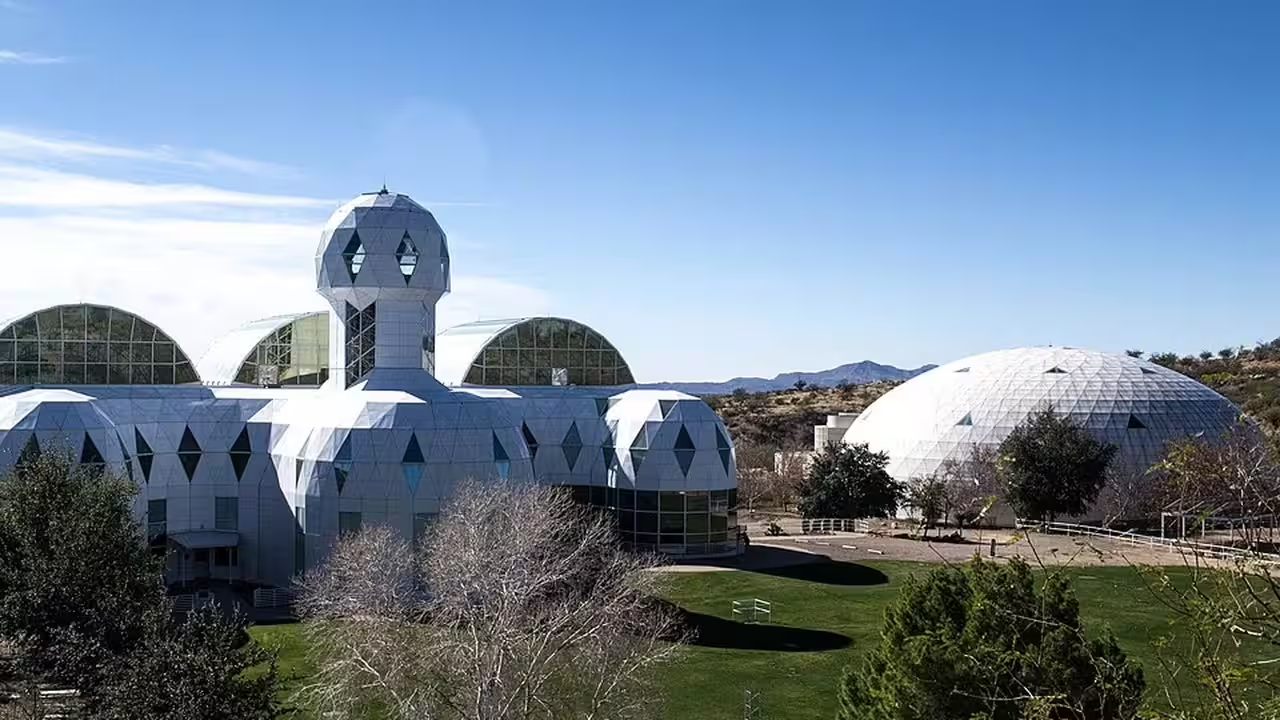
A rainforest floor may look quiet, but beneath the vegetation, soil microbes are constantly exchanging gases with the atmosphere. During a controlled drought inside Arizona's Biosphere 2, scientists found that this exchange could change direction as the soil dried. When soil moisture fell below about 19%, soil that had been acting as a net sink for several volatile organic compounds (VOCs) began releasing some of them into the air.According to research published in Nature Microbiology, the finding came from the Biosphere 2 Water, Atmosphere and Life Dynamics (B2-WALD) experiment, which examined the effects of prolonged drought and subsequent rewetting in the facility's enclosed tropical rainforest in Arizona. Researchers manipulated the rainforest's water supply and continuously monitored soil moisture and VOC exchange as the drought progressed. Soil moisture fell from about 29% to 12.5%, allowing the team to track how the soil's ability to absorb and release VOCs changed under increasing water stress. The controlled conditions of Biosphere 2 also allowed researchers to regulate drought duration and rainfall during the recovery phase, providing a way to isolate the effects of changing soil moisture.As the soil dried, its role changedBiosphere 2's tropical rainforest is a large enclosed ecosystem in Oracle, Arizona, with roughly 1,940 square metres of rainforest vegetation rooted in soil up to several metres deep. Unlike a natural rainforest, where drought develops alongside changes in temperature, rainfall and atmospheric conditions, the enclosed system allowed researchers to isolate the effects of prolonged drying. During the experiment, soil moisture declined from about 29% before the drought to 12.5% at its driest point. Scientists continuously measured VOCs leaving or entering the soil using specialised chambers connected to a proton-transfer-reaction time-of-flight mass spectrometer. This allowed them to track changes in gas exchange as the drought progressed. Under wetter conditions, the soil acted as a net consumer of several VOCs, including isoprene, monoterpenes, carbonyl compounds and alcohols. In other words, more of these compounds were being taken up by the soil than released from it.The researchers found that the soil's capacity to consume VOCs progressively weakened as the drought intensified. At soil moisture levels below approximately 19%, the soil switched from being a net sink to a source for several VOCs. Carbonyl compounds such as acetone, acetaldehyde, butanone and pentanone, for example, shifted from net uptake before drought towards net emissions under severe drying.The microbes behind the switchThe researchers then looked more closely at what was happening inside the soil. Their evidence pointed towards microorganisms as an important driver of the change. During wetter conditions, soil microbes consumed some of the VOCs present in the soil-atmosphere system. As drought intensified, microbial activity declined overall, but the organisms did not simply become inactive. Instead, their use of carbon changed.Nature Microbiology also notes that researchers used carbon-13-labelled pyruvate to follow how soil microbes processed carbon under normal and drought conditions. During drought, emissions of several volatile metabolites, including acetate, acetone and diacetyl, increased, while carbon dioxide released from microbial processing declined. The researchers interpreted this as evidence that drought altered microbial carbon metabolism, leaving more carbon in volatile compounds that could escape into the atmosphere. This helps explain why the change in VOC behaviour was more complicated than simply saying that dry soil produces more gases. The drought affected both production and consumption. Some microbial pathways became less active, while other processes associated with stress and the accumulation of intermediate metabolites became more prominent.What happened when rain returned?The experiment also examined what happened when water came back. After 65 days without normal rainfall, researchers rewetted the rainforest. The return of water produced a rapid burst of carbonyl emissions, followed by a more prolonged release of sulfur-containing compounds. The first response appeared to involve largely abiotic processes, while the later emissions were linked more strongly to biological activity. The response shows that drought does not simply push an ecosystem from one stable state into another. Drying and rewetting can produce different chemical reactions, with the timing and composition of emissions changing as the soil moves between wet and dry conditions.The implications extend beyond the glass walls of Biosphere 2. Tropical forests are major contributors to the global pool of biogenic VOCs, and climate change is expected to increase the frequency or duration of drought in some regions. If prolonged drying reduces the ability of soils to consume atmospheric VOCs while increasing the release of certain compounds, the overall balance between the forest floor and atmosphere could change.The Arizona experiment does not show that every drought-stricken rainforest will behave in the same way. What it does reveal is a less visible consequence of water stress. Drought can alter the chemistry of soil itself, changing the underground microbial processes that determine which compounds are retained and which escape into the atmosphere. Inside Biosphere 2, that transition could be watched in unusually fine detail: as the soil dried, its capacity to absorb VOCs weakened, and below roughly 19% moisture, the balance tipped towards emission. A forest floor that normally helped remove certain gases from the air had, under severe drought, begun putting some of them back.Catch the latest World News and Live updates. Download the TOI app.
Topics in this story
Gathered from external sources. Rights to this text belong to whoever originally published it.