After salvage crews recovered a Wells Fargo treasure-box lid from the wreck of the S.S. Central America, it sold for $99,600 at auction in 2022
Discover the historic Wells Fargo treasure box lid recovered from the S.S. Central America wreck, auctioned for $99,600 in 2022. Learn about the ship's journey, its significance, and the artifacts recovered from the ocean depths.
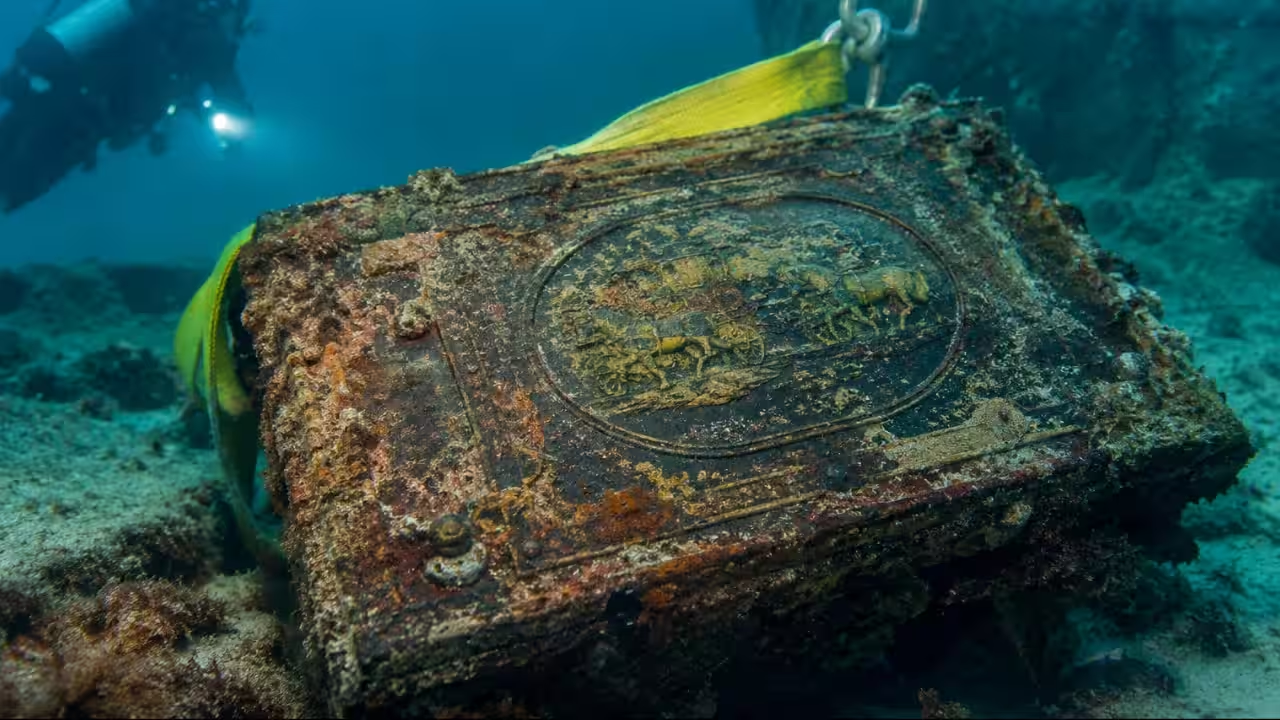
In the 1850s, steamships carried California gold across the Isthmus of Panama and on to New York, and one of those ships, the S.S. Central America, never completed the final leg of its journey from Havana. The ship sank during a hurricane, taking most of the people aboard and a heavy load of California gold with it. For more than a century, the ship and its cargo remained on the ocean floor, out of reach of researchers and treasure hunters. Modern salvage teams found the ship and retrieved some of its gold, personal effects, and cargo pieces. Among these items that have since been sold to collectors is a wooden lid of a treasure box belonging to Wells Fargo.A hurricane sank the Central America in September 1857The reanalysis notes from the Hurricane Research Division at NOAA for the 1857 season refer to the storm as the Central America Disaster of 1857, as documented in Ludlum’s 1963 book. This note uses a central pressure of 961 millibars as the measure of the intensity of the storm, but the wind speed of 94 knots is to be considered an estimate unless there is a specific meteorological source. The official track uses 90 knots, which the reviewers see as proof that the storm can be classified as a hurricane. The Papers of Abraham Lincoln project records that the S.S. Central America, carrying $1.5 million in gold bullion, went down off the coast of South Carolina on September 12, 1857, after being battered by the hurricane. Other information about the storm’s path and intensity includes its path near the Keys and into the Gulf, as well as being considered a major hurricane in the reanalysis, as the reviewers state that the 90-knot estimate qualifies it as such.A 1985 probability distribution guided the search that located the wreckThe wreck remained lost until a statistically based search plan led searchers to it. In Search for the SS Central America: Mathematical Treasure Hunting, published in 1992 in Interfaces, Lawrence D. Stone describes being asked in 1985 to develop a probability distribution for the ship’s location. He writes that the method combined historical, statistical, analytic, and subjective approaches and that the resulting search plan found the wreck. The paper reports that 425 people died in the sinking and describes the wreck as lying almost 8,000 feet below the surface, an approximate figure, while the 2022 auction report and numismatic sources give about 7,200 feet.The above-mentioned study reports that the Columbus-America Discovery Group raised one ton of gold bars and coins from the wreck in 1989 after three summers of effort at sea. In a 2017 interview with The Naked Scientists, Stone said that one of the key pieces of information was the last position Captain Herndon called out to a passing ship at about 6 p.m. on the evening of the sinking, roughly two hours before the vessel went down.Eastern bankers had counted on the gold as the Panic of 1857 took holdThe Lincoln project entry explains why the cargo mattered beyond its value. Eastern bankers had hoped California gold would help strengthen the financial system, and the ship’s loss came as the Panic of 1857 took hold. The scholarly picture is more layered. In The Panic of 1857: Origins, Transmission, and Containment, published in The Journal of Economic History, Charles Calomiris and Larry Schweikart trace the panic to a decline in western land and railroad investments, which stressed securities brokers and banks in eastern cities.Because the authors place the weight on those investments, and the panic was already underway before the ship sank, the lost gold appears to have worsened an already strained system rather than created the crisis. The authors describe the shock spreading through the banking system as brokers marked down collateral, margin calls intensified, and eastern money markets tightened before the Central America was lost.Holabird sold 270 recovered artifacts in Reno on December 3, 2022A December 8, 2022 press release from Ken Hall Public Relations says Holabird Western Americana Collections sold 270 lots of California Gold Rush items salvaged from the S.S. Central America at its December 3 auction in Reno, Nevada, and online. The release adds that sales reached almost $1 million, with more than 7,500 bidders from the United States and six other countries. The salvage company that discovered the wreck reached an agreement with the insurers and their successors. Coin World reported that an Ohio judge approved an agreement under which California Gold Marketing Group bought the treasure recovered in 2014 from Recovery Limited Partnership and Columbus Exploration for $30 million.The lid engraved with the Wells Fargo name brought $99,600The unique wooden lid of a Wells Fargo & Co. treasure box was among the highest-priced pieces in the auction, selling for $99,600. Holabird describes it as the lid to the oldest known Wells Fargo treasure shipment box, with the engraving “Wells Fargo & Co./New York” clearly visible. In the announcement of the December 2022 auction by Holabird Western Americana Collections, it was stated that the purser’s keys to the treasure room of the S.S. Central America were sold for $103,200 and five-button miner’s work pants found in the wreckage were sold for $114,000. Although the announcement says that it is a record of the highest price of jeans, it is worth noting that this record claim should be attributed to the organizers of the auction. A treasure shipment box from the San Francisco bankers Sather & Church sold for $6,300, CoinWeek reported.You use AI every day. Now get your AI Quotient. Take the AIQ test.
Topics in this story
Gathered from external sources. Rights to this text belong to whoever originally published it.