Ball State buried about 3,600 geothermal wells beneath its Indiana campus; the system now heats and cools 47 buildings and saves roughly $2 million a year
Ball State University transforms its energy system by installing the largest geothermal heating and cooling network in the US, saving approximately $2 million annually and significantly reducing carbon emissions.
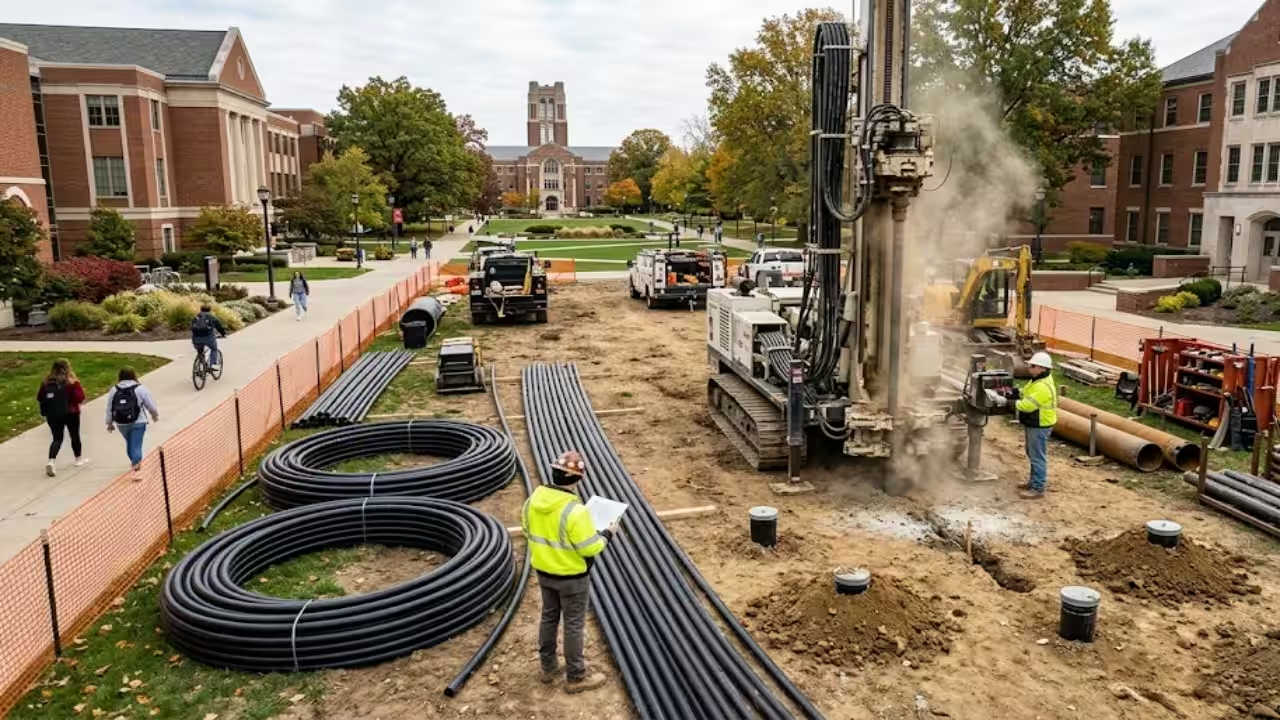
For nearly 70 years, Ball State University in Muncie, Indiana, relied on coal to heat its campus during winter. The campus heating plant had four coal-fired boilers that burned, according to later estimates, about 36,000 tons of coal a year to keep classrooms and residence halls warm. But as the equipment aged and the cost of installing a new fossil fuel boiler increased, university leaders began to look at renewable options instead. The university has installed a campus-wide geothermal network that now supplies heating and cooling across much of the campus.According to the US Department of Energy, it is one of the country’s largest ground-source geothermal heating and cooling systems. Construction began in 2009 to replace four coal-fired boilers and eventually provide heating and cooling to 47 buildings across the campus. Geothermal heat pumps had long been used to heat and cool individual buildings, but applying the technology at this campus scale was unprecedented at the time.Why did the university digCoal was turning into a bad investment. The boilers were getting older and less dependable, and the cost of a new fossil fuel unit would have increased with each passing year. The university decided to transform the entire campus after a proof of concept trial persuaded the team that a ground source heat pump system could supply both hot and chilled water.Not everyone saw that as wise. Two reputable geothermal system designers informed project manager Jim Lowe they weren't sure a system this big would be practical and effective, according to Ball State's own magazine. Drilling started in July 2009 after Lowe refused to accept that. The remaining coal-fired boilers were shut down in March 2014. The bill arrived at $83 million, covered by state appropriations and federal grants, including Recovery Act money.How the ground does the workA few feet below the surface, the ground remains close to 55 degrees Fahrenheit, providing a relatively stable temperature that engineers can use as a source of heat in winter and a place to reject heat in summer. About 3,600 boreholes, each roughly 400 feet deep, were drilled across campus, and every one holds a loop of pipe sealed in grout. Because this is a closed-loop system, fresh water circulates through the pipes without ever touching natural groundwater.In winter, heat pumps extract heat from that fluid and transfer it into the buildings. In summer, the process reverses: heat is extracted from the buildings and released back into the ground. There are two district energy stations, one north and one south, with four heat pump chillers, each of 2,500 tonnes. About 10 miles of distribution piping connect the energy stations to campus buildings, while the borehole fields contain roughly 1,000 miles of smaller geothermal piping.How the system worksThe system has also substantially reduced the university's carbon footprint by replacing coal-fired heating. The campus is avoiding the burning of coal, thus saving roughly 85,000 tonnes of carbon dioxide a year, along with reductions in sulphur dioxide, particulate matter and coal ash, the engineers’ design summary said.It's not all one-sided. Ball State's project analysis found that the geothermal system could reduce overall energy use and carbon dioxide emissions compared with continuing to rely on the coal-fired boilers. The project also required a substantial upfront investment, making state and federal support important to its development.But the initiative has attracted interest far beyond Indiana. Ball State said tour groups from Germany, Iceland, Japan and South Korea had visited the two energy stations. One of the project engineers later worked on a geothermal system at Ford Motor Co.'s world headquarters.The lesson is practical for colleges and towns facing the same issue. A complete loop of wells can replace coal for heating and cooling at the district level and can pay off in lower running costs and healthier air, if there is money to cover the drilling. Ball State was among the first universities to use a geothermal system at this scale, and the boreholes beneath the campus now perform much of the heating and cooling work once supplied by coal.You use AI every day. Now get your AI Quotient. Take the AIQ test.
Topics in this story
Gathered from external sources. Rights to this text belong to whoever originally published it.