'1 tick, 2 ticks': Kin seek hope in text-delivery reports in Nepal
South Asia News: TRISHULI BAZAAR (NUWAKOT, NEPAL): For two days after Serbian citizen Enisa Lekovic disappeared in the floods in Nepal, a WhatsApp message sent by her .
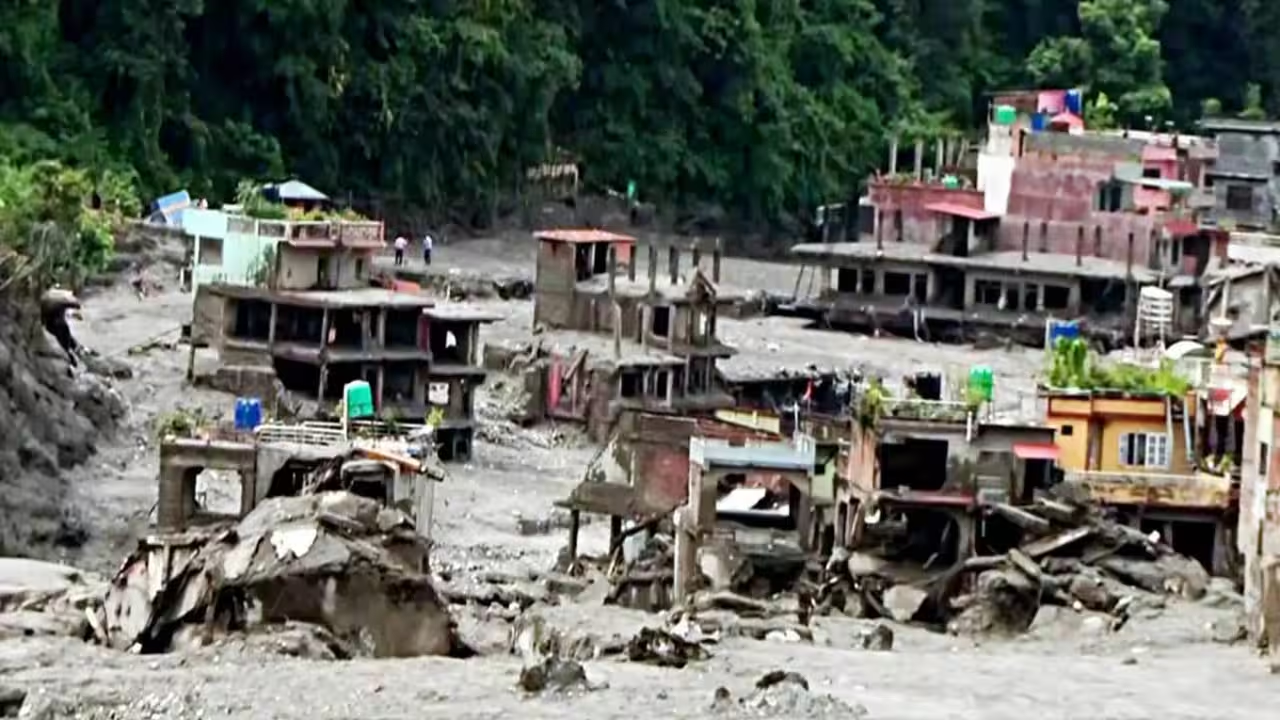
TRISHULI BAZAAR (NUWAKOT, NEPAL): For two days after Serbian citizen Enisa Lekovic disappeared in the floods in Nepal, a WhatsApp message sent by her daughter sat on a single grey tick - sent, but not delivered. Then, on Aug 28, the screen changed: the tick had turned into two blue ones - the family's first real sign of hope. On Tuesday, that hope turned into relief when her daughter, Ines Todorovic, confirmed that Lekovic had been found alive and was on her way to Kathmandu. "I can't describe what I felt these days," she wrote on social media.Like Lekovic's family, relatives of hydropower workers missing in the Bhote Koshi-Trishuli flood began turning phones into search evidence after rescue teams could not provide definite answers. They repeatedly sent messages, watching whether single grey ticks turned into two, while many bypassed conventional search desks and approached Nepal Police Cyber Bureau, Nepal Telecom, Ncell and rescue teams with mobile numbers, asking them to trace the last tower and sector where the phones had been active before signals disappeared.For families with little else to go on, a change in message-delivery status or a last tower ping became a potential clue to where a missing relative might be - and where rescuers should look next.Relatives of Roshan Kumar Joshi, an environmental expert from Morang working at the 216MW Upper Trishuli-1 Hydropower Project, repeatedly messaged him after he went out of contact. "Roshan, are you safe? Please reply as soon as you find any connectivity," read one. The single tick did not change as relatives searched social media, contacted project staff and waited for news. At the Upper Trishuli-3B Hydropower Project, relatives of engineer Pramila Pathak, 32, wrote: "Pramila, are rescue teams near your quarters? Send a location pin if your phone turns on." That message too remained undelivered.Telecom officials, however, said that a single grey tick could not show whether someone was alive, trapped or even carrying a functioning phone. Nepal Telecom said that after power supplies failed in affected areas, it shut down data and other services and kept only 2G voice services running to conserve battery backup. Internet-based messaging platforms such as WhatsApp could not deliver messages.Private mobile operator Ncell also issued a statement cautioning against drawing conclusions from a phone going offline. "A phone can disappear from the network because it was damaged by water or because its battery ran out. Disconnection does not necessarily mean the person was caught in the disaster. They may have reached safety and simply run out of battery."Meanwhile, the last mobile tower and sector used by a handset offered a more specific geographical clue. Families approached the Nepal Police Cyber Bureau, Nepal Telecom, Ncell and rescue teams with mobile numbers and requests to establish where missing workers' phones had last connected before signals disappeared. Joshi's family eventually received one such record: "Ramche-C, 9.10am, Aug 26." It showed that his handset had last connected through sector C of the Ramche tower in Rasuwa, allowing relatives to narrow the direction in which they wanted rescuers to search. Chitragupta Bhatta, who worked at Trishuli Hydropower Company Limited, left another significant digital trace. His family received: "Neupane Chaur, 9.26am, Aug 26." His phone remained active more than 15 minutes after the flood struck the area, raising hopes that he might have reached or remained inside a tunnel. "...We began to hope that perhaps he is inside a tunnel," a relative said. "So many days have passed... It is becoming difficult to hold on."A senior executive with Huawei Nepal said mobile towers generally divided coverage into three directional sectors. "By mapping the direction, we can determine whether the phone was on the river side or the mountain side."Privacy rules created another hurdle. Families could move beyond physical search desks in their hunt for clues, but telecom operators could not directly hand them subscriber's location records. A Nepal Telecom said such information is shared with security agencies through authorised channels.Catch the latest World News and Live updates. Download the TOI app.
Topics in this story
Gathered from external sources. Rights to this text belong to whoever originally published it.