October full Moon: How and when to see the Hunter's Moon
October's full Moon, known as the Hunter's Moon, will rise on Sunday night. Will the weather be in your favour?
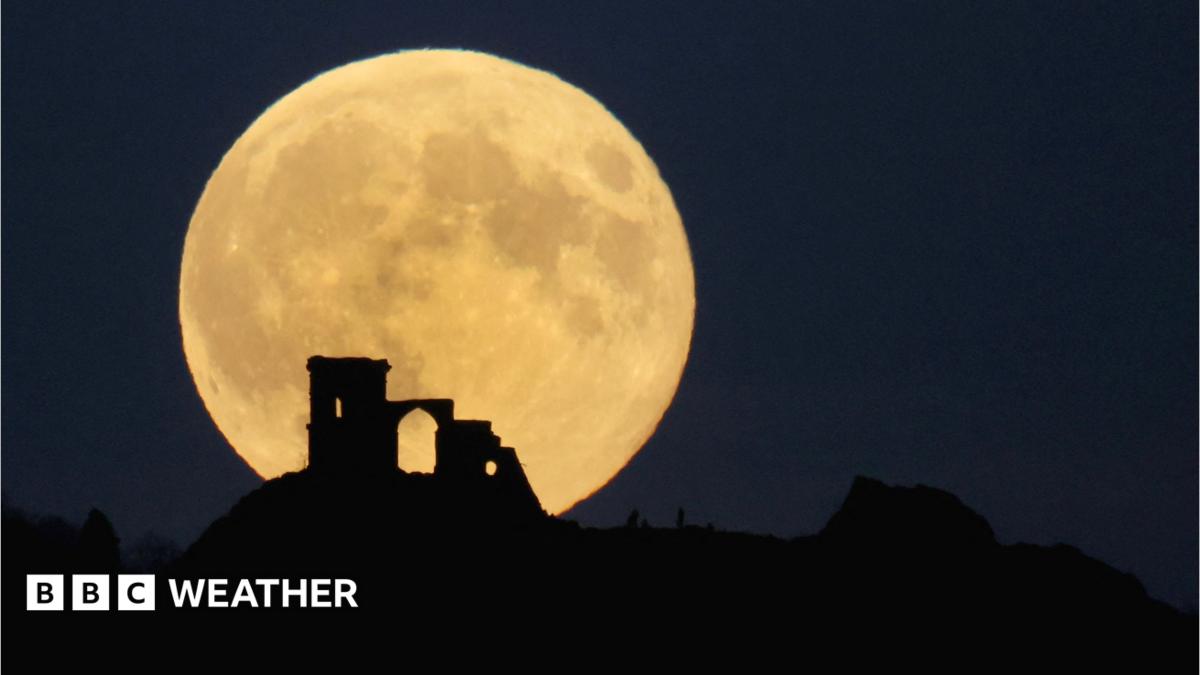
October's full Moon, nicknamed the Hunter's Moon, is set to light up the night sky this weekend.
It will be visible in the UK from Sunday 25 October into the morning of Monday 26 October.
Marking the 11th full Moon of 13 in 2026, it is the final one before a run of four consecutive supermoons , external .
If you want to catch a glimpse, keep an eye on the forecast to see if the weather will allow a clear view.
When is the best time to view the Hunter's Moon?
The Moon will rise in the east at just after 16:00 GMT on Sunday and set towards the west between 07:00 and 08:00 GMT on Monday - times vary across the UK.
The Moon will be officially full at 04:11 GMT on Monday. This is the moment of "syzygy" when the Sun and Moon will be aligned either side of the Earth.
However, the Moon will appear full on both Sunday and Monday nights, giving skygazers two chances to spot it.
During a full Moon, the whole of the Earth-facing side of the Moon is illuminated by the Sun.
You may notice an orange or reddish hue to the Moon when it is low in the sky due to the scattering of short wavelength blue light as it passes through a large depth of the atmosphere.
The longer wavelength red and orange colours are not scattered as readily so pass through to our eyes.
The Moon may also appear larger in the sky near moonrise and moonset - something called the "Moon Illusion".
This is when our brain makes us think the Moon looks bigger because it is viewed alongside objects on the horizon such as buildings and trees.
As well as looking out for the full Moon, there is also a chance to spot some shooting stars, with the Orionid meteor shower just past its peak.
The extra lunar light, however, may obscure some of the meteors, so be patient and leave time for your eyes to adjust.
Full Moons throughout the year have traditionally been given names that reflect what is going on in nature .
Different cultures use different names for the 12 or 13 full Moons across the lunar calendar, but many of the common ones we use today originate from Native American cultures.
In October, the term Hunter's Moon comes from the time of year hunters would have been most active, preparing for the colder and darker winter months ahead.
The Hunter's Moon is known to sit in the sky for a particularly long time - similar to the preceding Harvest Moon - giving hunters extra light in the skies.
Will the weather be clear enough to see the Moon?
Storm Boelo will continue to bring rain and very strong winds to northern Scotland early on Sunday night, but prospects of seeing the Moon increases as the night wears on.
There will be plenty of blustery showers in west Scotland and north-west England - any gaps between these could give a brief chance to view.
For the rest of the UK prospects are better, especially early in the night with clearer skies, before cloud tends to spread in from the south-west later.
If the weather fails to cooperate where you live, the next chance to see a full Moon will be on 24 November as the Beaver Supermoon.
This will be followed by a Christmas Eve Cold Supermoon on 24 December.
The succession of supermoons will then continue into 2027, with January and February's full Moons both set to be supermoons too.
Topics in this story
Gathered from external sources. Rights to this text belong to whoever originally published it.