After Rábida Island removed invasive rats in 2011, scientists later confirmed a native gecko alive there that had previously been known only from ancient remains
After eradicating invasive rodents from Rábida Island in the Galápagos, scientists discovered a native gecko species previously thought extinct. This groundbreaking find highlights the ecological impact of invasive species removal and the importance of biodiversity conservation.
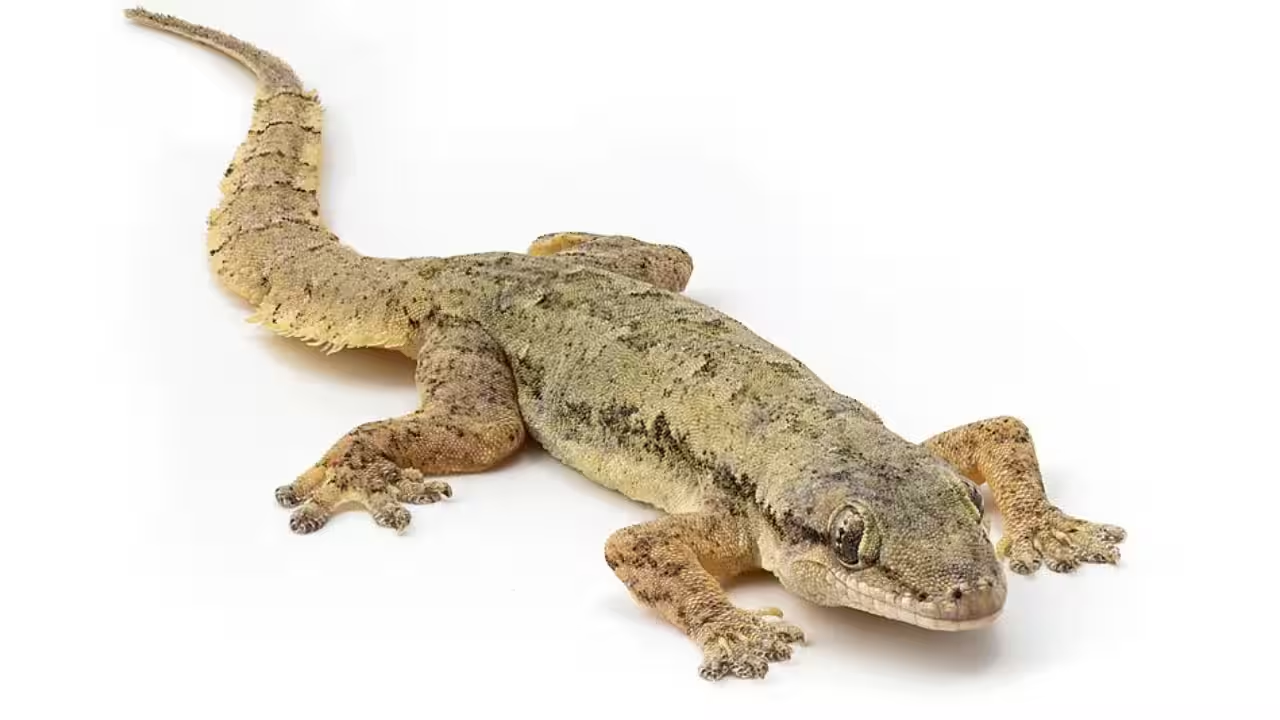
Historically, Rábida Island in the Galápagos had no records of living leaf-toed geckos, only bone remains dating back thousands of years. It was in 2011 that the Galápagos National Park and its partners were able to eradicate brown rats that invaded the island. After a year, a gecko was spotted, and more geckos were collected through expeditions carried out in 2019 and 2021. The paper, published in June 2025, came almost 14 years after the eradication. The authors suggest the removal of the rats may have helped the geckos, but it is not known how the two species interacted on Rábida Island before the rats were removed.A 499-hectare island with no gecko records except bones 5,700 to 8,540 years oldRábida, also called Jervis, is a 499-hectare island in the middle of Galápagos, located about 4.5 kilometers south of Santiago Island and 25 kilometers east of Isabela Island. There are 11 kinds of leaf-toed geckos, genus Phyllodactylus, distributed throughout the islands, but they are some of the most secretive land vertebrates on the archipelago because of their nocturnal lifestyle. No gecko specimen was ever collected from Rábida despite the extensive collecting effort from the late 19th century until the early 20th century.The sole record of gecko presence on Rábida came from sub-fossil remains estimated at 5,700 to 8,540 years old. The authors stated that it may be possible that no gecko specimen is recorded due to insufficient collecting effort. Field guides cited that there was an undescribed and possibly extinct gecko in Rábida but without details. This led the researchers to think that the geckos were already extinct when humans arrived on the archipelago.2011 eradication of brown rats, and one gecko photographed in 2012In 2011, the Galápagos National Park and its conservation partners carried out an eradication program targeting invasive brown rats. Island Conservation, which led the effort with the park, the Charles Darwin Foundation and The Raptor Center, says a gecko long thought extinct on the island was noticed a year later. In 2012, scientists and rangers surveying the island photographed a Phyllodactylus gecko, the first live leaf-toed gecko from Rábida to be documented in published literature. The specimen itself is no longer available and cannot be found in the collections where it was said to be deposited, so its identification rests on the photographs alone. The 2019 and 2021 collections, backed by tissue samples and physical specimens, provided the confirmation. Other groups that searched for the geckos prior to and during 2011 found no geckos or any trace of geckos.Nine geckos were sampled in October 2019 and 10 were collected in August 2021The observation was confirmed through two different expeditions. In October 2019, scientists collected tail tissue from nine individuals of geckos and returned the reptiles to nature. In early August 2021, ten whole specimens were caught by hand at night, mainly among lava rocks. These geckos were deposited in the vertebrate collection of the Charles Darwin Foundation in Puerto Ayora, while tissues were sent to the zoological museum of Pontificia Universidad Católica del Ecuador in Quito. In a combined analysis of two mitochondrial genes, the Rábida geckos fell within Phyllodactylus maresi but differed from Santiago geckos by 19 mutations. The 2025 study in PLOS ONE, led by Omar Torres-Carvajal, sequenced DNA from five of the samples. The Rábida geckos formed a strongly supported group closely related to Phyllodactylus maresi from Santiago and Marchena, and the authors assigned them to that species. Their morphology was similar to geckos from Santiago and Marchena.Because of that genetic divergence, the authors classified the Rábida geckos as a distinct evolutionary unit that can be managed separately. However, there is a warning in place. Some uncertainty remains about the classification of Phyllodactylus maresi, because few complete museum specimens exist for comparison: only five in total, with three from Santiago and none from Marchena. The ten whole specimens collected on Rábida in 2021 now add to that limited reference material. The authors indicate that the geckos from Rábida Island may have been helped by the process of rodent eradication, with increased distribution and population levels making them more visible. Lizard populations in the Caribbean, as well as those on offshore New Zealand islands, have shown signs of recovery after rodent eradications were performed. The ecological connection between rodents and geckos on Rábida Island is not known. The paper reports no population estimate, and it cannot show whether the geckos survived hidden through the rat years or recolonized. It shows that a species thought lost was present, genetically distinctive, and found after the rats were removed.Another Galápagos rediscovery, and why voucher specimens matterThe authors compare the find with other Galápagos rediscoveries. A 2022 study in Communications Biology showed that the Fernandina giant tortoise, Chelonoidis phantasticus, is not extinct. After the 2019 rediscovery, the only female found was moved to the park's tortoise center, and expeditions began searching for males. A valuable point learned from the findings of this paper is that vouchers with DNA samples are ideal for recording common and rarely studied species like the leaf-toed gecko because this will allow conservation efforts to be linked to specific interventions, such as removal of invasive species.You use AI every day. Now get your AI Quotient. Take the AIQ test.
Topics in this story
- Rábida Island
- leaf-toed gecko
- Galápagos Islands
- biodiversity conservation
- invasive species eradication
- Rábida Island gecko rediscovery
- Galápagos National Park
- Galápagos invasive species eradication
- conservation of invasive species
- Rábida Island brown rat eradication
- Phyllodactylus maresi
- Rodents impact on gecko populations
Gathered from external sources. Rights to this text belong to whoever originally published it.