Codebreaker, 103, kept his WW2 heroics a secret for decades
Fred Vanke was sworn to secrecy but has now been honoured by Bletchley Park.
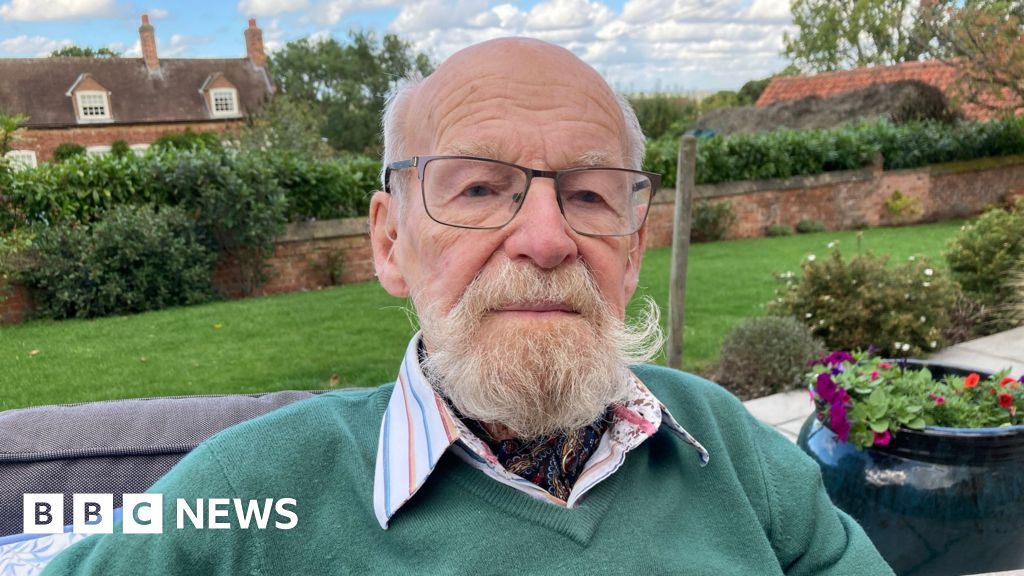
"My wife died and didn't know. I never told anybody. In fact, she always complained - all your friends, when they come visit, they all have stories to tell and you never tell anything."
From fleeing the Nazi invasion of his native Poland, to training as an operative to work behind enemy lines, to helping to crack the codes which turned the tide of the conflict, Fred Vanke had an eventful World War Two.
Sworn to secrecy however, his family and friends almost never learned of the true role the 103-year-old played in the Allied war effort.
But research into the life story of Vanke, now living in Breaston, Derbyshire, has written a new chapter on the history of Bletchley Park's famed codebreakers.
About 100 Poles based in the UK carried out work on behalf of Bletchley Park between 1940 and 1945.
After Fred shared his story, research has added the names of 27 Polish codebreakers and signals intelligence (sigint) to the Bletchley Park Roll of Honour, and more could follow.
The additions represent one of the most significant expansions of the documented Polish contribution to Britain's wartime codebreaking effort in recent years, helping historians better understand the scale of the intelligence partnership between Britain and the Polish government-in-exile.
Believed to be the last surviving member of these Polish codebreakers, Ferdynand Stanislaw Vanke grew up in Krakow, but fled at the age of 16 when war arrived on his doorstep in 1939.
He said: "I did wake up in the morning hearing the planes. I ran to the window and I could see Germans coming over but I thought it was Polish Air Force training.
"People were screaming and falling to the ground and we could hear machine gun fire. My father burst in and said 'in to the cellar, the Germans are coming'. That's how my war started."
Fred, his sister and a friend travelled east in a Polish Army Hospital van, to his grandparents' home, avoiding Nazi gunfire on the roads.
"I could see people coming from all over the place, masses of people," he said. "When Germans would come, my sister said to me 'under the van, under the van'. That's the first time I've seen people being injured to that extent."
After his initial destination Syria was lost with the invasion of France, he instead made his way to British-controlled Palestine where he joined the newly-formed Polish brigade, the Carpathian Rifle Brigade alongside his father.
"I'm going to be a soldier at last," Fred remembers thinking.
He proved his worth and after officer training in Tel Aviv he was sent to Glasgow to join the Cichociemni, a Polish special forces unit trained for occupied Poland.
"Cichociemni in Polish means dark and quiet," he said. "I've gone right through the courses, how to use the poison, how to kill people quietly, and all that sort of thing.
"One day my commanding officer, Colonel Mayer, called me and explained 'you're young, I've got a son like you, you volunteer to be dropped in Poland you will last four or five months on average and that's the end of you. I've got something better'.
Instead, a captain visited from Bletchley Park, the then-secret headquarters of the Government Code and Cypher School, the forerunner of GCHQ, and the base for Allied codebreaking.
"He gave us all a lecture and a little puzzle," said Fred.
After cracking the first, he was given a second which he also deciphered.
"He said, 'you've got a gift which very few people have'," Fred recalled.
So despite being in his early 20s, several years younger than anyone else on the unit, Fred was recruited to work at The Arches in Boxmore, a Polish sigint station near Hemel Hempstead which supported Bletchley Park.
The Arches was from the street a large but unassuming house but inside the building featured more than a dozen rooms turned into offices for codebreakers, and its garden was filled with huts housing radio operators.
One of dozens of Polish codebreakers based there, Fred would work in a team listening to German signals and attempting to decode them.
Fred said: "You start with the simple things. You've got to learn the language, how it is built, and what is the quirk in that language, and you base your guessing on that.
"When I arrived there first, I never knew anybody there, it was a little strange, but very very soon it was like a holiday."
However outside of The Arches, life was tougher for Fred.
He said: "The people in Hemel Hempstead, because we had uniforms with Poland, they spat on you and called 'why don't you eff off to fight Germans instead'.
"You couldn't say what you're doing, so that was a little bit upsetting."
But what Fred and his Polish compatriots were doing, both before the war and during it, was pivotal in the Allied war effort.
Among those identified during the research were Marian Rejewski and Henryk Zygalski, two of the three Polish mathematicians who alongside Jerzy Różycki first broke the German military Enigma cipher before the war, and who continued codebreaking work in Britain after escaping occupied Europe.
At the Pyry Conference near Warsaw in 1939, Polish cryptologists invited French and British counterparts, including Alastair Denniston and Dilly Knox, to share their pioneering success in breaking the German Enigma machine cipher.
Dr David Kenyon, the research historian at Bletchley Park Trust who investigated Fred's story, said: "This meeting was important because it laid the groundwork for partnership between the British and the Polish and significantly helped the subsequent British attack on Enigma."
Fred said: "I was very pleased when I received a letter from the British government for what I've done. But I was very proud of Zygalski, Rejewski and Różycki - that's our three real codebreakers."
After the war, Fred moved to Nottingham where he started a photography firm with a fellow Polish ex-paratrooper.
"I met my wife in Jessops in one of the shops," he said. "She was a model there, once I saw her, I said 'this is my wife'."
The couple raised three children, and were together until her death in 1996 - but Fred never told her about his wartime role.
"My wife died and she still didn't know what I was doing. I never told anybody," he said. "In fact, she always complained - 'all your friends, when they come visit, they all have stories to tell, you never tell anything'.
"You were sworn not to tell, so I kept that."
Having reached the age of 103, Fred puts his long life down to luck, whiskey and stopping smoking in 1963, and believes he must now be the last surviving Polish codebreaker.
"I'm bound to be, I am 103-and-a-half, and I was the youngest by two years," he said.
Kenyon said: "Due to the secrecy of the work at Bletchley Park, so much of this work remained classified for decades - the full scale of Polish involvement in Britain's WW2 codebreaking effort is still being pieced together.
"Adding these Polish names to our Roll of Honour pays tribute to the contribution made by Polish citizens in the wider Allied effort in WW2, not only on the fighting fronts, but also at Bletchley Park, and in other secret intelligence work, a contribution which may have been overlooked in the past."
Rafał Wiśniewski, Chargé d'Affaires a.i. at the Embassy of the Republic of Poland in London, said: "The work of Polish cryptologists, well before and during WW2, was instrumental in cracking the Enigma cypher and, ultimately, in the Allied victory, which helped save countless lives.
"The evidence proving direct links to Bletchley Park and other secret intelligence work is truly important and shows the depth of our co-operation, which needs to be recognised."
Fred's daughter Caroline Whelan, 60, said: "We've had a very happy, normal life, considering dad had a really traumatic start to his.
"It is unbelievably fantastic that he is able to witness the acknowledgement that so many people haven't been able to," she said.
"He's one of the people that you never get bored of talking to, and he's always got a story to tell now."
Listen to BBC Radio Derby on Sounds and follow BBC Derby on Facebook , on X , or on Instagram . Send your story ideas to eastmidsnews@bbc.co.uk or via WhatsApp on 0808 100 2210.
Plan for mural of WW2 hero on council building
Pioneering footballer to be honoured with plaque
Blue plaque for 'unsung' Bletchley codebreaker
Woman involved in WW2 codebreaking turns 102
Topics in this story
Gathered from external sources. Rights to this text belong to whoever originally published it.