In 2009, families in Long Branch, New Jersey, forced the city to withdraw takeover cases that would have cleared their modest homes for luxury condominiums
In a landmark decision, families in Long Branch, New Jersey succeeded in protecting their homes from eminent domain actions aimed at clearing land for luxury condominiums, ending years of legal disputes and establishing vital protections for neighborhood residents.
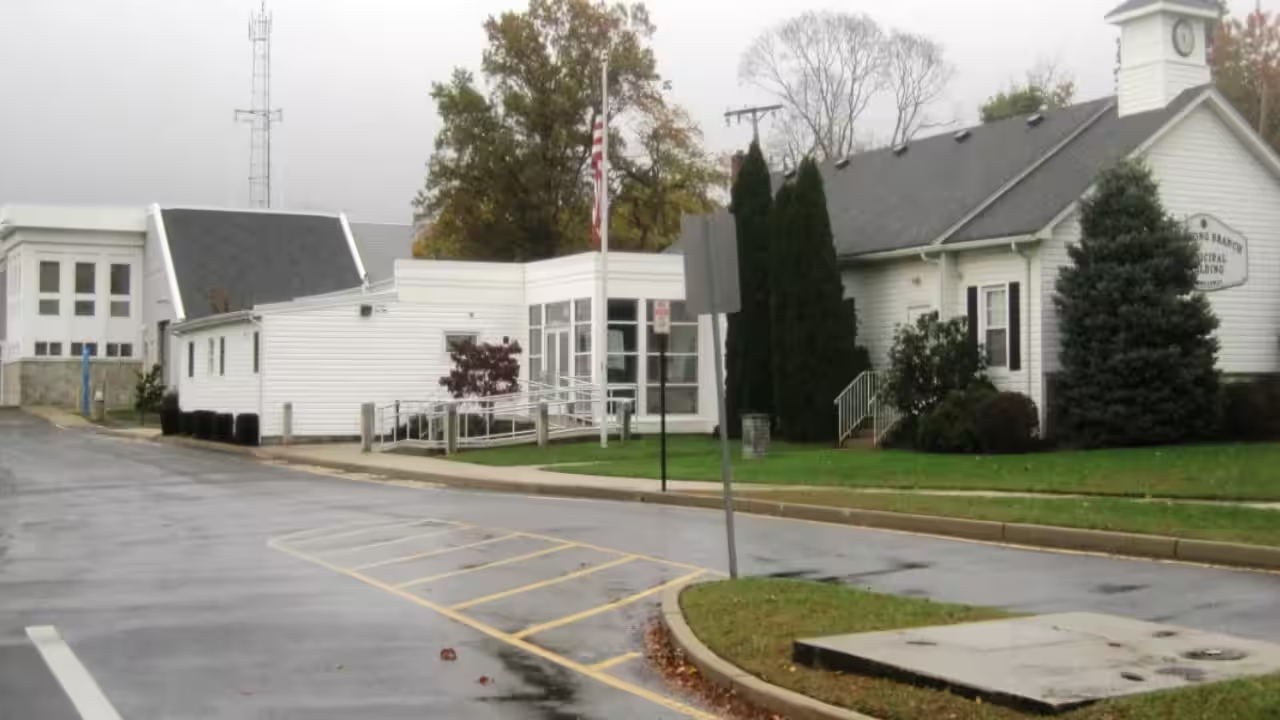
Families in Long Branch, New Jersey spent years fighting the city’s attempt to acquire their homes through eminent domain for a private redevelopment project. The dispute concluded in September 2009, with an agreement that dismissed the condemnation cases, protecting homeowners from future takings under redevelopment plans to the neighbourhood.The neighborhood, known as MTOTSA, covered Marine Terrace, Ocean Terrace and Seaview Avenue had families for generations as occupants of its cottages and bungalows. Among them was Lori Vendetti, whose parents, Carmen and Josephine Venditti, as a summer residence built their MTOTSA home in 1960 and eventually retired there in 1989. Lori lived across the street from her parent’s house.The MTOTSA neighbourhood was designated by Long Branch as part of a required redevelopment in 1996. However, representatives of several homeowners; the Institute for Justice argued that the neighborhood didn’t meet the conditions associated with blight. A city survey that year found only three of 38 residences, or 7.8%, in poor condition. In their argument, the organization pointed to a 1995 plan which recommended the preservation of MTOTSA and to a statement from Mayor Adam Schneider in 2001 which deemed that the neighborhood to be in good condition.The redevelopment plan moved toward private residential constructionThe city gave the contract of redevelopment to Applied Companies in February 2000 and later partnered with Matzel & Mumford, a subsidiary of K. Hovnanian. The plans submitted in 2004 called for 150 condominiums and townhouses, and the proposed selling prices ranged from $500,000 to more than $1 million. However, the plan was later amended and the number of units was increased to 185, rendering the estimated potential revenue from the project to reach $130 million to $185 million.The city filed eminent-domain actions against homeowners in 2005 and 2006. In June 2006, A Monmouth County Superior Court ruling allowed the condemnation effort to proceed. The homeowners appealed with representation from the Institute for Justice and New Jersey attorney Peter Wegener.In August 2008, a three-judge panel of the New Jersey Appellate Division unanimously reversed the lower-court decision. The panel found that substantial evidence was not provided by Long Branch to support its findings that properties required redevelopment on the basis asserted by the city which sent the case back to the trial court. Subsequently, Long Branch indicated that it was willing to withdraw the eminent-domain actions, and negotiations began over the remaining issues surrounding the neighborhood.The September 2009 agreement ended the condemnation cases The agreement gave homeowners access to tax abatements allowing them to reinvest in their properties, while part of their attorneys’ fees was paid for by the city. In addition, it also required Long Branch to repave and repair all streets in the neighborhood, along with long-neglected streetlights. The settlement addressed developer-owned properties as well, some had been abandoned and boarded up. The developer was required to begin the work immediately and complete demolition of those homes by April 2, 2010. The court retained jurisdiction over the agreement to ensure that its terms were carried out. For Lori Vendetti and other residents, the settlement concluded the immediate threat of losing their homes through the condemnation cases. In a victory announcement in November 2009, Vendetti said, “At long last, we can get our homes, lives and neighborhood back.” as reported by the Institute of Justice.The Long Branch case unfolded at the backdrop of a wider legal debate concerning eminent domain after the U.S. Supreme Court’s 2005 decision in Kelo v. City of New London. The case concerned the government’s extent to use eminent domain for private development based on expected economic benefits. In Long Branch, however, the 2008 appellate ruling focused specifically on the evidence supporting the city’s redevelopment and blight findings. The 2009 agreement then ended the condemnation actions and established protections for the MTOTSA homeowners.You use AI every day. Now get your AI Quotient. Take the AIQ test.
Topics in this story
Gathered from external sources. Rights to this text belong to whoever originally published it.