Northern Ireland Troubles Bill: No shoot-to-kill missions against IRA, says former SAS officer
The soldier is speaking out now because of the government's draft law to deal with the legacy of the Troubles.
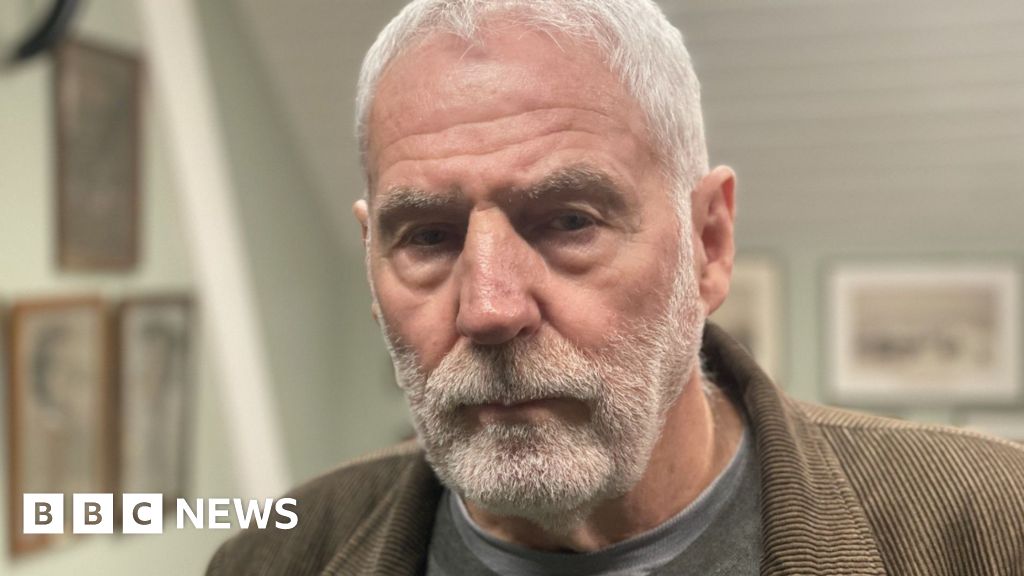
A former officer with the Army's Special Air Service (SAS) has denied it was involved in shoot-to-kill missions against the IRA during the Troubles in Northern Ireland.
George Simm had remained silent about his time in Northern Ireland for almost 50 years, but has now accused the government of abandoning veterans in its legislation to deal with the legacy of the conflict.
He served during the 1970s and 80s and was involved in hundreds of operations, including an SAS ambush in which three IRA men were killed.
The government said the Troubles Bill, which seeks to deal with unresolved legacy of the decades-long violent conflict, "includes effective safeguards for any veteran" .
The special forces unit of the British Army was involved in scores of the most controversial killings during the conflict and while the majority of its victims were IRA members it also killed civilians.
While no official numbers are available for killings carried out by the SAS, according to Simm the unit arrested more people than it killed.
"When you shoot you shoot to kill but the inference from our detractors using propaganda was that you went out there with the full intent to kill, we didn't," he said.
He added the evidence "on every occasion as far as I am aware has proved the opposite".
He said "this is just propaganda" and attacked the "weakness and pathetic nature of the British government to not deal with this".
"They are not fit to be in charge of an army on operations," he added.
The UK government has said it has "strengthened" the proposed legislation to ensure it includes "effective safeguards" for any veteran who is asked to provide information to the Legacy Commission or a coroner.
"It makes clear that there was no equivalence between lawful conduct by soldiers and the actions of terrorists. And in cases relating to the Army the operational context and orders by senior officers must be taken into account," a Northern Ireland Office spokesperson told BBC News NI.
Victims and veterans keeping close watch on Troubles legacy bill debate
Draft law to deal with Troubles legacy backed by MPs
NI Secretary defends planned changes to Troubles bill
Asked if he could recall any incidents when those they shot dead could have been arrested, he said: "No not at all. Two of the ones I was on they were firing at us when we got out of cars, we were under fire.
"We were absolutely professional and highly trained and if your premise is true then every one of the guys we arrested would be dead, so its not true."
George Simm was the SAS commander in charge when his unit killed three IRA men in an ambush at Drumnakilly near Omagh in 1988.
The gang which included brothers Gerard, 29, and Martin Harte, 23, together with their brother-in-law Brian Mullan, 26, had planned to kill an off duty UDR man while he was driving a coal lorry.
But the SAS unit had been tipped off about the attack and were waiting for the gang. Simm posed as the lorry driver and pretended he had broken down at the side of the road.
"I heard the car coming and could see it was a Sierra and suddenly out of the back window was a hood with a gun and he fired a burst at me which forced me to take evasive action," he said.
"The car was speeding towards me and there were bullets flying everywhere and I went around the back of the truck, and I know it was Martin Harte who was firing under the truck.
"I could feel them and the bullets were flying into the hedge where the other guys were and I thought some of them may have been hit but they weren't."
He said the car stopped and one of the other IRA men ran around the back of the truck "to kill him", and then the soldiers opened fire.
He added it was all over in "three or four seconds" and "that was the end of the operation".
The families of the three men have insisted it was a "shoot-to-kill operation" and they could have been arrested.
Ignatius Harte, a brother of two of men, previously told the BBC that the Army had "prior knowledge of the men being armed, they had access to the weapons so therefore they could have been arrested at any time and charged".
"They lured them into an ambush and shot them dead without any warning," he added.
But when asked if it was a "shoot-to-kill mission", George Simm said "definitely no".
"When someone is shooting at you with a Kalashnikov at close range" and bullets are travelling at "600m a second it is not possible to think rationally in a nanosecond".
"We are ready for every operation, so if they shoot or they're intending to shoot us, then we'll go at it," he said.
"But we can also do the other one which is the aim. The police want to get hold of these guys and interrogate them."
Simm said he had been previously questioned at an inquest about the SAS operation at Drumnakilly and had nothing to hide.
The Northern Ireland Troubles Bill replaces the previous Conservative government's contentious 2023 Legacy Act, which introduced a ban on inquests and civil actions related to Troubles-era incidents .
Labour's bill involves a legacy commission to investigate Troubles-related killings, a separate information recovery body, and a dedicated legacy unit within An Garda Síochána (Irish police).
Simm said he was "frustrated" because the narrative around the regiment and the British Army had been "so perverted, so corrupted by stupid politics and the corruption of the legal process".
"So people like me decided we are going to change that as we want people to understand the truth about the operations because that is rarely spoken about as the MoD censor us," he said.
"They tell us you can't talk about it and at the same time they order us into a courtroom to do exactly that. I'm not doing that anymore as I've been abused by their stupidity for too long."
He also questioned why it was only soldiers who appear in a witness box when so many others who were in the chain of command are never called to give evidence.
Asked about the risks of going public and concerns about his personal safety, he said: "I am 72 and I'm just not worried anymore. There is a bigger game in play here and I am duty bound to do what I am doing and its not just me.
"The whole of the SAS association, a great swathe of senior officers finally are in the game and have got into the fight."
The former officer also challenged republicans and said the IRA was now fighting the war by other means.
"They've all put away their weapons in the deep hides and they've all got laptops now and they are all social media warriors doing the same thing but we have to continue to fight, but we need to sort the law out first," he said.
"Families are jumping up and down claiming the British government did this and the SAS did that.
"I would be more inclined to ask the leadership of the republican movement what did they do and for what. Because it was all for nothing."
Troubles legacy bill is not an amnesty for soldiers - NI secretary
Attorney general approval required for serious Troubles prosecutions
Topics in this story
Gathered from external sources. Rights to this text belong to whoever originally published it.