Commander who would not leave: The Phillora battle that won Lt Col Tarapore the Param Vir Chakra
News News: On this day in 1965, Lieutenant Colonel Ardeshir Burzorji Tarapore breathed his last on the battlefield, having led his regiment, the Poona Horse, thr.
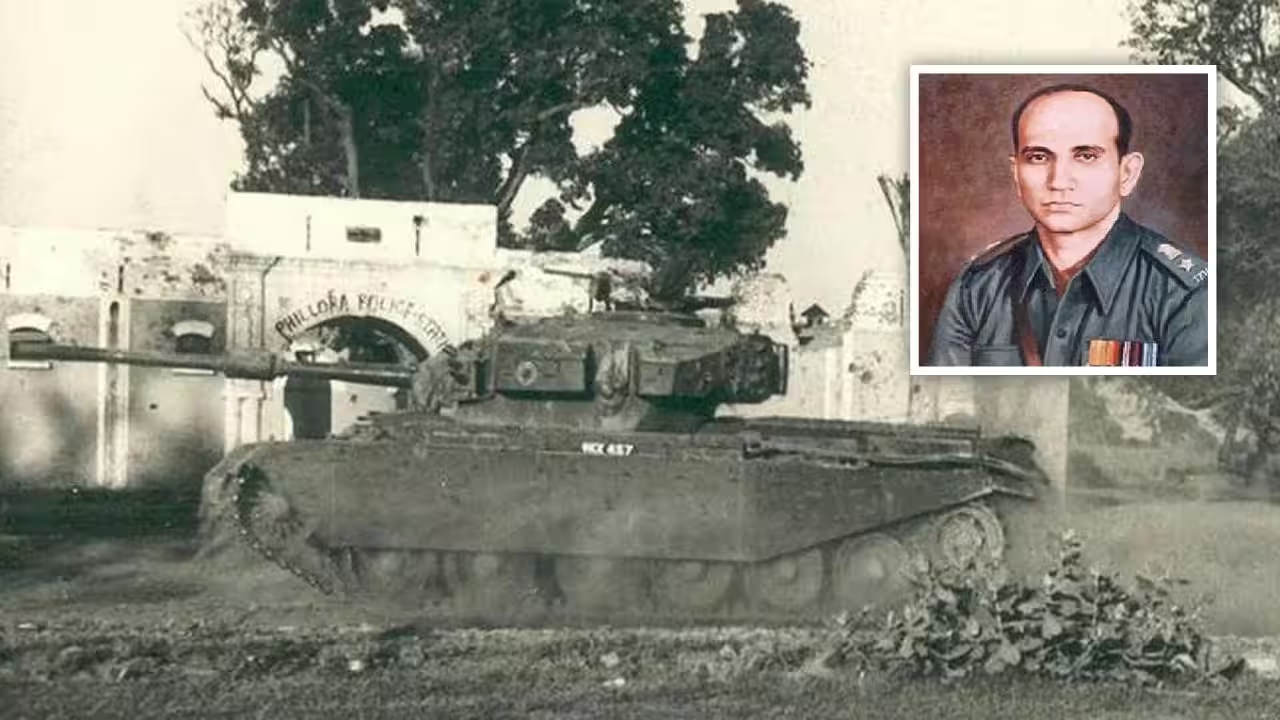
On this day in 1965, Lieutenant Colonel Ardeshir Burzorji Tarapore breathed his last on the battlefield, having led his regiment, the Poona Horse, through six days of relentless tank warfare against Pakistan in the Sialkot sector. Even after being wounded, he refused evacuation, staying with his men. By the time he fell, his regiment had destroyed roughly 60 enemy tanks while losing just nine of its own, one of the most lopsided armoured victories. For his leadership and courage, Lt Col Tarapore was posthumously awarded the Param Vir Chakra.Lieutenant Colonel Ardeshir Burzorji Tarapore, fondly remembered as Adi, was born in Bombay on August 18, 1923, into a family with a military lineage stretching back to an ancestor who served as a military leader under Shivaji. Commissioned into the 7th Hyderabad Infantry on January 1, 1942, Tarapore had set his heart on joining the armoured regiment of the Hyderabad State Forces, a dream that came true after Major General El-Edroos witnessed his bravery firsthand when he jumped into a bay to retrieve and safely dispose of a live grenade. He was subsequently transferred to the 1 Hyderabad Imperial Service Lancers, and after Hyderabad's merger with the Indian Union, his commission was revised to January 1, 1945, when he joined the storied Poona Horse.The 1965 war itself grew out of Pakistan's Operation Gibraltar, a mass infiltration attempt into Kashmir launched on August 5, followed by Operation Grand Slam on September 1, both of which were ultimately repelled by Indian forces, leading to full-scale war after Indian troops crossed the Radcliffe Line on September 6. Tasked with capturing the Sialkot sector, 1 Corps assigned Poona Horse, part of the 1st Armoured Division, the job of isolating Sialkot from Lahore by securing Phillora, Chawinda and the Tharoh Cross Roads.On September 11, as Tarapore's regiment moved to strike Phillora from the rear via Chawinda, it was suddenly counterattacked by heavy Pakistani armour advancing from Wazirwali. Tarapore held his ground, pressing the attack under continuous tank and artillery fire, and even after being wounded, refused evacuation. His regiment captured Wazirwali on September 14, then pushed on to Jassoran and Butur-Dograndi two days later, where his tank was hit repeatedly. Mortally wounded, Tarapore continued leading until his final moments. Under his command, the regiment destroyed roughly 60 Pakistani tanks against the loss of just nine of its own, a six-day feat of valour that earned Tarapore the Param Vir Chakra, India's highest wartime gallantry award, a legacy that endures as one of the defining chapters of India's military history.The Poona Horse itself carries a lineage dating back to 1817, raised under the Treaty of Poona negotiated by Mountstuart Elphinstone. Having fought in France, Palestine and Mesopotamia during the First World War, and as part of the British Eighth Army in the Second, the regiment went on to serve in Operation Polo in Hyderabad in 1948, before playing a decisive role in both the 1965 and 1971 wars, earning the Pakistani-coined title "Fakhr-e-Hind" for its battlefield conduct. The regiment has earned two Param Vir Chakras, the second won was awarded to Lt Arun Khetrapal in the 1971 war. Besides the two PVCs, members of the regiment have also earned four Victoria Crosses, the highest decoration for valour in the British empire.
Topics in this story
Gathered from external sources. Rights to this text belong to whoever originally published it.