Google, Bill Gates's fund invests $31.8M in California startup aiming to build solar farm using robots and much less land
US News: Solar plants are currently being touted as the future bitcoins for economies and the environment. As futuristic as the approach towards them may be, t.
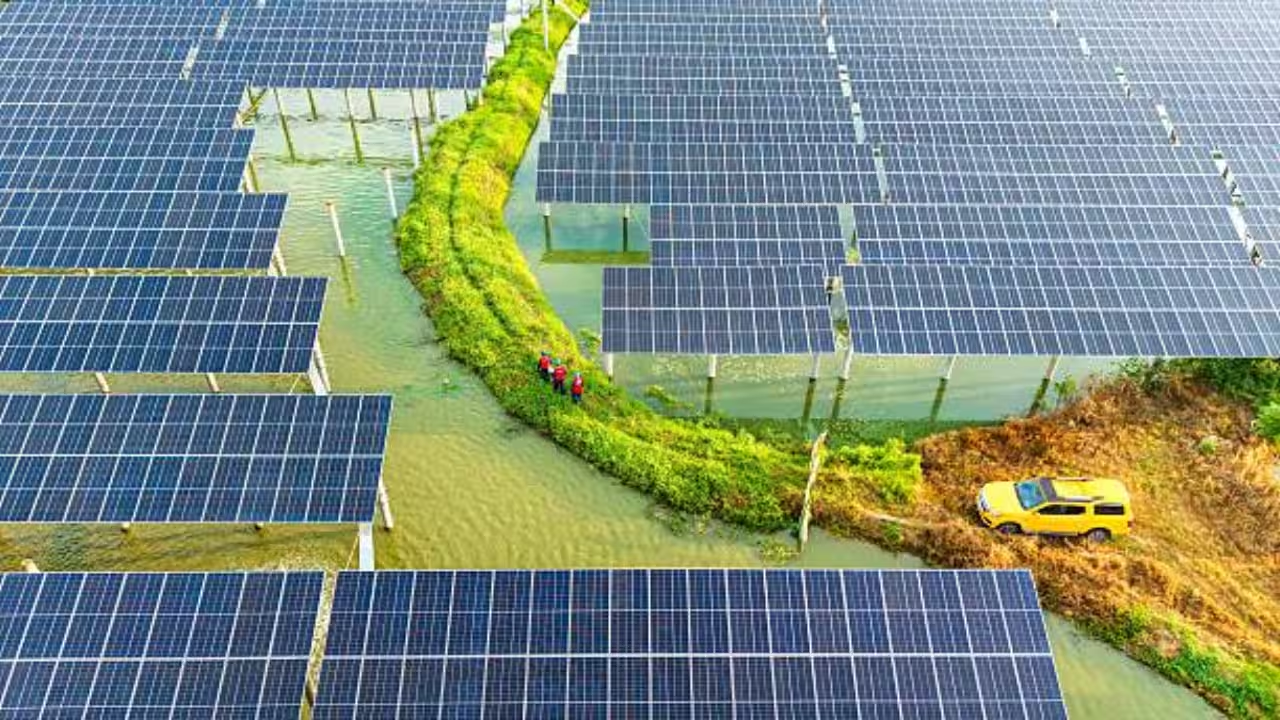
Solar plants are currently being touted as the future bitcoins for economies and the environment. As futuristic as the approach towards them may be, they still rely on a process that is extremely traditional. Teams arrive at the site, move structures and install thousands of components to make up a structure that can span hundreds of acres. According to an article published by PowerMag, while panels have become cheaper and more efficient, the way they are installed continues to be plagued by labour, land, steel and time bottlenecks.This is a gap that a California-based startup is aiming to fill. Planted just raised $31.8 million to expand a fleet of robots that work directly on solar park installation and launch a new generation of machines called Sage. What has made the buzz, apart from the robotic aspect, is the interest of people in the project: Piva Capital and RA Capital Management Planetary Health led the investment, while Google, Breakthrough Energy Ventures, Khosla Ventures, and Gigascale Capital also participated.Google and a fund created by Bill Gates invested in the company as the competition shifted from merely producing the cheapest panels to identifying those who can convert vacant land into MW faster. Breakthrough Energy Ventures was born from Bill Gates’ initiative to fund climate technologies. Meanwhile, Gigascale Capital was founded by Mike Schroepfer, a former executive at Meta. At the same time, Google’s involvement stands out during a period of rapidly growing electric demand associated with digital infrastructure.This funding comes at a time when the company claims that demand for the robots already exceeds its current capacity. After deploying more than 10MW in 2025, the company stated it aims for 100MW this year, a tenfold increase within a year. Furthermore, its potential project pipeline has already surpassed 20 GW.How it worksInterestingly, the most catching aspect of this project is not the replacement of human labour with robots. Planted is attempting to transform the entire construction process of a solar plant into something of a production line, with software, photovoltaic structures and field robotics to reduce stages that currently take up months or even years.Instead of treating every solar plant as an individual project, the company aims to turn deployment into a repeatable process. It wants software and robots to take up tasks that, as of now, require large teams in the field. The company has developed an integrated system that combines software planning, high-density solar structures that follow the topography, field storage, and robotics.A typical solar farm uses long racks to hold rows of panels that move to track the sun throughout the day, squeezing the maximum amount of power out of each panel. But the design requires flattening the land to accommodate the racks, adding time and expense. The hillier parts of a site might not be used at all. Instead, Planted uses a separate post for each panel, so it can follow the natural terrain without changes. First, the company uses software to build a digital twin—a live virtual model—of the site and plan where each post should go. Then, it uses robots to precisely place each post, pulling them from a compartment that the startup compares to a giant toothpick dispenser. A custom bracket on top makes it possible to snap on a solar panel like putting together a Lego set.The level of precision needed for each post would be difficult to achieve manually. “Placing thousands of foundations precisely is exactly the kind of work that’s slow and error-prone for crews,” said Eric Brown, Planted’s CEO. By following the bumps and hills of the terrain, Planted can pack in more solar panels and build in places that conventional designs couldn’t use.As such, the park is designed with automation in mind from the start. The structure itself has been simplified and prepared for automated installation. Furthermore, the software plays a crucial role in configuring the project. Consequently, the company aims to eliminate steps that typically require manual adjustments during construction.According to the company, its structures are better able to navigate the irregularities of the terrain. As a result, areas that would be problematic for traditional solar trackers can accommodate panels. At the same time, Planted claims to be able to produce twice as much energy per acre, reducing the area occupied by the project.By building directly on the existing landscape instead of grading the land to flatten it, it can also make it easier to get environmental approvals. “How you design a system is pretty related to how you can get it permitted and interconnected,” Brown says. Vegetation stays in place, and stormwater flows the way it did before. The panels also sit lower, so there’s less visual impact on the surrounding area.On the way to successPlanted cites a recent project of 28MW, installed behind the metre to serve a neocloud type data centre. According to the company, 10 months passed from the first contact to the power delivery. Even more impressively, the actual construction in the field took less than three months. The California-based company also pointed to smaller projects that add other advantages. It completed the Bowes Solar project, an 11 MW venture in Illinois for Cultivate Power, while another project managed to reduce its footprint by 10 acres after the original design was rejected by local authorities. In addition, it is preparing the Armoracia project, backed by Aligned Climate Capital.At its core, what the company is selling is speed and in this field, it matters. With the new funding, the startup plans to expand its robotic fleet. It will use part of the resources to launch the Sage, its next-generation robot, in 2026.This transformation occurs in a market where the combination of generation and energy storage is starting to gain increasingly larger projects, such as the Chilean park of 165 MWp paired with a battery that could reach 925 MWh.Overall, solar power is already the dominant new source of energy in the U.S. In the first half of 2026, solar and battery storage made up 70% of new capacity added to the grid. In the second quarter, 9.6 GW of utility-scale solar was installed, up 61% over the same period last year.Brown believes Planted’s approach could help solar grow even faster. “We can see a lot of the cards unfolding where legacy solar wouldn’t be able to meet the moment without some pretty meaningful changes to actually shift from doing hundreds of gigawatts to doing the terawatts that are needed right now,” he says.Catch the latest World News and Live updates. Download the TOI app.
Topics in this story
Gathered from external sources. Rights to this text belong to whoever originally published it.