In 1952, a retired Canadian undertaker began saving empty embalming-fluid bottles: Around 500,000 bottles and 250 tons of glass later, he had built a castle-like home
Rest of World News: David H. Brown retired from the funeral business in 1952 after 35 years as an undertaker, when he began collecting empty bottles that had once held em.
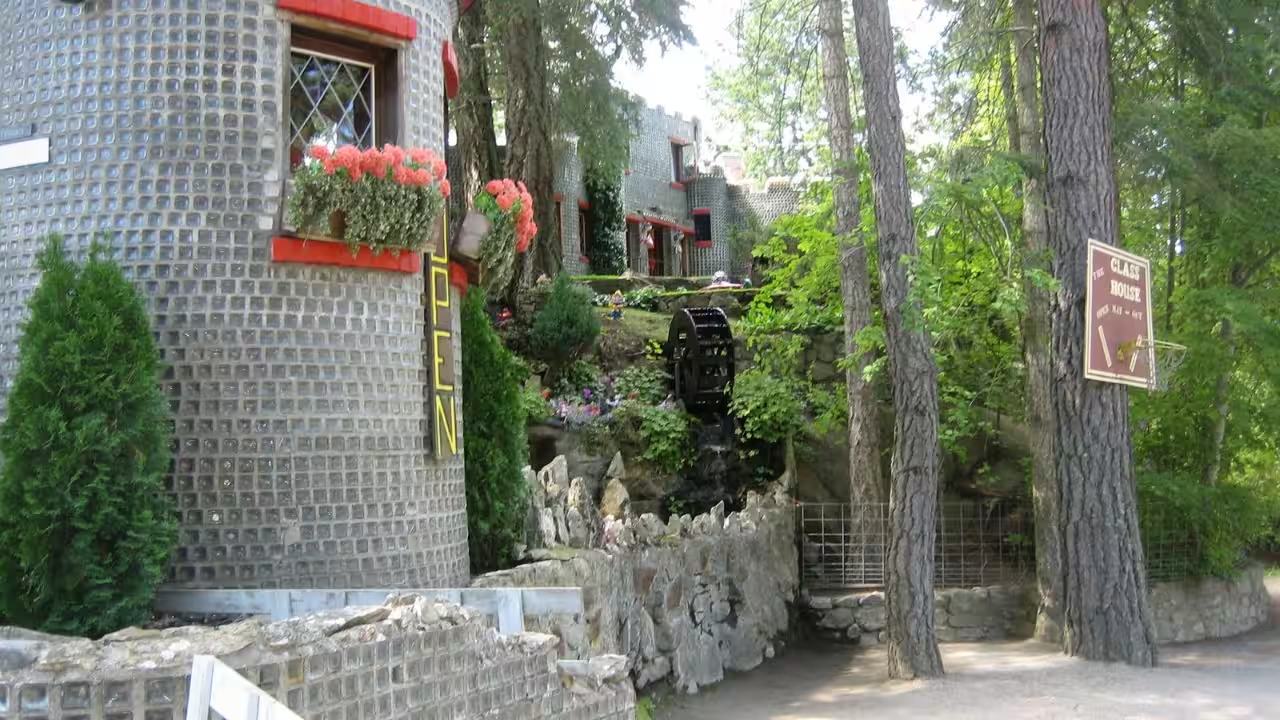
David H. Brown retired from the funeral business in 1952 after 35 years as an undertaker, when he began collecting empty bottles that had once held embalming fluid. Brown believed the square glass containers could have another use, and over time, that idea grew into a full-scale construction project on the shores of Kootenay Lake in British Columbia, Canada. The result was a two-story home built with around 500,000 discarded embalming-fluid bottles, with a castle-like front and a cloverleaf-shaped layout.The story of the house is documented by SPACES Archives, which records that Brown began the project in 1952. The archive describes the structure as having the footprint of a three-leaf clover, while crenellations across the front gave it an appearance more associated with a small castle than a conventional retirement home. The bottles had previously been used to hold formaldehyde embalming fluid in Brown's own profession and were collected from undertakers and funeral-industry colleagues.He collected bottles from funeral homes across western CanadaKootenay Rockies Tourism says that Brown traveled across western Canada to collect bottles from friends in the funeral profession, and eventually, he had acquired about 500,000 square-shaped embalming-fluid bottles. Together, the glass reportedly weighed around 250 tons. Brown's used the bottles as a building material, and Kootenay Rockies Tourism quotes him as saying the project began because he wanted to "indulge a whim of a peculiar nature." The same account says Brown had concluded that the discarded bottles should have some practical use after he retired.The containers were square, which allowed them to be arranged more easily than ordinary round bottles. SPACES Archives explains that they were laid horizontally, and their mouths and necks were pointed inward. Their square bottoms formed the outside surface of the house. Wood lath was wired between the bottle necks to hold the arrangement in place, while cedar planking formed the interior walls, and the building was therefore more than a collection of bottles embedded in concrete. Brown developed a structure around the glass and incorporated it into the walls themselves. Kootenay Rockies Tourism.The bottle collection became a 1,200-square-foot houseThe finished building measured roughly 48 feet long and 24 feet wide, with about 1,200 square feet of floor space. SPACES Archives records six round rooms, including a full kitchen, two bedrooms and a fireplace. It was two stories high, and the walls were made from hundreds of thousands of glass bottles, while the facade had crenellations resembling the upper edges of a castle wall. The surrounding property also became part of Brown's larger project. A wishing well, waterwheel, bridge, stone walls and other smaller structures were added to the grounds. Kootenay Rockies Tourism also describes a glass-bottle bridge and a path leading toward the lakeshore.Brown and his wife had originally intended to use the building as their private residence, and that changed as people traveling along Highway 3A near Boswell began stopping to see it. SPACES Archives says the Browns eventually decided to open the property to visitors rather than keep it solely as a home. It stands near Kootenay Lake, south of Boswell in southeastern British Columbia. The house remains one of the more unusual examples of reuse architecture in the region because of the scale of Brown's collection and the specific source of the containers.The house is still standing more than seven decades laterThe Glass House still exists at 11341 Highway 3A even seventy years after its construction began. SPACES Archives lists its status as "Extant," which means that the structure remains standing, while current regional tourism listings continue to advertise it as a visitor attraction. The Kootenay Lake Chamber of Commerce currently lists the Glass House as open for paid tours seven days a week from May through October. Its listing identifies the property as being made from more than half a million embalming-fluid bottles and provides the same Highway 3A location near Boswell.It began in 1952 as a retired undertaker's attempt to find another use for empty bottles and ended with a house made from about 250 tons of glass. The building was never hidden away as a private curiosity, and drivers still stop along the Kootenay Lake route to see the bottle walls, the cloverleaf-shaped structure and the former funeral-industry containers that Brown turned into a home.Catch the latest World News and Live updates. Download the TOI app.
Topics in this story
Gathered from external sources. Rights to this text belong to whoever originally published it.