COP31: New draft deal aims to avert collapse of talks at climate summit
The UN COP31 meeting in Turkey enters a second day of overtime as countries struggle to reach an agreement.
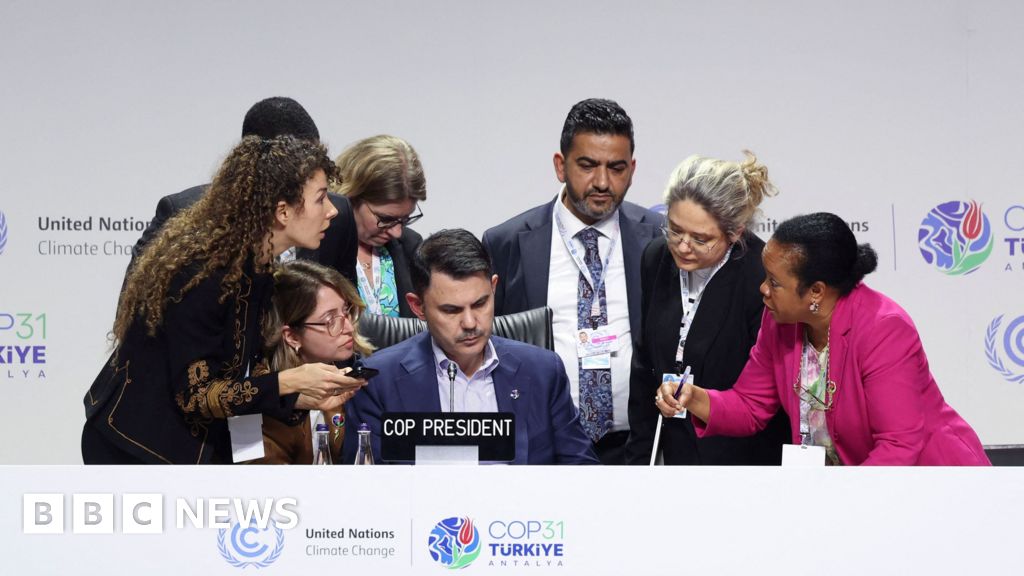
Efforts to avert the collapse of talks at the UN COP31 summit have faced further delays on the second day of overtime, as countries struggle to reach a new global climate deal.
A new draft agreement was published in the early hours of Sunday which the Turkey and Australia co-hosts hoped would bridge the divide between nations.
Although it still includes no specific reference to "transitioning away from fossil fuels" - an omission in the previous draft that sparked threats of walkouts - it does acknowledge a previous commitment made by countries to do just that three years ago.
Countries were expected to reconvene to decide whether to approve a new deal, but that meeting was delayed on Sunday morning.
The president of the talks, Turkey's Environment Minister Murat Kurum, told the BBC he was "hopeful" of a breakthrough as he entered the summit on Sunday.
"We will be happy soon enough," he said.
But that outlook was not shared by the EU, which the BBC understands considers the new text to be a backward step.
The EU and Pacific states had been arguing against the removal of fossil fuels from the draft text. The EU has not yet reacted to this latest draft.
The Africa Group is likely to be disappointed at this latest iteration as it includes no specific figure on money for adaptation and instead kicks that decision to future meetings.
The new draft also includes for the first time a recognition that the world is on track to miss the crucial goal of keeping temperatures below 1.5C of warming.
These talks are approaching the longest-running in the COP history.
If countries cannot reach consensus - as required by the UN's climate talks process - the negotiations could be suspended until next year. This has only happened once before since countries started holding COP climate meetings in 1995.
Just hours before the new text was published, EU Commissioner for Climate Wopke Hoekstra said if the bloc could not get "what is needed in terms of climate action... then there's no deal."
Energy Secretary Miatta Fahnbulleh, the UK's chief negotiator, struck a more hopeful tone, saying her team was still working to get an agreement.
A draft deal unveiled earlier this week called for a faster phase-out of fossil fuels, but a second, pared-down version released on Thursday stripped away all mentions of coal, oil and gas - sparking threats of a walk out.
The fallout led to the summit in Antalya blowing past the original deadline of Friday . On Saturday negotiating teams who had Sunday morning flights were rescheduling them - a sign a deal was still not in sight, and raising the risk that as teams eventually had to leave, the meeting could lose the critical numbers needed to pass an agreement.
As part of a last ditch effort to produce an acceptable text, the European Union and Saudi Arabia - who were deeply divided over the future of fossil fuels - were brought together on Saturday to seek a compromise.
COP31 President and Turkish Environment Minister Murat Kurum told delegates in the early hours of Sunday he believed concerns had been addressed.
"We ask you to look at this decision carefully," Kurum said. "We are closer than ever to agreement on the remaining issues."
Ministers from Panama, Solomon Islands, Cote d'Ivoire and the EU were fighting to have a commitment to move away from fossil fuels put back into the final agreement, after fossil fuel producers led by Saudi Arabia pushed for its removal.
"It is not acceptable to have a COP or a cover decision that does not even mention fossil fuels and we simply will not put up with it," said Juan Carlos Navarro, Panama's minister for the environment.
Tuvalu's Climate Minister Maina Talia told reporters it was a "red line" for the low-lying Pacific nation: "We're talking about the root cause of all of this".
France's Minister of Ecological Transition, Monique Barbut, took aim at several references in the text to carbon capture, use and storage (CCUS) - the technology that takes emissions when they are released and stores them underground - as a licence for other countries to keep burning oil and gas.
"We cannot be announcing to the world that we are now getting to 1.5 increase in the temperature and do business like nothing was happening," Barbut said.
In the latest text the commitments to CCUS have been reduced, which may be enough to alleviate the EU's concerns.
For the first time at a COP, the agreement - known officially as the Antalya Accords - could acknowledge that the goal set under the Paris climate accord of keeping global temperature rise below 1.5C has been missed.
The world is entering a period called "overshoot".
Beyond this point scientists warn millions more people will be exposed to sea level rise and extreme heat.
But Australia's Climate Change and Energy Minister, Chris Bowen, who is leading negotiations, pushed back on the need to include language on fossil fuels.
He argued the summit was about implementation, and should focus on the move towards clean energy sources.
One of the other key issues raised by developing nations - the lack of money - appears unresolved in the latest draft agreement.
Earlier versions of the text included an agreement to ramp up money for adaptation to $120bn (£91bn) by 2035 - a figure that was then removed.
"We did not come here to beg, we came here to claim what is rightfully ours for our people who are suffering the brunt of anthropogenic activities of developed countries," said Zanetor Agyeman Rawlings, Ghana's Environment Minister and chair of the African Group of negotiators.
Climate activists and environmental groups, who are observers to these talks, have slammed negotiations.
"I can tell you without any doubt that this has been the worst COP ever," said Mohamed Adow of Powershift Africa.
More climate money for Africa? Europe says use what's already pledged
Fight over fossil fuels leaves COP31 climate talks in deadlock
Topics in this story
Gathered from external sources. Rights to this text belong to whoever originally published it.