Scientists discovered an unnamed female mummy in 1935, the Egyptian Mummy has been left screaming for 3,000 years
Tech News News: An ancient Egyptian mummy discovered in Thebes in 1935 has left scientists trying to explain one unusual detail for decades: her face appears frozen i.
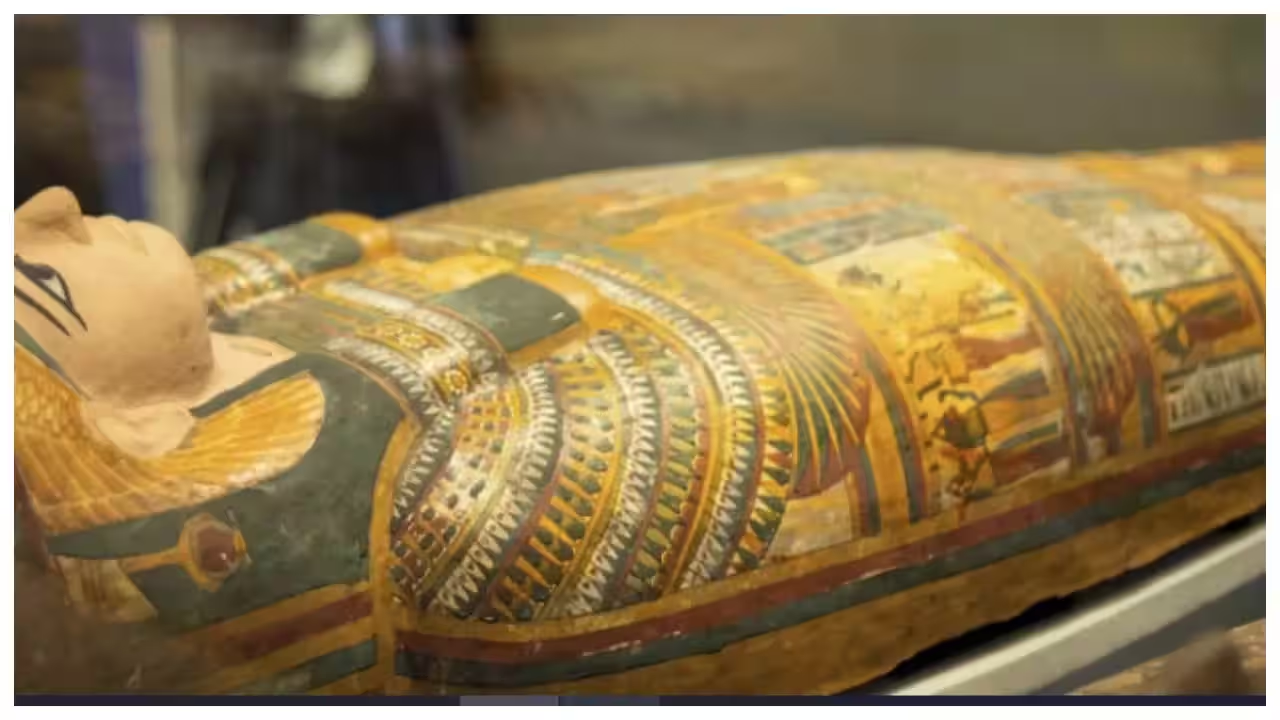
An ancient Egyptian mummy discovered in Thebes in 1935 has left scientists trying to explain one unusual detail for decades: her face appears frozen in a scream. The woman was buried about 3,000 years ago and had received an expensive burial treatment, making it unlikely that her strange expression was simply the result of poor mummification. As stated in reports, researchers examined the mummy again in 2024 using X-rays, CT scans and several laboratory techniques. They found no clear cause of death, but suggested that a severe and sudden event may have caused a phenomenon known as a cadaveric spasm, leaving the woman’s mouth open and her face contorted at the time of death.3,000-year-old Egyptian mummy discovered in ThebesThe unnamed woman was discovered in 1935 in Thebes, an ancient Egyptian city. Her coffin carried no inscription identifying her. Her appearance immediately drew attention because her mouth was open and her face looked as though she had died while screaming.At first, researchers considered whether poor embalming could have caused the expression. Ancient Egyptian embalmers normally took extensive steps to preserve a body and make it look as natural as possible.However, evidence from the woman’s burial suggested that her body had received careful and costly treatment.Expensive materials used in the mummy's burialThe mummy wore an elaborate wig made from date palm fibres. It had been dyed with reddish henna and covered with a crystalline powder containing quartz, magnetite and albite. Her body, clothing and wig were also treated with imported resins. One of the materials used was frankincense associated with Punt, a region known for exporting valuable goods including aromatic resins and gold. Juniper resin was also used.These details suggested that the woman came from a wealthy section of ancient Egyptian society and that her embalmers had not simply carried out a careless or incomplete mummification.Why was the ancient Egyptian mummy left screamingOne unusual detail remains difficult to explain: the woman’s internal organs were still inside her body. In many ancient Egyptian burials, organs were removed during the mummification process and preserved separately in canopic jars. However, the researchers noted that later embalming practices could sometimes involve drying the organs and returning them to the body. There was no visible incision showing that the organs had been removed.Her arms also provide a clue about her status. They were positioned at her sides and only partly met over her lap. The researchers said this suggests she was not a member of the royal family, as royal mummies were buried with their arms crossed over their chests.Scientists examine the 'screaming woman' mummyIn 2024, mummy radiologist Sahar Saleem of Cairo University and Samia El-Merghani of Egypt’s Ministry of Tourism and Antiquities examined the mummy using several non-destructive methods. The investigation included X-rays and CT scans, as well as scanning electron microscopy, Fourier-transform infrared spectroscopy and X-ray diffraction analysis.The researchers found that the woman was around 5 feet tall and died at about 48 years old. Signs of wear were visible in her teeth and joints. But the tests did not reveal a clear cause of death.The researchers suggested that the woman's unusual facial position may have been caused by a cadaveric spasm. This phenomenon can involve certain muscles becoming fixed at the moment of death, particularly in cases involving severe pain or panic. It is different from normal rigor mortis because it can affect specific muscles rather than the entire body.The researchers said the expression could indicate that the woman died in extreme pain.Get the latest technology news and updates. Download the TOI App.
Topics in this story
Gathered from external sources. Rights to this text belong to whoever originally published it.