In the mid-1980s, farmers brought deer to a South Korean island for their antlers; after the business collapsed, roughly 1,000 feral descendants surrounded about 150 residents
Rest of World News: Investigate how the introduction of sika deer for antler farming in the 1980s led to a population explosion on Anma Island, threatening local residents and wildlife.
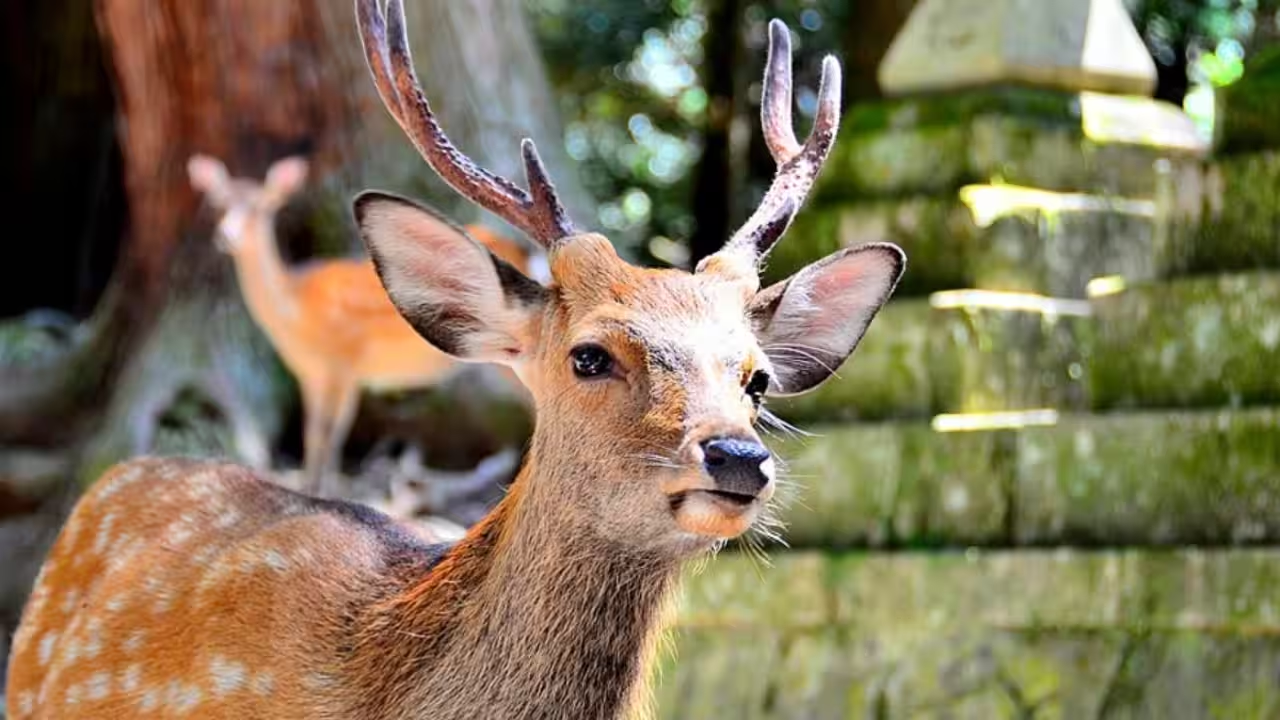
In the mid-1980s, a small group of farmers brought in around 10 deer to Anma Island, off South Korea’s southwestern coast. Their goal was to raise the animals for their antlers, which were considered valuable in traditional medicine. Nearly forty years later, the descendants of those 10 deer had become an unmanaged population numbering around 1,000. Meanwhile, approximately only 150 people remain on the island, according to a 2024 Reuters investigation.Anma Island, in Yeonggwang County, Jeollanam-do, originally had no sika deer, and South Korea’s Ministry of Environment says the animal was introduced by a livestock farmer in the mid-to-late 1980s. It now treats the incident as an example of how abandoned livestock can establish themselves in the wild when there is no effective system for controlling them.When the original business plan collapsed, the deer stayedThe commercial opportunity did not last long. The original business plan was to create a market for deer farming at the time, as the antlers’ material was traditionally used with ginseng and other medicinal herbs. Unlike hardened antlers, newly growing antlers are covered in soft tissues and can be harvested before they harden.The interest in traditional medicine, however, reportedly declined after the mid-1980s, causing the potential market for antlers to weaken. The farmers eventually abandoned the deer and left the island. 1985 to 1998 has been identified by the country’s ministry as the early introduction period. This was followed by a fifteen-year window of unmonitored exponential breeding, leading into the period of population overbalance from 2013. The roughly 1,000 animals seen by the Reuters team in 2024 were the result of many years of reproduction.The deer also lacked any natural predator on the island, and as their numbers increased, they fed extensively on herbaceous plants, fruits and tree bark. Surveys by the government authorities suggested that this grazing pressure was damaging vegetation and affecting native wildlife through competition for food and habitat.The problem became particularly visible for the people who remained on the island. On-site reporting revealed that the largely nocturnal deer moved through agricultural fields and gardens, and destroyed crops and damaged trees. Though the residents responded by putting up mesh nets and fences, some about 1.8 to 2 metres high, the animals could still jump over or tear through these barriers.A government survey found 937 deer population and widespread ecological damageIn April 2025, the Ministry of Environment reported that 937 sika deer were living on Anma Island. In addition to that, another 178 were found on Gureopdo Island. On Anma alone, the estimated density was 162 deer per square kilometre, about 23 times the country’s national average density for water deer, which the ministry gave as 7.1 animals per square kilometre.The survey used drone-based thermal imaging and unmanned sensor cameras in 2024. The government also documented the damage caused by the introduced species. Evidence of vegetation degradation, such as changes from grassland and forest toward more barren areas, was found in the assessment. The deer allegedly consumed native plants and competed with native Korean wildlife present on the island, including water deer, gorals, and roe deer.. Anma Island also recorded approximately 160 million won in crop damage over five years, giving the authorities a measurable economic basis for treating the herd as more than simply a nuisance to individual residents.South Korea took measures to control the herdSouth Korea’s Anti-Corruption and Civil Rights Commission took up the problem of abandoned livestock in January 2024. It recommended that the Ministry of Environment investigate the ecological and resident damage caused by the Anma deer. They had to determine whether the animals should be placed under a formal management plan. It also recommended that the Ministry of Agriculture, Food and Rural Affairs establish requirements for disposing of livestock when breeding businesses fail and impose penalties for abandoning animals.In 2024, by the time the Reuters team visited the island, the residents were allegedly already asking authorities to designate the deer as harmful wildlife. This would provide a legal framework for reducing the deer population. The residents considered culling the herd because other efforts had failed to control it.Eventually, in April 2025, the Ministry of Environment announced that it was pursuing designation of sika deer as a harmful wild animal because of their excessive population density, ecosystem impacts and agricultural damage. Such designations has thus allowed local government to issue capture permits in limited circumstances where other measures prove insufficient.Catch the latest World News and Live updates. Download the TOI app.
Topics in this story
Gathered from external sources. Rights to this text belong to whoever originally published it.